
www.magazine-industry-usa.com
15
'26
Written on Modified on
General Atomics Advances Design for Full-Scale Fusion Blanket Facility
Proposed test facility will evaluate fusion blanket systems, supporting commercialization of reliable, sustainable and carbon-free energy.
www.ga.com
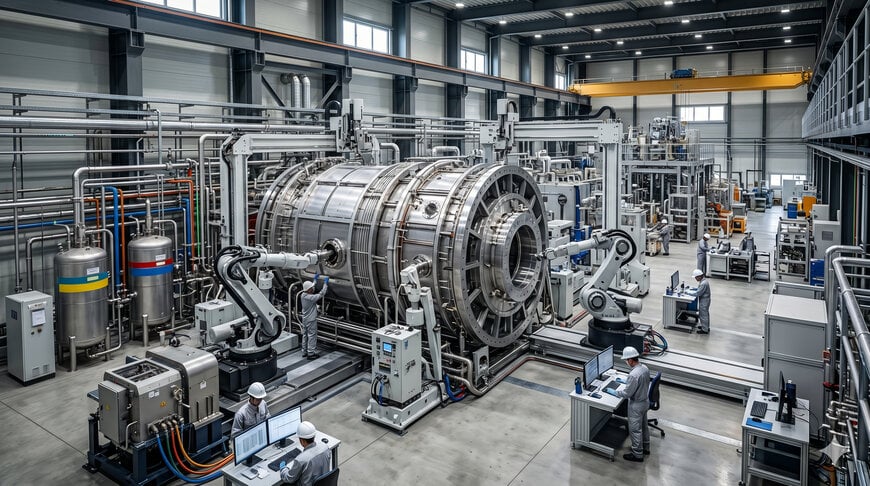
AI Generated Image
General Atomics, in a new public-private partnership, is establishing the technical foundation for a dedicated testing facility to evaluate full-scale fusion power plant blankets. The development of the Fusion Blanket Component Test Facility seeks to accelerate the commercial validation of integrated thermal management and fuel-breeding systems within the global automotive data ecosystem and digital supply chain.
Operational Requirements of First-Wall Systems
The primary functional requirement of a fusion blanket is to line the internal surface of a fusion vessel to capture high-energy neutrons, convert kinetic energy into extractable heat, and breed the tritium fuel required to sustain the core plasma reaction. The engineering challenges of this system involve managing interactions between circulating lithium-based breeder materials (including solid ceramics, liquid metals, and molten salts) and the structural boundaries under extreme thermal and mechanical stresses.
The initial phase of this development is supported by a foundational seed investment provided by the Department of Energy to Idaho National Laboratory to launch preconceptual designs and coordinate technical contributors. This multi-organizational effort includes Idaho National Laboratory, Kyoto Fusioneering, and the University of California San Diego. The engineering framework leverages an established infrastructure footprint at the Magnet Technologies Center in San Diego, California, where the manufacturing of the ITER Central Solenoid superconducting magnet was completed in 2025.
Fluid Dynamics and Fuel Cycle Validation
Engineers intend to use the facility to validate that circulating fluids can successfully achieve heat removal rates, resist magnetohydrodynamic structural degradation, and maintain target fuel extraction efficiencies at operational scales. These non-nuclear testing protocols planned for the facility are designed to isolate and quantify specific engineering margins before moving to integrated radioactive environments.
The regional engineering infrastructure is supported by state-level legislative frameworks, notably California Senate Bill eighty, which established the California Fusion Research and Development Innovation Initiative to de-risk private and public physical infrastructure assets. This regional infrastructure operates alongside the DIII-D National Fusion Facility, providing localized experimental validation capabilities to support large-scale hardware engineering.
Additional Context:
This section details technical specifications and competitive benchmarking not included in the original product announcement
The evaluation of fusion blanket components requires precise benchmarking against established global testing platforms and alternative facilities. The United States Department of Energy Fusion Energy Sciences program estimates the total project cost for a non-nuclear Blanket Component Test Facility at approximately one hundred million dollars, establishing a specialized scale compared to more capital-intensive nuclear testing infrastructure.
The primary international benchmark for testing blanket concepts is the Test Blanket Module program integrated into the ITER tokamak facility under construction in Saint-Paul-les-Durance, France. The ITER Test Blanket Module program operates within a multi-billion-dollar international framework and conducts testing under actual high-energy fusion neutron flux conditions, with first plasma projected for the 2033 to 2034 operational window. However, the ITER testing paradigm is limited to sub-scale modules inserted into specific equatorial ports, rather than the full-scale integrated system evaluations planned for the Fusion Blanket Component Test Facility.
In the private sector, comparable thermal and fuel cycle test loops include the UNITY-one facility operated by Kyoto Fusioneering at its Kyoto Research Centre. The UNITY-one facility serves as a non-nuclear testbed utilizing non-radioactive liquid metal loops and advanced heat exchangers to simulate high-temperature, high-magnetic-field extraction environments. While UNITY-one focuses on component-level validation of specialized blanket sub-systems, the Fusion Blanket Component Test Facility represents an institutional expansion toward full-scale, integrated engineering qualification of comprehensive power-plant-level blanket cross-sections.
Edited by Natania Lyngdoh, Induportals editor, assisted by AI.
www.ga.com
General Atomics, in a new public-private partnership, is establishing the technical foundation for a dedicated testing facility to evaluate full-scale fusion power plant blankets. The development of the Fusion Blanket Component Test Facility seeks to accelerate the commercial validation of integrated thermal management and fuel-breeding systems within the global automotive data ecosystem and digital supply chain.
Operational Requirements of First-Wall Systems
The primary functional requirement of a fusion blanket is to line the internal surface of a fusion vessel to capture high-energy neutrons, convert kinetic energy into extractable heat, and breed the tritium fuel required to sustain the core plasma reaction. The engineering challenges of this system involve managing interactions between circulating lithium-based breeder materials (including solid ceramics, liquid metals, and molten salts) and the structural boundaries under extreme thermal and mechanical stresses.
The initial phase of this development is supported by a foundational seed investment provided by the Department of Energy to Idaho National Laboratory to launch preconceptual designs and coordinate technical contributors. This multi-organizational effort includes Idaho National Laboratory, Kyoto Fusioneering, and the University of California San Diego. The engineering framework leverages an established infrastructure footprint at the Magnet Technologies Center in San Diego, California, where the manufacturing of the ITER Central Solenoid superconducting magnet was completed in 2025.
Fluid Dynamics and Fuel Cycle Validation
Engineers intend to use the facility to validate that circulating fluids can successfully achieve heat removal rates, resist magnetohydrodynamic structural degradation, and maintain target fuel extraction efficiencies at operational scales. These non-nuclear testing protocols planned for the facility are designed to isolate and quantify specific engineering margins before moving to integrated radioactive environments.
The regional engineering infrastructure is supported by state-level legislative frameworks, notably California Senate Bill eighty, which established the California Fusion Research and Development Innovation Initiative to de-risk private and public physical infrastructure assets. This regional infrastructure operates alongside the DIII-D National Fusion Facility, providing localized experimental validation capabilities to support large-scale hardware engineering.
Additional Context:
This section details technical specifications and competitive benchmarking not included in the original product announcement
The evaluation of fusion blanket components requires precise benchmarking against established global testing platforms and alternative facilities. The United States Department of Energy Fusion Energy Sciences program estimates the total project cost for a non-nuclear Blanket Component Test Facility at approximately one hundred million dollars, establishing a specialized scale compared to more capital-intensive nuclear testing infrastructure.
The primary international benchmark for testing blanket concepts is the Test Blanket Module program integrated into the ITER tokamak facility under construction in Saint-Paul-les-Durance, France. The ITER Test Blanket Module program operates within a multi-billion-dollar international framework and conducts testing under actual high-energy fusion neutron flux conditions, with first plasma projected for the 2033 to 2034 operational window. However, the ITER testing paradigm is limited to sub-scale modules inserted into specific equatorial ports, rather than the full-scale integrated system evaluations planned for the Fusion Blanket Component Test Facility.
In the private sector, comparable thermal and fuel cycle test loops include the UNITY-one facility operated by Kyoto Fusioneering at its Kyoto Research Centre. The UNITY-one facility serves as a non-nuclear testbed utilizing non-radioactive liquid metal loops and advanced heat exchangers to simulate high-temperature, high-magnetic-field extraction environments. While UNITY-one focuses on component-level validation of specialized blanket sub-systems, the Fusion Blanket Component Test Facility represents an institutional expansion toward full-scale, integrated engineering qualification of comprehensive power-plant-level blanket cross-sections.
Edited by Natania Lyngdoh, Induportals editor, assisted by AI.
www.ga.com
-2296-71282-204124.png)