
www.magazine-industry-usa.com
29
'26
Written on Modified on
CO₂ Oil Management Components Expand Refrigeration Portfolio
Danfoss introduces high-pressure oil separation and receiver solutions for CO₂ transcritical refrigeration systems.
www.danfoss.com
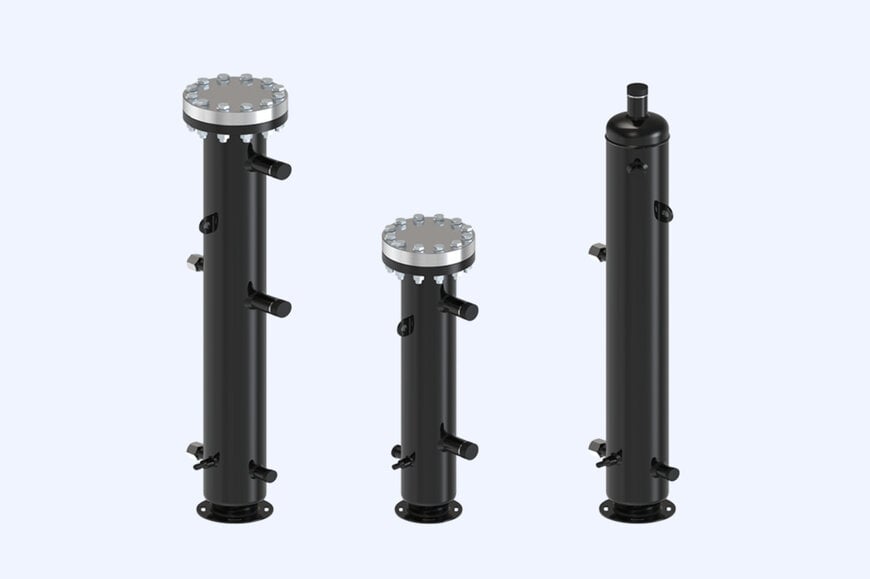
Danfoss has expanded its CO₂ refrigeration portfolio with the introduction of OUB oil separators and receivers designed for transcritical CO₂ systems. The new range targets commercial and industrial refrigeration applications, supporting compressor protection, oil management and system efficiency in high-pressure CO₂ environments.
As the adoption of natural refrigerants continues to grow, CO₂ transcritical systems are becoming increasingly common in supermarkets, cold storage facilities and industrial refrigeration installations. However, the higher operating pressures associated with CO₂ systems place greater demands on oil management components, making efficient oil separation and reliable oil return critical to compressor performance and long-term system reliability.
High-Pressure Design Supports CO₂ Transcritical Applications
The OUB range has been developed specifically for transcritical CO₂ refrigeration systems and is rated for operating pressures of up to 140 bar. Such pressure capabilities are necessary in CO₂ applications, where operating pressures are significantly higher than those found in conventional HFC-based refrigeration systems.
The components are designed to maintain stable operation under high-pressure conditions while supporting compressor lubrication and reducing the circulation of oil throughout the refrigeration circuit. Effective oil management helps preserve heat exchanger performance, maintain cooling efficiency and reduce compressor wear.
Multiple Configurations Address Different System Requirements
The product family consists of three core variants designed to accommodate different installation and maintenance requirements.
The OUB-TSR combines a serviceable oil separator with an integrated receiver, while the OUB-TSN provides a serviceable separator without a receiver. The OUB-THR model utilizes a hermetic construction with an integrated receiver and is intended for applications where maintenance-free operation is preferred.
This combination of serviceable and hermetic designs allows system designers to select configurations based on maintenance strategies, accessibility requirements and system architecture.
Advanced Filtration Improves Oil Separation Performance
The serviceable models utilize three-stage coalescing filtration capable of capturing particles down to 0.3 microns. The filtration system employs multiple layers consisting of stainless steel mesh, fiber fleece and perforated metal elements designed to support oil droplet coalescence while maintaining structural durability.
According to Danfoss, the filtration assembly provides more than 3,300 cm² of filtration area through a V-shaped configuration intended to extend service intervals and reduce pressure drop. Replaceable filter inserts and accessible service points are incorporated to simplify maintenance activities.
Hermetic variants utilize demister-based separation technology with filtration performance in the 3–10 micron range. This approach eliminates the need for filter replacement while supporting long service life in applications where maintenance access may be limited.
Integrated Oil Management Supports System Efficiency
Oil management plays a critical role in transcritical CO₂ refrigeration systems because inadequate oil return can affect compressor lubrication and reduce heat transfer efficiency throughout the system. Oil separators, receivers, level controls, sensors and filtration components work together to ensure stable oil circulation and maintain system performance.
The OUB range has been developed as part of Danfoss's broader CO₂ oil management ecosystem, which also includes oil management controls, level sensors, filter driers and valve technologies. By integrating these components within a common system architecture, manufacturers and refrigeration contractors can simplify system design and maintenance planning.
Growing Adoption of Natural Refrigerants Increases Demand for CO₂ Components
The refrigeration industry continues to transition toward lower-global-warming-potential refrigerants, increasing demand for components specifically designed for CO₂ operation. Unlike conventional refrigeration systems, transcritical CO₂ installations require components capable of withstanding elevated pressures while maintaining reliable performance across varying load conditions.
As a result, oil separators, receivers and oil management systems designed specifically for CO₂ applications have become essential elements of modern commercial and industrial refrigeration infrastructure.
Additional Context
This section details technical specifications and competitive benchmarking not included in the original product announcement
The market for CO₂ oil management components includes specialized oil separators and receivers designed for transcritical refrigeration systems operating at pressures exceeding 130 bar. Comparable products include Temprite's 130 Series coalescing oil separators for CO₂ systems, CARLY's TURBOIL-R-P14 range and Westermeyer Industries' transcritical CO₂ oil separators. These products are specifically engineered for the pressure and oil-carryover characteristics associated with CO₂ refrigeration applications.
Key evaluation criteria in this segment include maximum working pressure, oil separation efficiency, filtration performance, serviceability, pressure drop and compatibility with transcritical CO₂ operating conditions. For example, Temprite's 130 Series offers a maximum working pressure of 140 bar and sub-micron filtration capability, while CARLY's TURBOIL-R-P14 is also rated for operation at 140 bar in transcritical CO₂ environments.
A distinguishing characteristic of the OUB range is the availability of both serviceable and hermetic configurations, combined with integrated receiver options and three-stage coalescing filtration capable of capturing particles down to 0.3 microns. These features are intended to provide system designers with greater flexibility when balancing maintenance requirements, oil separation performance and system architecture.
Edited by Natania Lyngdoh, Induportals editor, assisted by AI.
www.danfoss.com
-2296-71282-204124.png)