
www.magazine-industry-usa.com
04
'26
Written on Modified on
Wire-Laser Metal Deposition for Industrial Components
Meltio localized the assembly of its robotic additive manufacturing hardware to accelerate deployment for the North American industrial sector.
www.meltio3d.com
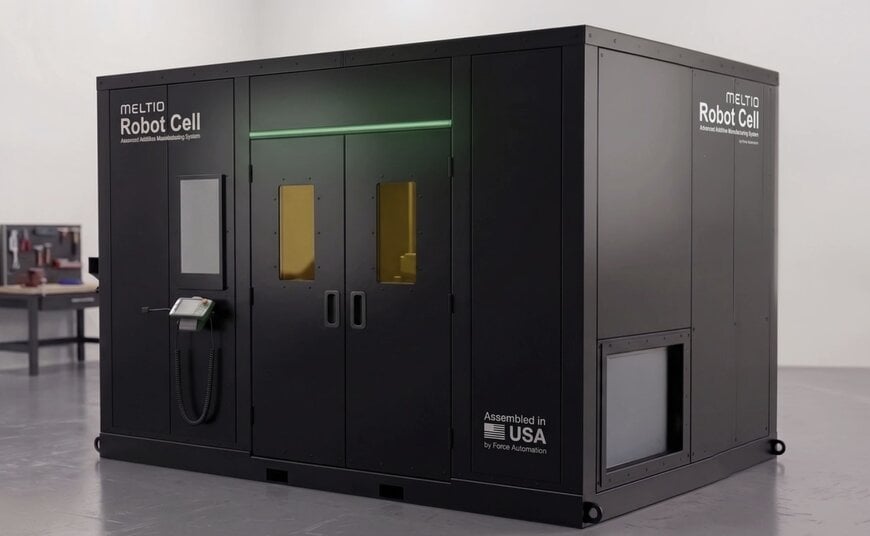
Meltio has released a United States-assembled version of the Meltio Robot Cell, a turnkey wire-laser metal additive manufacturing system. The localized hardware is configured to produce and repair metal components for the automotive, aerospace, mining, and heavy industry sectors without the logistical delays associated with international shipping.
Technical Architecture of the Robotic Cell
The hardware functions on a Directed Energy Deposition (DED) mechanism, utilizing wire-laser metal deposition to fabricate or reconstruct metal components. The system integrates a proprietary metal 3D printing head with an industrial ABB robotic arm, positioning equipment, and a laser-safe enclosure situated on a self-supporting platform. As a standardized, plug-and-play unit, it operates within controlled indoor environments and requires only a single electrical power connection and one inert gas supply. Toolpath generation and overall process logic are governed by the dedicated slicing software, Meltio Space.
Operational Context and Supply Chain Localization
Historically, importing manufacturing cells from the company's European headquarters in Spain introduced logistical friction and extended lead times for North American clients. By partnering with FORCE Automation Inc., a Connecticut-based automation firm and certified ABB Robotics Integration partner, the assembly process has been domesticated. This transition removes system integration variables for the end-user, delivering a pre-configured solution that complies with United States industrial requirements and bypasses customs bottlenecks.
"This new hardware system allows the customer to receive a cell for robotic metal 3D printing, removing the integration process and long assembly lead times," stated Alejandro Nieto, Meltio Product Manager. "The Meltio Robot Cell has a specific area for every supply the cell requires daily; only connecting to the inert gas and electric supply is enough to start manufacturing."
Industrial Application Areas and Performance Metrics
The integration of robotic additive manufacturing into existing production workflows enables functional feature addition, hard-facing for worn surfaces, and on-demand spare part generation. In the tooling sector, Italian forging firm Cavaletto Mario S.p.A. replaced manual electrode welding with the robotic cell for repairing trimming dies, achieving a 67 percent cost reduction compared to traditional welding methods.
Similarly, heavy industry supplier Eurobearings mounted the deposition system on a mobile gantry to repair large-scale components, reducing lead times by 30 to 50 percent while lowering material waste. In automotive applications, exhaust manufacturer Ferrita utilized the system to fabricate custom stainless-steel tailpipes, cutting both production time and tooling costs by approximately 50 percent compared to conventional manufacturing techniques.
Additional Context
This section details technical specifications and competitive benchmarking not included in the original news release.
Meltio’s technology utilizes a wire-laser metal deposition (W-LMD) process, which differs significantly from the Wire Arc Additive Manufacturing (WAAM) systems produced by competitors such as Lincoln Electric Additive Solutions. While WAAM platforms typically yield higher volumetric deposition rates suited for massive, near-net-shape structural parts, W-LMD employs a precision laser as the primary heat source. This thermal mechanism results in a smaller heat-affected zone (HAZ), reduced thermal distortion, and higher structural resolution, making the Meltio system more viable for repairing high-tolerance tooling or adding fine geometric features that require minimal post-process CNC machining. Furthermore, while many heavy industrial robotic DED systems are custom-built per facility, the Meltio Robot Cell is benchmarked as a standardized, self-contained enclosure, lowering the capital expenditure and facility integration threshold compared to bespoke gantry-based Electron Beam Additive Manufacturing (EBAM) systems.
Edited by Aishwarya Mambet, Induportals Editor, with AI assistance.
www.meltio3d.com
-2296-71282-204124.png)