
www.magazine-industry-usa.com
22
'26
Written on Modified on
OMRON & Dassault Systèmes integrate virtual twins for manufacturing
Partnership combines virtual simulation and industrial automation to enable IT/OT convergence, reducing commissioning time, errors and operational risks in production systems.
industrial.omron.eu
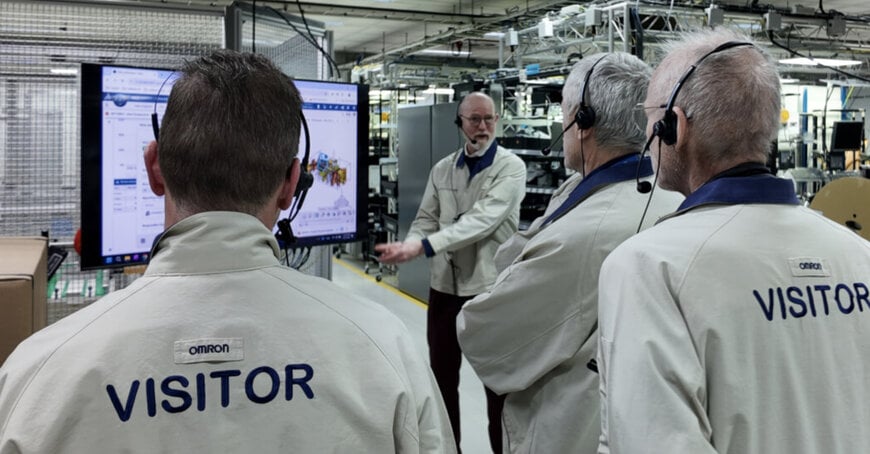
Industrial automation, discrete manufacturing, and smart factory systems are increasingly adopting digital engineering approaches to improve flexibility and reduce commissioning risks. In this context, OMRON and Dassault Systèmes have partnered to integrate virtual twin technology with industrial automation platforms, enabling continuous interaction between simulated and real production environments.
The collaboration addresses a common limitation in manufacturing: the separation between product design, automation engineering, and production operations. These silos often lead to longer commissioning cycles, increased error rates, and reduced adaptability of production systems. By linking virtual simulation with physical automation systems, the partnership introduces a unified workflow from design to operation.
Virtual twin integration across the production lifecycle
At the core of the approach is the integration of Dassault Systèmes’ 3D UNIV+RSES platform with OMRON’s Sysmac automation system. This combination enables the creation of a virtual twin of production systems, where manufacturing lines, robot behavior, and logistics flows can be designed, simulated and validated before physical deployment.
Engineers can test multiple operational scenarios in a controlled digital environment, including performance, safety and maintenance conditions. This reduces the likelihood of design errors and minimizes rework during commissioning.
Continuous feedback between virtual and physical systems
Once deployed, the physical production system remains connected to its virtual counterpart. Real-time data from sensors, controllers and robotic systems is fed back into the virtual model, allowing comparison between simulated and actual performance.
This closed-loop approach supports:
- Identification of performance deviations
- Fine-tuning of system parameters
- Predictive maintenance strategies based on operational data
By maintaining alignment between virtual and real systems, manufacturers can optimize processes continuously rather than relying solely on pre-deployment validation.
IT/OT convergence for flexible manufacturing
The integration of information technology (IT) and operational technology (OT) enables a digital continuum across the production lifecycle. Instead of isolated engineering stages, manufacturers can manage design, validation and operation within a single environment.
This approach is particularly relevant for applications requiring frequent reconfiguration or high variability, such as automotive production lines, electronics manufacturing and high-mix industrial assembly. In these environments, the ability to simulate and validate changes before implementation supports greater flexibility and reduced downtime.
The collaboration was presented at Hannover Messe 2026 (April 20–24, Hall 14, Booth H74), where the companies demonstrated how virtual twin technology combined with automation systems can improve efficiency across production system design and operation.
By bridging virtual simulation and real-world automation, OMRON and Dassault Systèmes contribute to the development of more integrated and data-driven manufacturing systems, where validation, optimization and operation are part of a continuous process.
Edited by Natania Lyngdoh, Induportals Editor — Adapted by AI.
www.omron.com
IT/OT convergence for flexible manufacturing
The integration of information technology (IT) and operational technology (OT) enables a digital continuum across the production lifecycle. Instead of isolated engineering stages, manufacturers can manage design, validation and operation within a single environment.
This approach is particularly relevant for applications requiring frequent reconfiguration or high variability, such as automotive production lines, electronics manufacturing and high-mix industrial assembly. In these environments, the ability to simulate and validate changes before implementation supports greater flexibility and reduced downtime.
The collaboration was presented at Hannover Messe 2026 (April 20–24, Hall 14, Booth H74), where the companies demonstrated how virtual twin technology combined with automation systems can improve efficiency across production system design and operation.
By bridging virtual simulation and real-world automation, OMRON and Dassault Systèmes contribute to the development of more integrated and data-driven manufacturing systems, where validation, optimization and operation are part of a continuous process.
Edited by Natania Lyngdoh, Induportals Editor — Adapted by AI.
www.omron.com
-2296-71282-204124.png)