
www.magazine-industry-usa.com
12
'26
Written on Modified on
Omron Develops Weather IoT Sensor for Local Monitoring
The compact seven-in-one module targets on-site weather risk management across construction, agriculture, logistics, energy infrastructure, and smart cities.
industrial.omron.eu
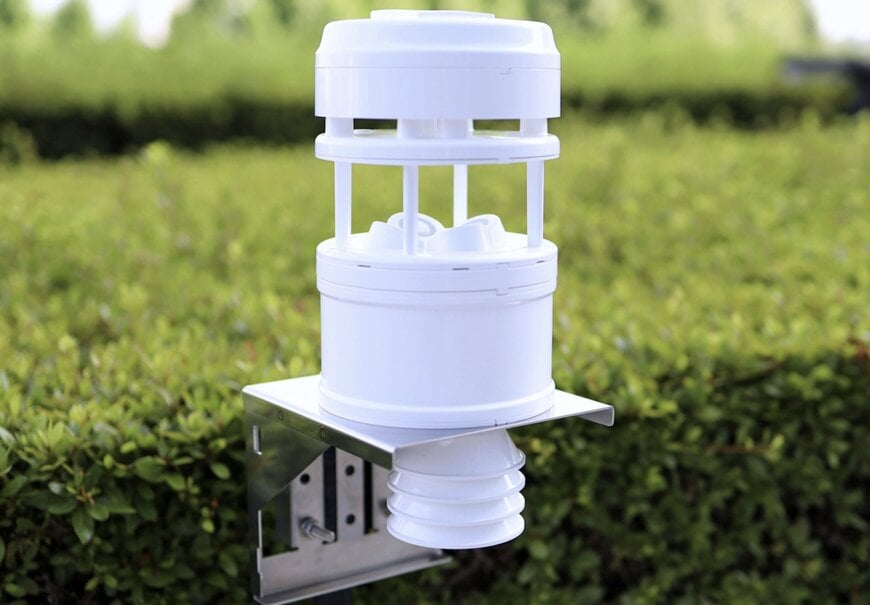
Omron Device & Module Solutions Company has developed a new weather IoT sensor module in collaboration with Weathernews Inc. to support real-time, on-site monitoring in applications where localized weather data is operationally critical. The companies introduced the sensor as a compact, cost-focused approach for continuous measurements in outdoor environments.
Why localized weather sensing is becoming operationally critical
As extreme and less predictable weather patterns increase disruption risks, continuous monitoring is becoming a practical requirement for sectors exposed to rapidly changing outdoor conditions. Local, real-time weather data is increasingly important for day-to-day operations across agriculture, energy infrastructure, meteorology, oil and gas, transportation and logistics, and smart cities—where decisions depend on immediate site-level conditions rather than generalized regional forecasts.
In construction, this can translate into earlier precautions against strong winds at altitude or unsafe heat conditions. In agriculture, access to both real-time conditions and historical trends supports decisions around irrigation, planting, and harvesting. Outdoor event and leisure operators similarly rely on site-level conditions to determine whether activities remain safe.
Lowering the cost and complexity barrier of weather instrumentation
A recurring limitation in conventional weather monitoring approaches is cost and deployment effort. Many weather sensor systems require significant installation coverage across a site, raising both capital and operating costs. Practical constraints also include specialized engineering expertise needed to install, maintain, and troubleshoot these systems—creating a barrier for locations that need reliable data but lack budget or technical staff.
The collaboration aimed to address these constraints through a sensor module designed to be more accessible, flexible, and cost-effective, with a focus on filling local data gaps and expanding on-site monitoring coverage.
Engineering challenges: rainfall detection and high-wind calibration
While Omron has experience in sensing and embedded technologies, developing a weather sensor required integrating meteorological behavior into design and validation. Weathernews contributed domain knowledge to define what performance levels and detection behavior would be required in field deployments.
One design issue emerged during rooftop and high-rise prototype testing: raindrop detections increased unexpectedly due to droplets adhering to the sensor and vibrating in the wind. Omron engineers refined both software and hardware based on Weathernews feedback, resulting in a structure intended to prevent raindrops from remaining on the sensing surface.
Wind sensing created another major constraint: the unit needed to detect wind velocity up to 50 m/s (about 180 km/h), a range relevant to construction-site risk scenarios where wind at height can endanger equipment and personnel. Omron built an internal wind tunnel for testing, but it could not reproduce representative conditions at the maximum wind speed, so the company used a more powerful external wind tunnel to calibrate the sensor and confirm performance.
A seven-in-one composite sensor with plug-and-play installation
The outcome of the 15-month development cycle was a composite unit combining seven sensing functions in one module. It provides real-time measurements of wind direction, wind velocity, rainfall, temperature, humidity, barometric pressure, and light levels.
Rather than requiring complex installation, the unit is designed as plug-and-play, needing only a power supply to operate. This can simplify deployment for remote sites or facilities where engineering resources and maintenance windows are limited.
Outdoor readiness and communications roadmap
For outdoor deployment, the sensor is rated IPx3 and is designed with no moving parts, reducing mechanical failure modes and limiting maintenance requirements. For Europe, the currently supported interface is wired RS232. Future communication options under consideration include LTE-M and LoRa, expanding potential integration into connected operational platforms and a wider automotive data ecosystem of distributed sensing and analytics.
Where the module fits in real deployments
The sensor is positioned for remote areas and operational sites where reliable weather data is difficult to obtain. Continuous localized monitoring supports earlier site-level warnings and improved planning around weather-driven disruption, enabling more efficient data collection and analysis while improving resilience against climate-related events.
In practice, the value lies in decision-grade local measurement: detecting high-wind thresholds on construction sites, monitoring microclimates affecting irrigation strategy, or improving safety decisions in outdoor facilities—using one compact sensor rather than a distributed, complex weather instrumentation setup.
www.omron.com
-2296-71282-204124.png)