
www.magazine-industry-usa.com
27
'26
Written on Modified on
Kanadevia Inova Deploys HSAD–Gasification RNG Facility in Minnesota
The Louisville Township plant will process 75,000 tons of organic waste annually to produce 200,000 MMBtu of renewable natural gas and 8,000 tons of biochar.
kanadevia-inova.com
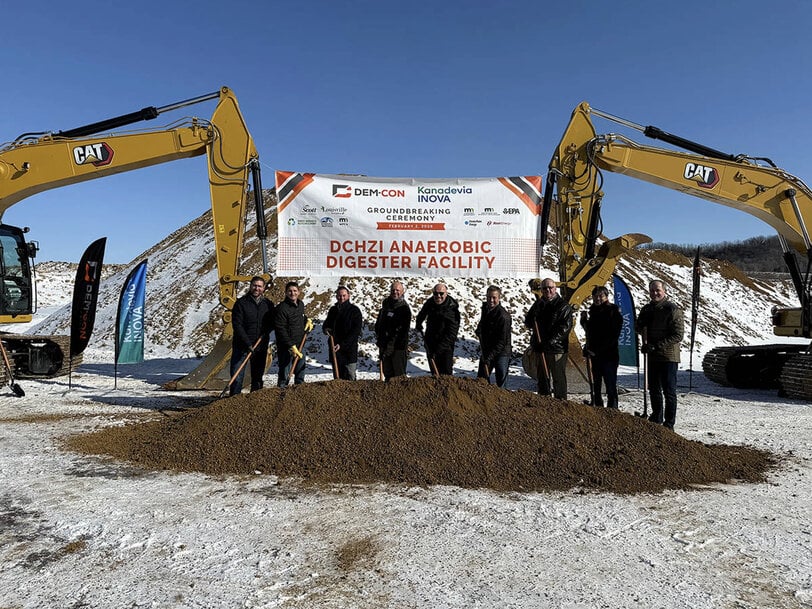
Targeting municipal waste management, renewable natural gas infrastructure and circular waste management, Kanadevia Inova has launched construction of a high-solids anaerobic digestion and gasification facility in Louisville Township, Minnesota, designed to convert 75,000 tons of organic waste per year into pipeline-quality renewable natural gas and biochar.
Converting Municipal Organic Waste into Renewable Gas
The Louisville Township Renewable Gas Project represents a large-scale deployment of integrated biological and thermochemical processing for municipal solid waste (MSW). Once operational in 2027, the DCHZI Bioenergy facility will process up to 75,000 tons of organic material annually.
The plant is expected to generate approximately 200,000 MMBtu of renewable natural gas (RNG) per year, equivalent to the average annual energy demand of around 2,700 U.S. households. In addition, it will produce approximately 8,000 tons of biochar annually.
Feedstock includes both source-separated organics (SSO) collected in compostable bags and biodegradable fractions recovered from mixed MSW streams. According to national averages, food waste represents approximately 24% of household waste, making it the largest single waste component. When landfilled untreated, this fraction decomposes anaerobically and emits methane and CO₂, both significant greenhouse gases.
By diverting organic waste from landfill and converting it into renewable natural gas, the facility directly contributes to greenhouse gas (GHG) reduction targets and landfill diversion objectives defined by Minnesota state and municipal policies.
Integrated HSAD and Gasification Technology
A distinguishing technical feature of the project is the combination of high-solids anaerobic digestion (HSAD) with downstream gasification.
Anaerobic digestion is a biological process in which microorganisms decompose organic matter in oxygen-free conditions. In HSAD systems, feedstock with higher dry matter content is processed in sealed digesters, producing biogas composed of approximately 60% methane and 40% carbon dioxide.
The biogas is then upgraded to remove CO₂ and impurities, resulting in pipeline-quality natural gas suitable for grid injection under the framework of the Minnesota Natural Gas Innovation Act.
However, anaerobic digestion alone cannot fully treat compostable packaging materials and residual contaminants commonly present in MSW-derived organic streams. To address this limitation, the facility incorporates a gasification stage following digestion. The remaining digestate and residual materials are thermochemically converted into biochar.
This integration enables higher overall material recovery and reduces residual waste requiring disposal.
Biochar as a Carbon-Sequestering Byproduct
Biochar produced through gasification can be used in soil amendment, environmental remediation and filtration applications. It contributes to nutrient retention and moisture management in agricultural soils and has demonstrated potential in mitigating perfluoroalkyl and polyfluoroalkyl substances (PFAS), persistent compounds commonly referred to as “forever chemicals.”
From a carbon accounting perspective, biochar provides long-term carbon sequestration, reducing the overall carbon intensity of the renewable gas production process.
According to Heath Jones, Regional President North America, the facility converts the organic fraction of municipal waste through anaerobic digestion, biogas upgrading and advanced gasification, adding biochar production as an additional material stream beyond biomethane.
System-Level Benefits for Circular Waste Management
The integrated process provides measurable operational benefits beyond energy production. These include:
- Significant reduction in landfill volumes
- Stabilization of nutrients to reduce pollution risks
- Reduction of pathogens in organic waste streams
- Improved odor control compared to untreated waste
By combining renewable natural gas production with biochar generation, the project aligns with circular waste management principles in which both energy and material value are recovered from municipal waste streams.
Public–Private Implementation Model
The project is being developed in collaboration with Ramsey/Washington Recycling & Energy (R&E), a joint powers organization serving Ramsey and Washington counties. The DCHZI Bioenergy facility is a partnership between Kanadevia Inova and Dem-Con Companies, LLC, integrating process technology expertise with regional waste management operations.
Under the Minnesota Natural Gas Innovation Act, CenterPoint Energy, Inc. and Xcel Energy, Inc. will support offtake and grid integration of the renewable natural gas produced.
Funding support has been provided by the Minnesota Environment and Natural Resources Trust Fund, as recommended by the Legislative-Citizen Commission on Minnesota Resources, in addition to grants from the Minnesota Department of Commerce and the State Competitiveness Fund Matching Funds Program.
Positioning Within the U.S. Renewable Gas Market
While anaerobic digestion facilities are widely implemented across North America, the integration of high-solids digestion with gasification for municipal organic waste at this scale remains less common. By combining biological conversion and thermochemical processing, the Louisville Township facility addresses both energy recovery and residual waste treatment within a single infrastructure.
For municipalities and utilities evaluating renewable natural gas infrastructure, the project illustrates how integrated process design can improve material recovery, reduce landfill dependence and support state-level decarbonization targets through standardized RNG grid injection and carbon-sequestering byproducts.
www.kanadevia-inova.com
Public–Private Implementation Model
The project is being developed in collaboration with Ramsey/Washington Recycling & Energy (R&E), a joint powers organization serving Ramsey and Washington counties. The DCHZI Bioenergy facility is a partnership between Kanadevia Inova and Dem-Con Companies, LLC, integrating process technology expertise with regional waste management operations.
Under the Minnesota Natural Gas Innovation Act, CenterPoint Energy, Inc. and Xcel Energy, Inc. will support offtake and grid integration of the renewable natural gas produced.
Funding support has been provided by the Minnesota Environment and Natural Resources Trust Fund, as recommended by the Legislative-Citizen Commission on Minnesota Resources, in addition to grants from the Minnesota Department of Commerce and the State Competitiveness Fund Matching Funds Program.
Positioning Within the U.S. Renewable Gas Market
While anaerobic digestion facilities are widely implemented across North America, the integration of high-solids digestion with gasification for municipal organic waste at this scale remains less common. By combining biological conversion and thermochemical processing, the Louisville Township facility addresses both energy recovery and residual waste treatment within a single infrastructure.
For municipalities and utilities evaluating renewable natural gas infrastructure, the project illustrates how integrated process design can improve material recovery, reduce landfill dependence and support state-level decarbonization targets through standardized RNG grid injection and carbon-sequestering byproducts.
www.kanadevia-inova.com
-2296-71282-204124.png)