
www.magazine-industry-usa.com
09
'26
Written on Modified on
GE Aerospace and Wolfspeed Partner on High-Voltage Silicon Carbide
The scope of the MOU aligns with the United States Government’s stated priorities of accelerating critical technologies for achieving faster time-to-power for strategic markets such as Artificial Intelligence.
www.geaerospace.com
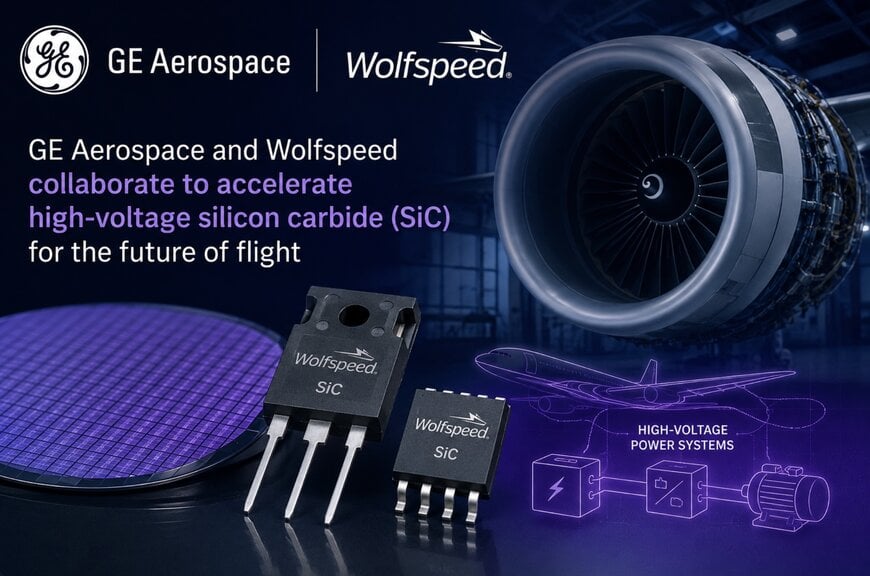
GE Aerospace and Wolfspeed Inc. have signed a Memorandum of Understanding (MOU) to collaborate on expanding the deployment of high-voltage silicon carbide (SiC) technology across industrial, aerospace, and defense sectors. The partnership centers on creating standardized power module formats utilizing advanced wide-bandgap semiconductors to enhance efficiency and structural simplicity in high-demand infrastructure.
Context of the Cooperation
The collaboration combines the technical capabilities of semiconductor manufacturer Wolfspeed Inc. and propulsion and systems provider GE Aerospace. The initiative responds to escalating power requirements and compressed deployment timelines driven by artificial intelligence (AI) infrastructure, industrial electrification, and military platforms.
As operating demands outpace the structural capabilities of legacy silicon, the companies seek to solve power-delivery bottlenecks and secure supply chains. By establishing a unified approach, the cooperation leverages complementary expertise to address the complexity of high-power system architecture while reinforcing domestic sourcing for strategic industrial components.
Technical Solution and Responsibilities
Under the terms of the MOU, the technical framework involves the supply of Wolfspeed's 10 kV SiC Metal-Oxide-Semiconductor Field-Effect Transistor (MOSFET) die. The participating companies are tasked with jointly designing standard high-voltage power module configurations intended for commercial deployment.
At the system level, these high-voltage modules function by reducing the total number of series-connected devices required within a circuit topology. Minimizing internal component complexity results in more compact, thermally stable, and reliable power systems. The developed formats are engineered to interface directly with next-generation solid-state transformers, heavy electrification lines, and advanced defense systems.
Deployment or Implementation
The cooperative technology will target specific operational systems across commercial and defense domains. Implementation is backed by existing technical milestones from both organizations. GE Aerospace has qualified high-voltage silicon carbide power units for U.S. military ground vehicles, establishing them as production-ready. Additionally, GE Aerospace has demonstrated its fourth-generation silicon carbide power MOSFET devices at its Research Center in Niskayuna, New York, focusing on boosting switching speed and component durability.
Wolfspeed supports the deployment phase via its high-volume 200 mm silicon carbide manufacturing infrastructure, which supplies the foundational 10 kV semiconductor blocks required for standard module integration.
Additional Context
This section details technical specifications and competitive benchmarking not included in the original news release.
High-voltage power electronics have traditionally relied on silicon-based Insulated Gate Bipolar Transistors (Si IGBTs). However, silicon material properties limit operational efficiency due to a narrow bandgap energy, which forces multi-device stacking to survive medium-to-high voltage thresholds. This increases system volume, weight, and thermal cooling requirements.
Silicon carbide features a wide bandgap and a dielectric breakdown strength ten times greater than conventional silicon. This allows a single high-voltage SiC device to block identical voltages that would otherwise require several series-connected silicon units.
Comparable commercialized silicon carbide MOSFET products in the power semiconductor landscape primarily target the 3.3 kV and 6.5 kV thresholds. However, escalating power demands from large-scale AI data centers and medium-voltage grid distribution systems require higher vertical breakdown limits. The deployment of a 10 kV unipolar SiC MOSFET alternative permits power architectures to achieve faster switching speeds and superior thermal conductivities. At a system level, these 10 kV SiC devices reduce power module volume to one-third and weight to one-half compared to 6.5 kV silicon-based products, lowering switching energy losses and reducing cooling dependencies.
Edited by Romila DSilva, Induportals Editor, with AI assistance.
www.geaerospace.com
-2296-71282-204124.png)