
www.magazine-industry-usa.com
05
'26
Written on Modified on
Compact Finger Grips for Industrial Equipment
Heinrich Kipp Werk expands its operating components portfolio with compact finger grips designed for ergonomic actuation in machinery, enclosures, and automation systems.
www.kippwerk.de
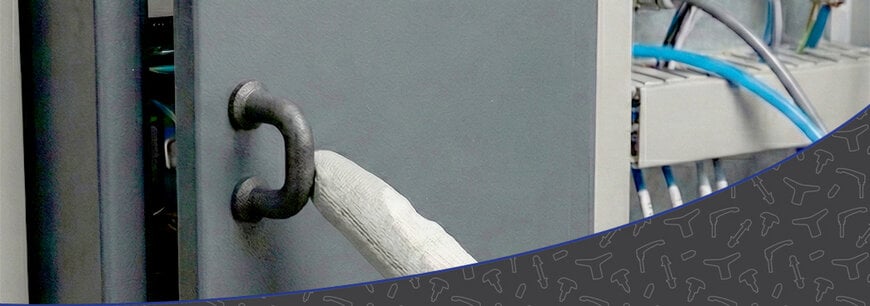
Compact operating components are essential in machinery and enclosure design where space constraints and clean surfaces are required. Heinrich Kipp Werk has introduced four new series of finger grips designed for single-finger operation, offering multiple material options for applications in machine construction, automation systems, and technical equipment housings.
Compact Design for Space-Constrained Installations
Finger grips are commonly used as minimalistic handles for opening hatches, drawers, or equipment covers in industrial environments. The newly introduced components from Heinrich Kipp Werk are designed for one-dimensional operation using a single finger, enabling actuation where conventional handles would require more installation space.
The grips are mounted from the rear side of the panel or component. This mounting approach keeps the outer surface visually unobstructed and simplifies cleaning, which can be important in environments such as food processing equipment, laboratory devices, and medical technology systems. The concealed mounting also supports ergonomic operation while maintaining a uniform industrial design language.
Due to their compact dimensions, the grips are suited for applications where equipment interfaces must remain unobtrusive while still allowing reliable manual access.
Four Material Series for Different Technical Requirements
The product range consists of four series that differ in material composition and surface finish. This structure allows designers to select a grip based on environmental conditions, corrosion resistance requirements, or aesthetic considerations.
The K0201 aluminium series includes six variants with diameters of 8 mm or 10 mm and centre distances of 30 mm or 40 mm. The grips are available with black or natural-tone anodised finishes. Aluminium end washers are offered as accessories for this series.
The K1793 stainless steel series provides ten variants with diameters of 5 mm, 8 mm, or 10 mm and centre distances of 30 mm or 40 mm. The surfaces are available either vibratory polished or matt abrasive blasted. Stainless steel end washers are available as accessories, supporting applications requiring corrosion resistance or frequent cleaning.
The K1799 steel series consists of five variants with diameters of 8 mm or 10 mm and centre distances of 30 mm or 40 mm. These grips are manufactured with a high-gloss polished surface finish and are also compatible with stainless steel end washers.
The K2292 plastic series offers the largest configuration range with 42 variants. These grips are available with or without a collar and with diameters of 8 mm or 10 mm and centre distances of 30 mm or 40 mm. Color options include black-grey, orange, yellow, green, blue, red, grey, and additional variants. Two self-tapping screws are supplied with each grip to simplify installation.
Applications in Machinery and Equipment Design
Finger grips of this type are typically integrated into industrial equipment where direct access to panels or compartments is required without the need for large handle assemblies. Common uses include access to service panels in machines, electrical switchboxes, protective covers, and control cabinet doors.
In automation equipment and enclosure systems, compact grips can improve usability while preserving the structural integrity of the housing. Their minimal footprint also supports design approaches that prioritize compact interfaces and visually consistent surfaces.
In medical technology devices or laboratory instruments, small handles can be advantageous when equipment surfaces must remain smooth for cleaning and contamination control.
Integration in Industrial Component Systems
Operating components such as finger grips form part of a broader mechanical interface system used in machinery and equipment construction. Designers typically combine these components with hinges, latches, and positioning elements to create functional access systems within machines or enclosures.
By offering multiple materials and surface treatments, the new finger grip series supports integration into a wide range of industrial environments, from corrosion-sensitive installations to equipment requiring color-coded components for identification or workflow management.
www.kipp.com
-2296-71282-204124.png)