
www.magazine-industry-usa.com
19
'26
Written on Modified on
IO-Link Port Expansion for Decentralized Industrial Automation
The new Murrelektronik IO-Link Multiplier quadruples a single master port to connect sensors and actuators while reducing wiring and hardware costs.
www.murrelektronik.com
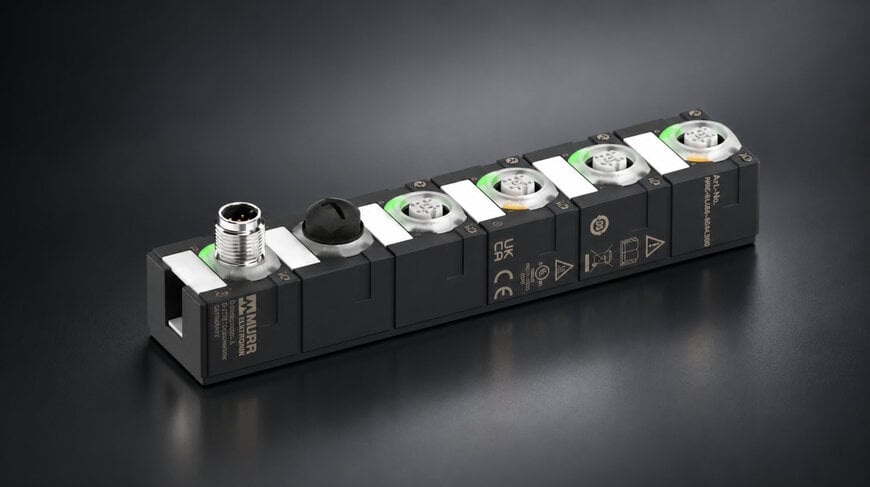
The continuous growth of smart sensors and actuators in manufacturing facilities rapidly saturates the available communication channels on existing control modules. To overcome this physical limitation without adding new network hardware, the IO-Link Multiplier developed by Murrelektronik quadruples the capacity of a single master port directly at the machine level.
Scalability Challenges in Decentralized Automation Architectures
In modern production lines and industrial machinery, the increasing adoption of intelligent field devices requires a growing number of data connection points. However, port availability on installed IO-Link master modules is often limited. When the need arises to integrate new sensors, actuators, or input/output modules into an existing system, the traditional approach involves installing additional master modules or expanding fieldbus nodes.
This intervention entails significant operational and economic drawbacks for electrical designers and system integrators. Adding new master modules consumes space inside the control cabinet or along the machine frame, increases wiring complexity, extends engineering times, and raises overall control hardware costs. In legacy system modernization projects (retrofits) or in the development of modular machine concepts, the lack of free ports represents a direct obstacle to system scalability.
Operating Principle and Port Multiplication Architecture
To solve the problem of field channel saturation, Murrelektronik has introduced the IO-Link Multiplier device. This compact component for decentralized automation connects via plug-and-play logic to a single IO-Link master port already present in the system, converting it into four independent and fully functional IO-Link ports.
From a communication architecture perspective, the module acts as a transparent concentrator and distributor of point-to-point serial data. The 32 bytes of IO-Link process data provided by the primary master port are flexibly distributed among the four secondary ports of the multiplier, allowing bandwidth allocation to be adapted to the specific requirements of the individual downstream devices.
This configuration preserves the full functionality of the communication standard. Cyclic process data, acyclic configuration parameters, and diagnostic information from all four connected devices remain fully accessible to the higher-level control system. Maintaining data transparency down to the field level facilitates automated commissioning and accelerates fault identification during preventive or corrective maintenance. Furthermore, LED status indicators on each port allow technicians to perform immediate visual diagnostics directly on the machine.
Technical Specifications and Cabling Topology Flexibility
In addition to allowing the simultaneous connection of up to four standard IO-Link devices through a single master port, the hardware architecture of the module offers flexible signal configuration options. As an alternative to IO-Link communication, the four ports can be used to acquire up to eight standard digital inputs or to drive up to four digital outputs.
Another relevant technical aspect concerns the physical extension of the network topology. According to IO-Link standard specifications, the maximum length of an unshielded cable between a master and a device is limited to 20 meters. By acting as an active intermediate repeater station between the master and the end device, the IO-Link Multiplier allows a cable length of up to 20 meters between the IO-Link master and the multiplier, plus an additional 20 meters of cable between the multiplier itself and the connected sensor or actuator. Doubling the total distance to up to 40 meters provides greater design freedom when routing cables across large machinery or distributed systems.
In terms of mechanical construction, the compact housing is certified with an IP65/IP67 protection rating against the ingress of dust, water jets, and temporary immersion. This feature makes the component suitable for direct mounting on equipment in harsh industrial environments, eliminating the need for junction boxes or secondary protective enclosures and aligning with cabinet-free automation concepts, such as the company's modular Vario-X ecosystem.
Industrial Applications in Modular Systems and Retrofits
Within the manufacturing and plant engineering sectors, the device is primarily used in two operational scenarios: the construction of new modular machines and the technological upgrading of existing facilities.
In modular machine design, original equipment manufacturers can standardize the base machine module with a reduced number of IO-Link masters, deploying the multiplier only in system variants that require optional groups of sensors or actuators. This reduces bill-of-materials costs for standard configurations and simplifies wiring variants.
In retrofit operations on active production lines, where adding sensors for condition monitoring or quality control requires new data collection points, the module enables expansion of the IO-Link infrastructure directly in the field without modifying the PLC architecture or purchasing new interface cards for the main fieldbus.
Additional Context:
This section details technical specifications and competitive benchmarking not included in the original product announcement.
To technically frame the function performed by the IO-Link Multiplier module within the international IEC 61131-9 standard (which defines IO-Link technology), it is necessary to distinguish this architecture from traditional digital I/O hubs. While a standard IO-Link hub exclusively collects binary signals (standard digital inputs and outputs) from multiple ports to funnel them toward a single master port as aggregated data, an IO-Link multiplier or master-device hub maintains full bidirectional serial communication (COM1, COM2, or COM3 modes) on each of its derived ports.
From a protocol performance standpoint, sharing a single master port equipped with 32 bytes of process data across four secondary ports requires verification during the system design phase: the sum of the input and output bytes generated by the four connected devices must not exceed the total 32-byte budget of the primary port. Additionally, because the multiplier aggregates and routes data packets from four channels over a single physical line to the master, the overall cycle time of the master port will be higher compared to a single direct connection. Consequently, this technical solution is optimized for process sensors, measurement transducers, LED indicators, RFID read heads, or pneumatic actuators with standard response time requirements (in the millisecond range), whereas direct connection to dedicated master ports remains preferable for ultra-high-speed motion control applications.
Across the industrial automation sector, component manufacturers address field channel expansion through distinct architectural approaches. Four-port or eight-port IO-Link master modules with integrated fieldbus interfaces (such as PROFINET, EtherNet/IP, or EtherCAT), manufactured by industry providers including Balluff, IFM Electronic, Turck, Pepperl+Fuchs, and Murrelektronik itself, offer 32 bytes of data per individual port and independent cycle times, but require a dedicated network node, bus cables, and IP or field addressing. Conversely, IO-Link port multipliers or active/passive extenders operate at a lower hierarchical level: they forego the fieldbus interface to minimize mechanical footprint and per-channel cost, while offering the technical advantage of acting as a signal repeater to extend the physical reach of the connection from 20 to 40 meters without requiring industrial Ethernet switches.
Edited by Sucithra Mani, Induportals editor – adapted by AI.
www.murrelektronik.com
