
New FLIR RS8480 Brings HD MWIR Detail to Proven Long-Range Science Camera Platform
New smaller form-factor HD MWIR camera delivers four times the pixels of standard VGA for long-range radiometric measurement.
www.flir.com
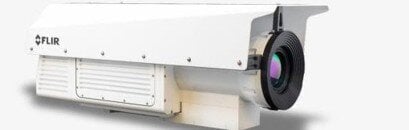
October 1, 2026 – Teledyne FLIR, part of Teledyne Technologies Incorporated, today launched the RS8480, the first smaller form-factor, high definition midwave infrared (HD MWIR) science camera in the RS lineup. Combining a new 1280 × 1024 HD MWIR sensor with the proven RS6780 chassis, the RS8480 brings increased detail and measurement capability to long-range science applications while retaining familiar optics, mounting, calibration, and FLIR Research Studio workflow.
Designed for large-scale and outdoor scientific research, including commercial aerospace and space launch sites as well as government and defense test ranges, the RS8480 enables users to detect, identify, and measure small or distant objects with more pixels. The innovative new camera fills the gap between the existing FLIR RS6780 and the larger, faster RS8500.
Four Times the Detail
The RS8480's high definition sensor provides four times the pixels of a standard 640 × 512 video graphics array (VGA) detector, equivalent to twice the linear sampling across a target. This additional spatial detail supports temperature and radiometric measurements, as well as the resolution of test articles and spatial measurements at long distances.
“Long-range outdoor scientific research teams need measurement data per pixel, not simply a high-quality video they can watch,” says Roger Martinez, Senior Principal Systems Engineer, Teledyne FLIR. “The RS8480 combines the resolution needed to put more pixels on small, distant objects with the proven RS platform, optics, and workflows that users already know. It therefore provides a straightforward path to HD MWIR performance without the disruption associated with introducing an entirely new camera platform.”
Measurement-Ready Performance
Based on a FLIR hot MWIR strained-layer superlattice (SLS) detector operating at 120 K, the RS8480 delivers a 1280 × 1024 resolution image, 37 mK typical NETD, and 14-bit dynamic range across the 3.4 to 5.1 µm spectral range. Radiometric data is available from every pixel and frame for measurement and analysis, rather than simply display purposes.
Key capabilities include:
• 50–250 mm continuous metric zoom, extendable to 150–750 mm using the optional 3× afocal multiplier for applications that need additional reach.
• Full-frame rates of approximately 45 Hz via GigE Vision and 60 Hz via CoaXPress.
• Fully adjustable integration times and frame rates, with windowing down to 32 × 4 for high-speed transient events.
• Range-grade synchronization, including IRIG-B, tri-level, and lock-in sync - plus TSPI-accurate timestamping.
The potential applications set to benefit from RS8480 are broad, spanning outdoor scientific campaigns, commercial space launch monitoring, aerospace test and evaluation, combustion research, high-temperature materials research, and defense range instrumentation. The cooler’s mean time between failure (MTBF) of 27,000 hours supports long-term operation in demanding outdoor environments.
Proven Platform, Simplified Integration
Of particular note, the new FLIR RS8480 retains the RS6780 electronics, chassis, mounting interface, continuous-zoom optics, factory calibration model, video interfaces, and rugged IP65 housing. For existing RS6780 users, the camera is purposely positioned as a detector and resolution upgrade rather than a complete platform change.
The RS8480 also maintains the FLIR Research Studio acquisition, radiometry, and analysis workflow, enabling existing teams to use familiar software and data pipelines.
To learn more about the RS8480 please visit: https://www.flir.com/products/rs8480/
-2296-71282-204124.png)