
www.magazine-industry-usa.com
15
'26
Written on Modified on
Vaisala Launches DMP370 for Intrinsically Safe Dew Point Monitoring
New instrument brings continuous DRYCAP moisture measurement to hazardous hydrogen, biomethane, natural gas and industrial processing environments with Ex certification.
www.vaisala.com
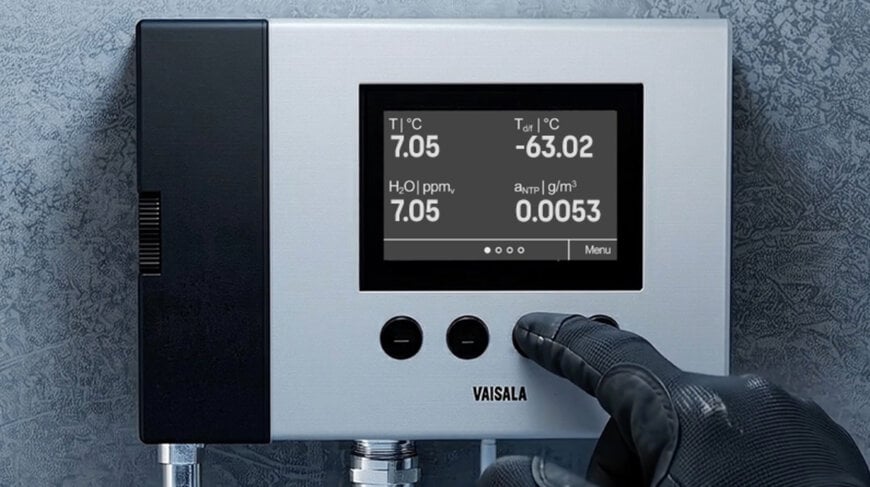
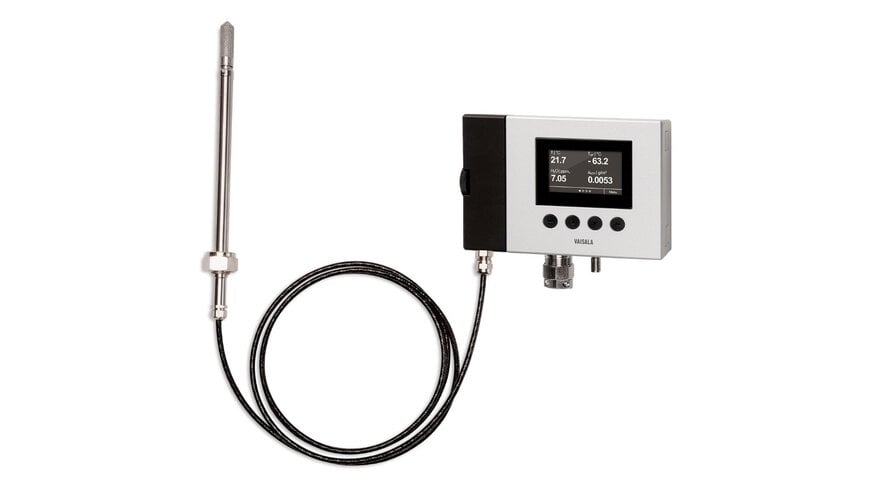
Vaisala has introduced the DMP370, an intrinsically safe dew point measurement instrument certified for deployment in explosive gas and dust atmospheres. The system combines the DMP37X sensor probe with the HMT370EX transmitter to support industrial decarbonization processes, including hydrogen generation, biomethane upgrading, natural gas grid injection, and synthetic fuel synthesis.
Moisture Detection Challenges in Combustible Gas Infrastructure
Industrial demand for hydrogen and renewable gases requires continuous monitoring of trace gas purity. Uncontrolled moisture in gas distribution pipelines, fuel cell feed lines, and electrolyzer stages causes operational issues ranging from catalytic poisoning and diminished fuel cell membrane efficiency to pipeline hydrate formation and accelerated interior corrosion.
Monitoring moisture content within hazardous process zones traditionally required compromise between safety classification and data continuity. Conventional trace moisture analyzers deployed in explosive atmospheres often require flameproof or explosion-proof enclosures that complicate field maintenance and spatial positioning. Alternative sensor technologies frequently rely on periodic thermal regeneration or sensor desiccation cycles, which interrupt continuous monitoring and create blind spots in process control loops.
Energy-Limiting Intrinsic Safety and Continuous Drift Compensation
The DMP370 addresses combustible atmospheric risks by adhering to the intrinsic safety protection concept (Ex i). By mechanically and electronically limiting electrical and thermal energy levels under both standard operation and worst-case electrical fault conditions, the unit cannot generate sufficient spark energy or surface temperature to ignite explosive gas-air mixtures. The certified configuration complies with ATEX and IECEx standards for Zone 0 and Zone 20 installations, and holds FM approval for Class I, II, and III, Division 1 environments.
The instrument incorporates Vaisala DRYCAP thin-film capacitive polymer sensor technology paired with continuous drift-compensation algorithms. This architecture maintains sensor calibration stability in dry gas environments without interrupting signal outputs for mechanical bake-out cycles, ensuring uninterrupted process tracking for plant automation and safety interlocks.
Antti Heikkilä, Product Line Manager of Industrial Decarbonization at Vaisala, stated that scaling hydrogen and renewable gas infrastructure from pilot projects to full industrial capacity requires monitoring hardware that operates continuously while complying with intrinsic safety standards in potentially explosive process zones.
Technical Applications Across Decarbonized Industrial Sectors
Beyond green hydrogen electrolyzers and biomethane pipeline injection points, the system targets processing stages where volatile organic compounds, explosive dusts, or high-pressure flammable gases are handled. In chemical synthesis, the instrument monitors feed streams for sustainable aviation fuels and methanol production. In lithium-ion battery manufacturing, the sensor verifies humidity thresholds in dry room feed lines containing suspended conductive carbon dust. The unit also serves industrial gas supply networks by validating inert blanket purges using nitrogen or technical compressed air in chemical storage facilities.
The instrument was introduced at Gastech 2026, held September 14–17, 2026, at the Bangkok International Trade & Exhibition Centre (BITEC) in Bangkok, Thailand. Initial commercial hardware deliveries are scheduled to begin in the first quarter of 2027.
Additional Context:
This section details technical specifications and competitive benchmarking not included in the original product announcement
The DMP370 operates across a dew point measurement range of -70 degrees Celsius to +10 degrees Celsius (-94 degrees Fahrenheit to +50 degrees Fahrenheit) with a standard accuracy of plus or minus 2 degrees Celsius dew point. The instrument operates under process pressures from 0 to 40 bar absolute (0 to 580 pounds per square inch) and within ambient process temperatures from -40 degrees Celsius to +60 degrees Celsius. The transmitter enclosure is manufactured from cast aluminum with ingress protection rated to IP66, providing dual 4-to-20 milliamp loop-powered outputs or digital RS-485 Modbus interfaces via certified galvanic isolation barriers.
Within the industrial market for intrinsically safe dew point transmitters, established benchmark instruments include the Michell Instruments Easidew I.S. (part of Process Sensing Technologies) and the Panametrics MIS Probe 2 (Baker Hughes).
The Michell Instruments Easidew I.S. uses a ceramic metal-oxide moisture sensor measuring dew points down to -100 degrees Celsius up to +20 degrees Celsius, achieving an accuracy of plus or minus 2 degrees Celsius dew point. The Easidew I.S. features an operating pressure tolerance up to 450 bar (6,500 pounds per square inch) and carries ATEX and IECEx Zone 0 certification. While the ceramic impedance mechanism delivers a lower dry-end measurement threshold than the DMP370 (-100 degrees Celsius versus -70 degrees Celsius) and higher static pressure endurance, thin-film capacitive polymers such as DRYCAP offer faster wet-to-dry recovery times and higher resistance to liquid water condensation exposure without requiring factory recalibration.
The Panametrics MIS Probe 2 utilizes an aluminum oxide moisture sensor providing a measurement span from -110 degrees Celsius to +20 degrees Celsius with an accuracy of plus or minus 2 degrees Celsius dew point. It operates up to 345 bar (5,000 pounds per square inch) with ATEX and IECEx Zone 0 intrinsic safety certification. Similar to metal-oxide sensors across the sector, long-term drift in dry-gas cycling often necessitates periodic factory recalibration cycles or sensor exchange programs, whereas the capacitive thin-film platform of the DMP370 uses automated on-board software drift compensation to preserve zero-point stability in continuous gas streams.
Edited by Natania Lyngdoh, Induportals editor, assisted by AI.
www.vaisala.com
-2296-71282-204124.png)