
www.magazine-industry-usa.com
11
'26
Written on Modified on
ABB Expands NINVA Non-Invasive Process Temperature Portfolio
ABB introduces three specialized models to its non-invasive temperature line, replacing conventional thermowells across demanding chemical, power, and marine sector operations.
global.abb
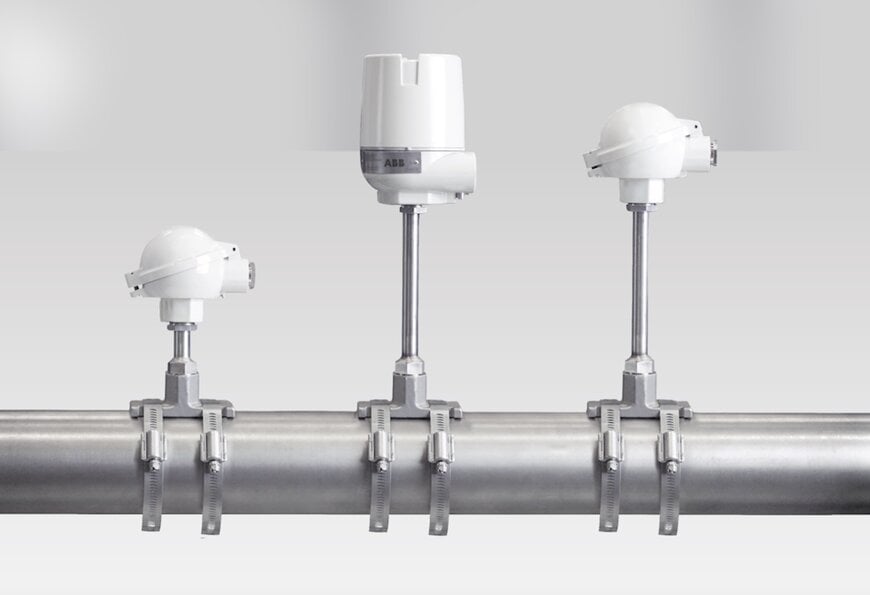
ABB has expanded its NINVA non-invasive temperature measurement portfolio with the introduction of NINVA Integrated, NINVA Remote, and NINVA Compact. The new solutions are designed to address distinct application needs in oil and gas, chemical processing, power utilities, and marine industries where safety and precision are paramount. The expansion helps operations maintain strict process control, reduce unplanned interventions, and comply with site and regulatory standards.
Operational and Commercial Advantages over Thermowells
The NINVA system clamps directly onto the outer diameter of process piping, allowing plant operators to capture accurate process temperature readings without cutting, welding, or maintaining traditional invasive thermowells. By utilizing measurements derived from the surface temperature of the pipe to infer internal fluid conditions, the hardware provides the same level of accuracy and responsive performance as traditional invasive devices.
This non-invasive structure lowers initial design and engineering overhead while decreasing material, field inspection, and installation costs compared to thermowell setups. The system can yield up to a 75 percent reduction in engineering workload and associated capital expenditure (CAPEX) costs. Furthermore, the platform stands as the first non-invasive temperature transmitter to achieve a Functional Safety SIL2 certification, rendering it a highly verified safe non-invasive temperature sensor variant for industrial use.
Targeted Industry Variants and Performance Ratings
The expanded portfolio establishes three dedicated system variations optimized for localized environmental and installation conditions:
- NINVA Integrated: Developed specifically for use in the chemical and oil and gas industries. It is rated for compatibility with metal piping spanning nominal diameters from DN15 to DN2500 (1/2" to 100"). This makes the integrated configuration suited for brownfield plant upgrades where process shutdowns and hot work permits are financially costly.
- NINVA Remote: Engineered to monitor high-temperature and hard-to-access deployment points in power and utility plants, specifically steam networks and high-temperature gas environments exceeding 400°C. The mechanical structure is rated to withstand heavy industrial vibrations of up to 2g. It connects with ABB’s TTF300-N field-mount transmitter to support flexible remote mounting and separate display views while maintaining robust temperature monitoring under harsh service conditions.
- NINVA Compact: Certified for marine applications, this variant is designed for demanding machine environments where physical space is constrained but reliable temperature indication remains mandatory. It features a high vibration capability rated up to 4g and works with smaller piping geometries starting at DN15 and above, skid systems, and mobile assets.
Additional Context
This section details technical specifications not included in the original news release.
The high accuracy of the NINVA non-invasive temperature measurement platform is achieved using a double-sensor architecture paired with advanced thermal correction algorithms. Traditional surface-mounted temperature sensors are prone to measurement errors caused by ambient temperature fluctuations and thermal contact resistance between the sensor tip and the pipe wall.
The hardware contains two discrete Resistance Temperature Detector (RTD) elements: a primary contact sensor that registers the pipe outer surface temperature and a secondary reference sensor that tracks the immediate ambient temperature within the connection head. These components utilize standard thin-film Pt100 platinum resistors configured in a three-wire circuit, adhering to Accuracy Class A specifications in accordance with standard IEC 60751.
The integrated electronic transmitter (based on the ABB TTH300 head-mount or TTF300 remote-mount platforms) contains localized firmware that runs a conjugate heat transfer correction algorithm. This software takes into account the ambient air conditions, localized insulation status, and the thermal resistance properties of the metal pipe walls.
By processing these variables in real time, the transmitter compensates for environmental cooling effects and mathematically infers the internal fluid temperature. The algorithm functions optimally on low-viscosity industrial fluids or steam moving through metal pipes in turbulent flow regimes, allowing the system to achieve a measuring range spanning from -40°C to 400°C on standard models, with extended remote sensor variations capable of operating at up to 550°C.
The mechanical assemblies utilize robust industrial connection heads constructed from epoxy-coated aluminum or 316L stainless steel, providing an ingress protection rating of IP66 or IP67 to withstand aggressive environmental exposure. Process integration is achieved using specialized clamp-on collar brackets, allowing the tool to attach securely via simple steel tension bands to eliminate the structural stress, dynamic bending, and vortex-induced vibration failure risks associated with inserting a physical thermowell probe directly into high-velocity piping streams. Industrial process communication and data extraction are fully supported using a standard 4-to-20 mA analog signal superimposed with the digital HART 7 protocol, enabling full remote configuration, diagnostic fault tracking compliant with NAMUR NE107 guidelines, and seamless integration into central distributed control systems.
Edited by Romila DSilva, Induportals Editor, with AI assistance.
This section details technical specifications not included in the original news release.
The high accuracy of the NINVA non-invasive temperature measurement platform is achieved using a double-sensor architecture paired with advanced thermal correction algorithms. Traditional surface-mounted temperature sensors are prone to measurement errors caused by ambient temperature fluctuations and thermal contact resistance between the sensor tip and the pipe wall.
The hardware contains two discrete Resistance Temperature Detector (RTD) elements: a primary contact sensor that registers the pipe outer surface temperature and a secondary reference sensor that tracks the immediate ambient temperature within the connection head. These components utilize standard thin-film Pt100 platinum resistors configured in a three-wire circuit, adhering to Accuracy Class A specifications in accordance with standard IEC 60751.
The integrated electronic transmitter (based on the ABB TTH300 head-mount or TTF300 remote-mount platforms) contains localized firmware that runs a conjugate heat transfer correction algorithm. This software takes into account the ambient air conditions, localized insulation status, and the thermal resistance properties of the metal pipe walls.
By processing these variables in real time, the transmitter compensates for environmental cooling effects and mathematically infers the internal fluid temperature. The algorithm functions optimally on low-viscosity industrial fluids or steam moving through metal pipes in turbulent flow regimes, allowing the system to achieve a measuring range spanning from -40°C to 400°C on standard models, with extended remote sensor variations capable of operating at up to 550°C.
The mechanical assemblies utilize robust industrial connection heads constructed from epoxy-coated aluminum or 316L stainless steel, providing an ingress protection rating of IP66 or IP67 to withstand aggressive environmental exposure. Process integration is achieved using specialized clamp-on collar brackets, allowing the tool to attach securely via simple steel tension bands to eliminate the structural stress, dynamic bending, and vortex-induced vibration failure risks associated with inserting a physical thermowell probe directly into high-velocity piping streams. Industrial process communication and data extraction are fully supported using a standard 4-to-20 mA analog signal superimposed with the digital HART 7 protocol, enabling full remote configuration, diagnostic fault tracking compliant with NAMUR NE107 guidelines, and seamless integration into central distributed control systems.
Edited by Romila DSilva, Induportals Editor, with AI assistance.
-2296-71282-204124.png)