
www.magazine-industry-usa.com
01
'26
Written on Modified on
Cold-Weather Pipeline Coating for Corrosion Protection
Denso has developed a low-temperature liquid coating designed to support pipeline construction, maintenance, and repair activities in sub-zero operating conditions.
www.densona.com
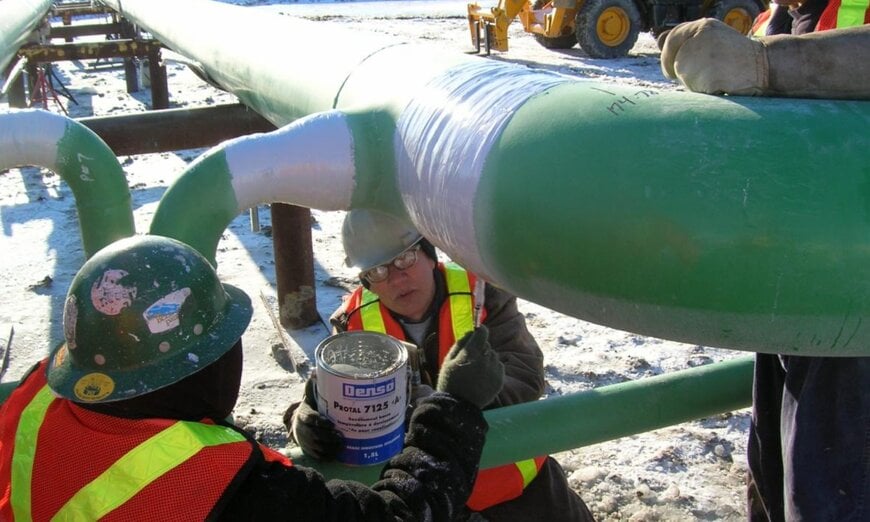
Pipeline construction and maintenance projects in cold climates often face coating application limitations due to temperature-sensitive materials and extended curing requirements. Denso's Protal 7125 addresses these challenges through a high-build liquid coating formulated for application on steel pipeline surfaces exposed to low ambient and substrate temperatures in the oil, gas, and natural gas sectors.
Low-Temperature Coating Technology for Pipeline Infrastructure
Corrosion protection systems are a critical component of pipeline integrity management. Conventional liquid coatings frequently require surface temperatures above freezing to achieve proper adhesion and curing. In cold-weather regions, these requirements can shorten construction seasons, increase project costs, and create operational delays.
Protal 7125 was developed to allow coating application on substrates at temperatures as low as -4°F (-20°C). The formulation is designed to remain effective on surfaces below 32°F (0°C), enabling corrosion protection activities during periods when environmental conditions would otherwise restrict coating operations.
The coating is intended for use across pipeline construction, maintenance, and rehabilitation projects where environmental temperatures present challenges for traditional protective systems.
High-Build Application and Reduced Installation Time
A key characteristic of the coating is its ability to achieve film thicknesses of up to 50 mils (1,270 microns) in a single application. High-build coatings can reduce the number of application passes required to reach specified protection levels, potentially lowering labor requirements and shortening installation schedules.
The coating also incorporates fast-curing properties that support earlier handling and backfilling activities after application. For pipeline contractors operating within limited weather windows, reduced curing times can help maintain construction schedules and minimize delays associated with coating work.
Compatibility with Fusion Bond Epoxy Pipeline Systems
Many transmission and distribution pipelines use Fusion Bond Epoxy (FBE) as a primary corrosion protection layer. Repair and field-joint coatings must demonstrate compatibility with these existing systems to maintain coating continuity and long-term performance.
Protal 7125 is designed to provide adhesion characteristics that complement FBE-coated pipelines. This allows the coating to be used in situations where field-applied protection is required, including girth welds, tie-ins, and localized repair areas.
The product is also available in 50 ml and 825 ml repair cartridge formats, supporting field maintenance activities and localized coating restoration without requiring larger-scale application equipment.
Pipeline Construction and Maintenance Applications
The coating is intended for several common pipeline protection scenarios, including new construction and in-service maintenance. Typical applications include girth weld protection, tie-in sections, push racks, and repairs to damaged FBE-coated surfaces.
Its low-temperature application capability may be particularly relevant for remote installations, northern pipeline networks, and maintenance operations where preheating or post-heating of pipeline surfaces is impractical or unavailable.
By enabling coating work under colder environmental conditions, the technology can support year-round pipeline integrity programs and help operators maintain corrosion protection standards across varying climates.
Corrosion Protection in Challenging Operating Environments
Pipeline operators continue to seek corrosion protection systems that can be applied efficiently while meeting operational and environmental constraints. Coatings capable of curing at lower temperatures can expand construction and maintenance opportunities beyond traditional seasonal limitations.
For oil, gas, and natural gas infrastructure, the ability to apply protective coatings on cold substrates while maintaining adhesion and film-build requirements may contribute to improved project execution and asset protection. Such technologies also support broader digital supply chain planning by reducing weather-related interruptions and improving maintenance scheduling flexibility.
Additional Context
This section details technical specifications and competitive benchmarking not included in the original news release.
Low-temperature pipeline coatings represent a specialized segment of the corrosion protection market. Comparable technologies include cold-weather epoxy and polyurethane-based field-joint coating systems offered by manufacturers such as Shawcor, Canusa-CPS, and STOPAQ. Performance comparisons in this category typically focus on minimum application temperature, cure time, dry film thickness per coat, adhesion strength, and compatibility with FBE systems.
The specified application capability of -20°C places Protal 7125 within the range of coatings developed for arctic, sub-arctic, and winter construction environments. Its reported ability to achieve 1,270 microns in a single coat is notable because many conventional liquid-applied pipeline coatings require multiple layers to achieve comparable thickness. In pipeline field-joint protection applications, higher single-coat build can reduce installation steps while maintaining the corrosion barrier required for long-term asset integrity.
Edited by Aishwarya Mambet, Induportals Editor, with AI assistance.
www.densona.com
