
www.magazine-industry-usa.com
01
'26
Written on Modified on
Fluid Power Controllers Add IO-Link and Standardisation
Parker Hannifin expands its SensoControl range with controllers designed for standardised integration, real-time monitoring, and compatibility with modern industrial connectivity architectures.
www.parker.com
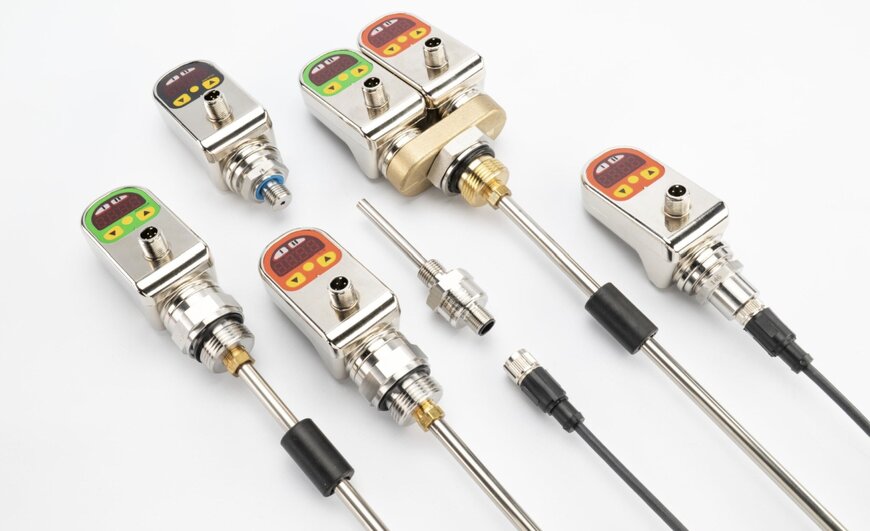
Industrial systems in sectors such as automotive manufacturing, off-road machinery, and power generation require precise monitoring of pressure, temperature, and fluid levels under varying operating conditions. In this context, Parker Hannifin has expanded its SensoControl controller family with a new generation of controllers and switches designed to improve measurement accuracy, response time, and system integration.
Extending monitoring capabilities across fluid power systems
The updated SensoControl portfolio addresses a range of applications in fluid power and industrial process environments, where consistent measurement and control directly influence system stability and efficiency. The new controller family includes four variants: SCLTSDI, SCLSDI, SCTSDI, and SCTSDI-Modular, covering level, temperature, and combined monitoring tasks.
All variants are built on a standardised platform with VDMA-based menu navigation and harmonised parameter structures. This approach simplifies configuration and supports consistent implementation across different machine platforms, particularly in distributed automation systems and digital supply chain environments where interoperability is critical.
Integration through IO-Link and analogue compatibility
Each controller variant includes IO-Link communication as standard, enabling device-level connectivity and data exchange within modern industrial networks. This supports centralised diagnostics, parameterisation, and integration into higher-level control systems.
In addition to digital communication, the controllers provide analogue output options, including 0–20 mA, 4–20 mA, and a newly introduced 0–10 V interface. This allows integration into existing analogue infrastructures, supporting both legacy systems and newer architectures within hybrid industrial environments.
Design considerations for industrial environments
The controllers are designed with IP67-rated housings to withstand exposure to dust, moisture, and mechanical stress. This enables deployment in demanding environments such as mobile hydraulics, agricultural machinery, and industrial production systems.
The updated design also improves response times and measurement accuracy, supporting applications where rapid feedback and precise control are required, such as compressor systems, test benches, and process automation setups.
Device-specific roles within the controller family
The SCLTSDI model combines level and temperature monitoring in a single device, with probe lengths up to 1000 mm and multiple output options. This configuration supports compact tank monitoring in hydraulic systems where both parameters must be tracked simultaneously.
The SCLSDI variant focuses on level measurement only, offering multiple installation lengths and optional analogue outputs. It is suited for applications where temperature monitoring is handled separately, such as storage or distribution systems.
The SCTSDI controller is designed for direct temperature measurement with an integrated probe, enabling fast and precise monitoring in processes such as air and gas compression or industrial machinery operation.
The SCTSDI-Modular variant supports PT1000 sensors and offers a modular approach to temperature monitoring. Its design allows flexible integration into distributed systems, including agricultural equipment and power generation installations.
Standardisation supporting scalable system design
By aligning all variants under a common interface structure and communication protocol, the expanded SensoControl family supports standardised deployment across multiple applications. This reduces engineering complexity and enables consistent system design for OEMs and system integrators.
The combination of IO-Link connectivity, analogue compatibility, and modular design reflects ongoing changes in industrial automation, where systems are increasingly required to balance real-time data acquisition with flexible integration into both new and existing infrastructures.
Edited by Aishwarya Mambet, Induportals Editor, with AI assistance.
www.parker.com
-2296-71282-204124.png)