
DESMI launches pump for liquefied CO₂ transfer
DESMI introduces DesCan pump technology to support safe and stable liquefied CO₂ handling in carbon capture and storage infrastructure.
www.desmi.com
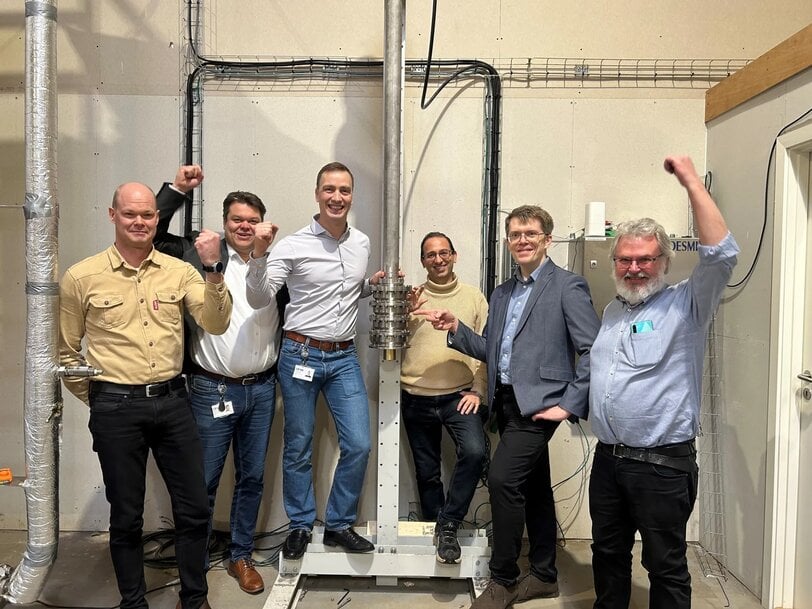
DESMI has introduced a new pump solution designed for carbon capture and storage (CCS) and liquefied CO₂ transport systems. The DesCan pump is developed to address the technical challenges associated with transferring liquefied carbon dioxide across hubs, terminals, and transport infrastructure.
As CCS projects scale from pilot to industrial deployment, the handling of liquefied CO₂ becomes a critical operational requirement, particularly in applications involving transfer between capture facilities, storage tanks, pipelines, and ships.
Technical design and operating principle
The DesCan pump features a can-mounted vertical deepwell configuration, where the hydraulic section is installed below the liquid level. This design ensures flooded suction conditions, which are essential for maintaining stable operation in systems with limited net positive suction head (NPSH).
Liquefied CO₂ presents specific challenges due to its physical properties. It typically operates close to saturation conditions, with high fluid density and a strong tendency toward vapor formation (flashing) at the pump inlet. These characteristics require careful control of suction conditions and hydraulic performance.
By positioning the pump below the liquid surface, the system minimizes the risk of cavitation and ensures consistent flow stability, even under demanding operating conditions.
Development based on operational requirements
The DesCan pump has been developed using operational insights from industrial fluid handling and deepwell pump applications. Existing pump technologies used in LNG or LPG systems are not fully optimized for liquefied CO₂, which behaves differently under similar conditions.
DESMI identified the need for a dedicated solution capable of handling:
- Low NPSH margins near saturation conditions
- Increased sensitivity to inlet pressure fluctuations
- Stable performance under high-density fluid conditions
The resulting design is tailored specifically for CO₂ transfer applications, improving reliability in comparison to adapted legacy systems.
Applications in CO₂ transport and storage
The pump is intended for deployment across multiple stages of CCS infrastructure, including:
- CO₂ hubs and terminal facilities
- Ship loading and unloading operations
- Truck transfer stations
- Pipeline injection and intermediate storage systems
The vertical configuration simplifies installation by eliminating the need for deep pump pits or elevated tank structures. This reduces civil engineering requirements and improves accessibility for maintenance and inspection.
Operational and system-level benefits
From a system design perspective, the DesCan pump contributes to:
- Improved hydraulic stability in CO₂ transfer systems
- Reduced infrastructure complexity
- Enhanced safety by minimizing cavitation and flashing risks
- Greater flexibility in facility layout
These factors are critical for large-scale CCS projects, where reliability and operational continuity directly affect system performance and cost efficiency.
Outlook for CCS equipment development
As global investment in carbon capture and storage accelerates, supporting infrastructure for CO₂ transport and storage is becoming increasingly important. Equipment designed specifically for liquefied CO₂ applications will play a key role in enabling scalable and reliable CCS systems.
The introduction of dedicated pump technologies reflects the broader transition from pilot-scale solutions to industrialized CO₂ value chains.
Edited by an industrial journalist, Lekshman Ramdas, with AI assistance.
www.desmi.com
-2296-71282-204124.png)