
www.magazine-industry-usa.com
13
'26
Written on Modified on
Copeland at 2026 IIAR Expo
From March 16 to 18, in San Antonio, Texas, Copeland will showcase its expanded Vilter portfolio, featuring high-efficiency natural refrigerant heat pumps designed to decarbonize industrial process heating applications.
www.copeland.com
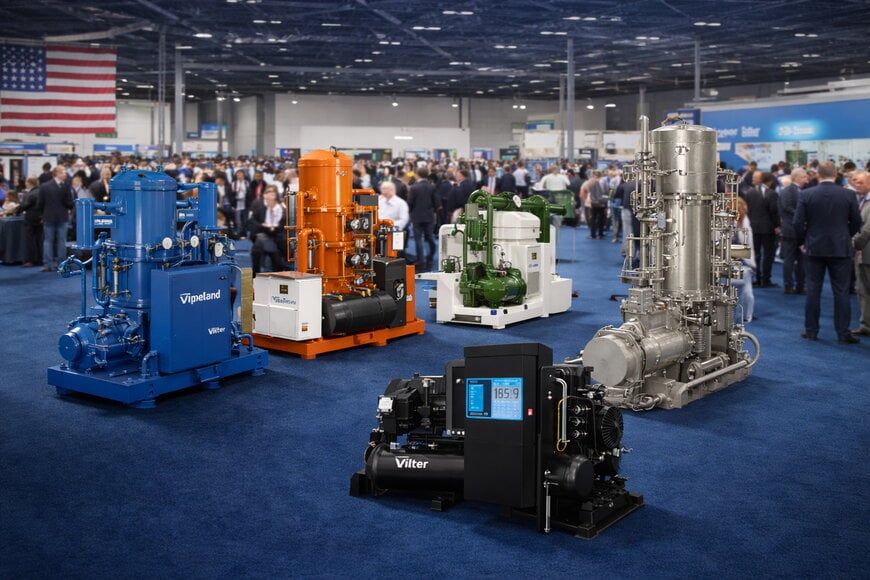
Industries seeking to decarbonize often face the challenge of replacing high-capacity fossil fuel boilers with sustainable alternatives that don't sacrifice performance. Conventional heating systems rely on carbon-intensive combustion, but a new generation of industrial heat pumps is now offering a superior alternative. By leveraging natural refrigerants and advanced compression, these systems provide a scalable, high-efficiency path to electrification that outperforms traditional competition in both temperature output and long-term reliability.
Engineering Superiority Over Multi-Stage Competition
The primary differentiator in modern industrial heating lies in the compressor technology. While many competitors rely on complex multi-stage systems to reach high temperatures, the Vilter VQ95 series utilizes a single-screw compressor design. This architecture is inherently more durable because it features fewer moving parts and eliminates the oil pump — a common failure point in standard units. Because the single-screw design can tolerate liquid droplets without damage, it allows for higher efficiency and lift without the need for superheat, which simplifies the overall system and reduces the total cost of ownership.
Achieving Steam-Level Temperatures with Natural Refrigerants
A common limitation for industrial heat pumps has been the inability to reach the extreme temperatures required for processes like food production or district heating. Recent advancements have pushed these boundaries significantly. Through the integration of specialized process heat technology, industrial heat pumps can now deliver temperatures up to 180 degrees Celsius. By using low-GWP (Global Warming Potential) natural refrigerants such as ammonia and CO2, these systems meet strict environmental regulations that many HFC-based competitors may struggle to comply with in the future.
Scalable Performance from Small Skids to Large Districts
Unlike bespoke, on-site builds that are difficult to replicate or expand, modern industrial heat pumps are designed with modularity in mind. A single skid can provide between 400 kW and 5 MW of heating capacity, and these units can be linked in parallel or serial configurations to meet larger demands. This "plug-and-play" approach allows facilities to scale their heating capacity as needed, transforming waste heat from sewage or industrial processes into a high-value renewable energy source for entire communities.
Impact on Sustainability and Operational Efficiency
Transitioning to this technology typically results in energy efficiency three to five times higher than that of conventional fossil fuel-based heating. In practical applications, such as large-scale food and beverage operations, this efficiency translates into halved energy usage and significant water savings. By replacing carbon-heavy HVAC and boiler systems with these high-performance electrified alternatives, industrial operators can effectively reach net-zero targets while ensuring their infrastructure is resilient to evolving energy standards.
Edited by an industrial journalist, Evgeny Churilov
www.copeland.com
-2296-71282-204124.png)