
www.magazine-industry-usa.com
29
'26
Written on Modified on
Low-Carbon Ammonia Project Advances in Indiana
Baker Hughes secures multiple awards to support a U.S. clean ammonia facility developed by Wabash Valley Resources.
www.bakerhughes.com
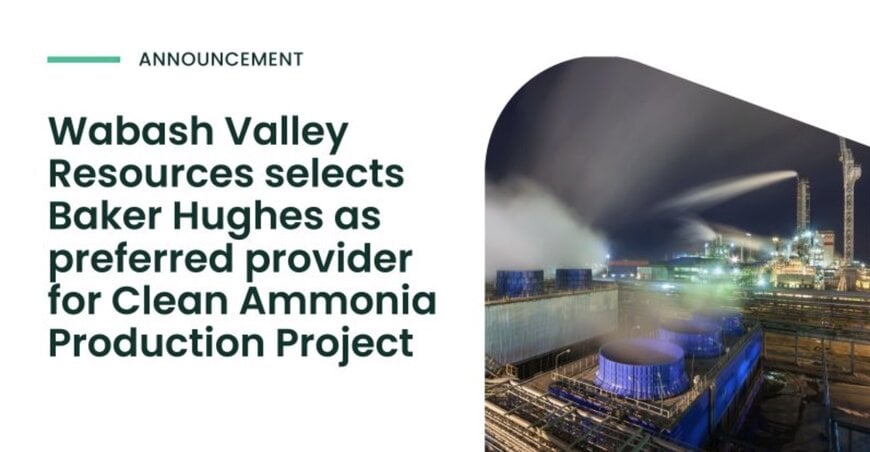
Baker Hughes has been awarded contracts to supply compression and subsurface solutions for a low-carbon ammonia fertilizer project in Indiana, supporting hydrogen production, CO₂ separation, and permanent sequestration within an integrated clean ammonia value chain.
Project scope and industrial context
The project is located in West Terre Haute, Indiana, where an existing gasification facility is being repurposed into a clean ammonia production plant. Once operational, the facility is designed to produce approximately 500,000 tons of ammonia per year while capturing about 1.67 million tons of CO₂ annually. The captured CO₂ will be permanently sequestered, positioning the project among the first large-scale low-carbon ammonia fertilizer plants in the United States.
The development targets the U.S. Corn Belt and broader agricultural market, where fertilizer availability and price stability are closely linked to domestic production capacity and energy inputs.
Technology awards across the ammonia value chain
Under the announced awards, Baker Hughes will supply several critical systems spanning multiple stages of the process. This includes compression equipment for a hydrogen purification system supplied by Honeywell UOP, supporting the hydrogen stream required for ammonia synthesis.
In addition, Baker Hughes will provide compressors for ammonia and syngas processing under a separate contract with another customer involved in the project. These systems are designed to operate under continuous, high-duty industrial conditions typical of large-scale ammonia production.
For carbon management, Baker Hughes will also deliver CO₂ injection pumps intended for permanent geological storage. These pumps are a key component in ensuring that captured CO₂ can be transported and injected at the pressures and flow rates required for long-term sequestration.
Integration of hydrogen, ammonia, and CO₂ handling
Low-carbon ammonia production relies on tight integration between hydrogen generation, synthesis gas handling, and carbon capture systems. Compression plays a central role in maintaining process efficiency across these interfaces, from hydrogen purification through ammonia synthesis and downstream CO₂ transport.
By supplying equipment across multiple process steps, Baker Hughes supports an integrated approach that reduces interface risk and helps maintain predictable operating performance. This is particularly relevant for projects converting existing assets, where new low-carbon processes must be engineered around legacy infrastructure.
Announcement and timeline context
The awards were announced during the 2026 Baker Hughes Annual Meeting, held in Florence, Italy. While construction and commissioning timelines were not disclosed, the selection of equipment suppliers represents a key milestone in moving the project from development toward execution.
Application perspective
Low-carbon ammonia is increasingly viewed as a strategic input for agriculture, combining fertilizer production with carbon management to address both food security and emissions reduction. Projects such as the Wabash Valley facility illustrate how repurposing existing industrial sites, combined with integrated hydrogen and carbon capture technologies, can accelerate deployment.
For equipment suppliers, participation across hydrogen, ammonia, and CO₂ systems reflects the growing convergence of energy, chemicals, and carbon management within the emerging low-carbon industrial landscape.
www.bakerhughes.com
-2296-71282-204124.png)