
www.magazine-industry-usa.com
22
'26
Written on Modified on
Parker updates PSD servo drives with new control modes
Software adds torque/force regulation, multi-axis gearing functions for cut-on-fly motion, and diagnostics for faster commissioning and condition monitoring.
www.parker.com
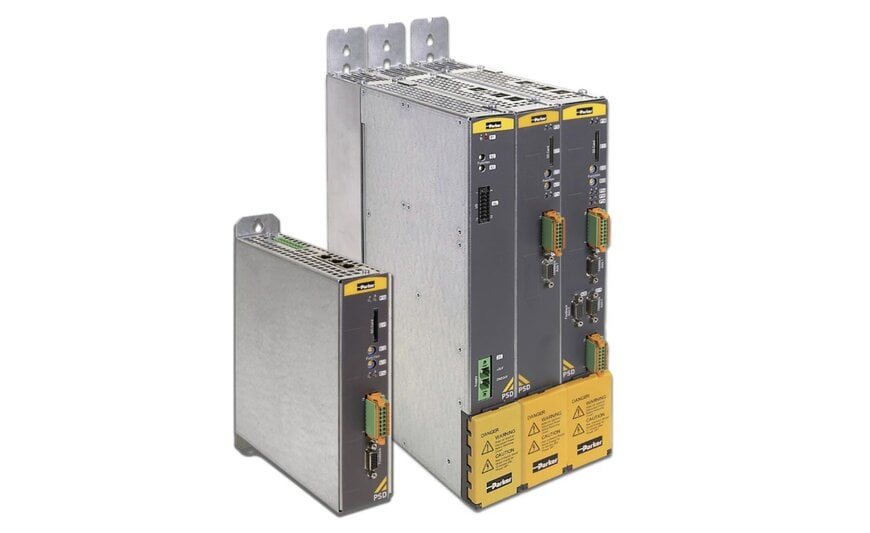
Servo drives are increasingly expected to handle more application logic at the edge—supporting precision force tasks, dynamic synchronization, and faster troubleshooting without external controllers or test tools. In this context, Parker Hannifin has released a major software update for its PSD servo drive family focused on “Intelligent Drive.”
Torque and force control built for pressing and winding
The software update introduces dedicated Torque Control and Force Control modes aimed at push, press, and winding applications where applied torque or force must be tightly regulated.
Open-loop Torque Control is designed to dynamically switch between current (torque) control and position control using measured feedback. The goal is to maintain torque-based behavior where needed while retaining positional control when required by the motion sequence.
Force Control uses a sensor input to enable closed-loop force regulation, targeting applications that need consistent force application such as press-to-fit operations, forming, and sensitive assembly steps.
New gearing functions for continuous motion machines
For dynamic multi-axis applications such as continuous handling and “cut-on-fly,” Parker adds new synchronization and gearing functions intended to reduce mechanical compromises while improving timing accuracy.
The GearInPos function synchronizes a secondary axis to a primary axis with positional alignment, with the goal of reaching the commanded speed precisely at the synchronization point. This is positioned for use cases like cutting and indexing where timing and phase alignment determine output quality.
The MoveSuperImposed function enables a relative movement overlay on an axis that is already moving. This supports compensatory or corrective position adjustments during continuous operation, allowing motion strategies where fine corrections are applied without stopping the main move profile.
Observers and notch filtering target stability and efficiency
The release includes performance and control improvements aimed at disturbance rejection and stable operation under changing loads. Parker highlights additions such as speed and load-torque observers and integrated notch filtering.
These functions typically support higher motion stability by estimating load behavior and suppressing resonant frequencies, which can reduce oscillations and improve usable bandwidth in servo tuning. In system terms, this can translate to tighter control, less overshoot, and more efficient energy use during transient events.
PSD Servo Manager adds multi-axis commissioning tools
On the engineering side, PSD Servo Manager adds features to speed up commissioning and tuning for machines with multiple drives.
A new multi-axis tool is intended to streamline coordinated configuration and motion setup across several drives. The software also adds an integrated signal analyzer that supports onboard frequency response measurements, reducing reliance on external instruments during tuning and validation.
Codesys network variables support machine-level data exchange
The update introduces support for Codesys network variables, enabling structured data exchange with other devices in the machine network. This is positioned for integration use cases such as condition monitoring, where drives share runtime variables for diagnostics, performance tracking, or maintenance-oriented monitoring.
Modular DC bus architecture remains a core PSD feature
Parker’s PSD platform is built around a modular multi-axis architecture with a central mains module and one-, two-, or three-axis modules that share a DC bus. This supports consolidated power distribution across axes while reducing redundant power hardware in multi-axis systems.
For smaller machines, Parker also offers a single-axis stand-alone version with the same functional capabilities. Installation and service features mentioned for the platform include fast wiring, a standard one-cable feedback solution, reduced cabling, and an integrated SD memory card to speed device replacement and configuration handling.
www.parker.com
-2296-71282-204124.png)