
Infrared heaters support thermal control in aircraft hangars
Marley Engineered Products expands its infrared heater portfolio to address efficiency, spatial constraints, and operational stability in aircraft maintenance and storage facilities.
www.marleymep.com
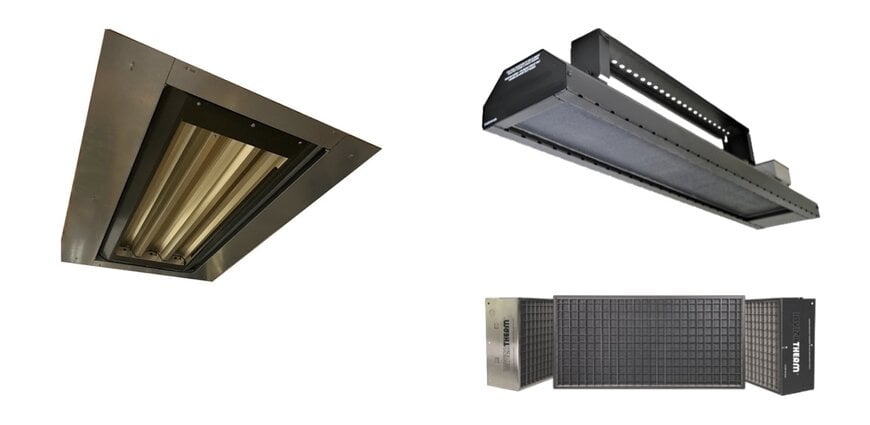
Marley Engineered Products has highlighted its range of infrared radiant heaters designed for aircraft hangars and aerospace maintenance environments, where large volumes, intermittent occupancy, and open-door conditions make conventional space heating inefficient. The product portfolio targets precise zone heating, reduced energy losses, and low-maintenance operation in technically demanding facilities.
Heating requirements in aircraft hangars
Aircraft hangars present specific thermal challenges due to high ceilings, large doors, and the need to maintain clear floor space and sight lines. Heating solutions must provide localized warmth for personnel and equipment without heating unnecessary air volume or interfering with maintenance operations.
Infrared radiant heating addresses these constraints by transferring heat directly to surfaces, equipment, and occupants rather than relying on air circulation. This approach improves thermal efficiency and reduces warm-up times in intermittently used spaces.
Infrared radiant heater design and integration
Marley’s infrared heaters are designed for flexible installation, including wall-mounted, ceiling-mounted, and recessed configurations. The ability to integrate heaters into structural elements allows facilities to preserve usable space and maintain clear overhead areas for aircraft movement and maintenance equipment.
The heaters operate without fans or moving parts, enabling silent operation suited to precision maintenance environments. Because infrared heat is delivered instantly, the systems do not require extended preheating periods, supporting on-demand use during maintenance windows.
Thermazone series for maintenance environments
The Thermazone series provides electric infrared heating without combustion, ventilation, or exhaust requirements. Heat is generated without flames, gases, or by-products, supporting indoor air quality and simplifying compliance in enclosed hangar environments.
The absence of bulbs, fans, or mechanical components contributes to low maintenance requirements and consistent performance over time. A thinner-profile variant, Thermazone Thin®, is designed for applications with tighter spatial constraints, offering higher heat output per surface area while maintaining a low visual profile.
FRP and FRS infrared heaters for large zones
For applications requiring broader coverage or higher output, Marley offers FRP and FRS infrared heaters. These units are suitable for spot heating, perimeter zones near hangar doors, and outdoor or semi-enclosed areas where convective heat losses are significant.
These heaters can be fully recessed into ceilings using listed trim kits, reducing visual impact and protecting performance from drafts or air movement. This configuration supports uniform heating in areas exposed to wind or frequent door operation.
Controls, efficiency, and durability
The infrared heating systems are compatible with zoned control solutions, including contactor panels, solid-state relay panels, and app-based interfaces. These controls allow operators to manage heating precisely based on occupancy, task zones, and operating schedules.
Electric infrared heating operates without on-site emissions and achieves efficiencies ranging from the mid-80% to high-90% range, depending on model and installation. The heaters are constructed from industrial-grade materials designed to withstand the environmental conditions typical of aerospace maintenance facilities.
By combining targeted heat delivery, installation flexibility, and low operational overhead, Marley Engineered Products’ infrared heaters provide a technical solution tailored to the thermal management requirements of modern aircraft hangars.
www.marleymep.com
-2296-71282-204124.png)