
www.magazine-industry-usa.com
04
'26
Written on Modified on
Intelligent Motor Management Systems for Legacy Infrastructure Modernization
Distributed by RS, the new Schneider Electric modular diagnostic platform transitions aging industrial motor setups from reactive troubleshooting to predictive maintenance workflows.
www.rs-online.com
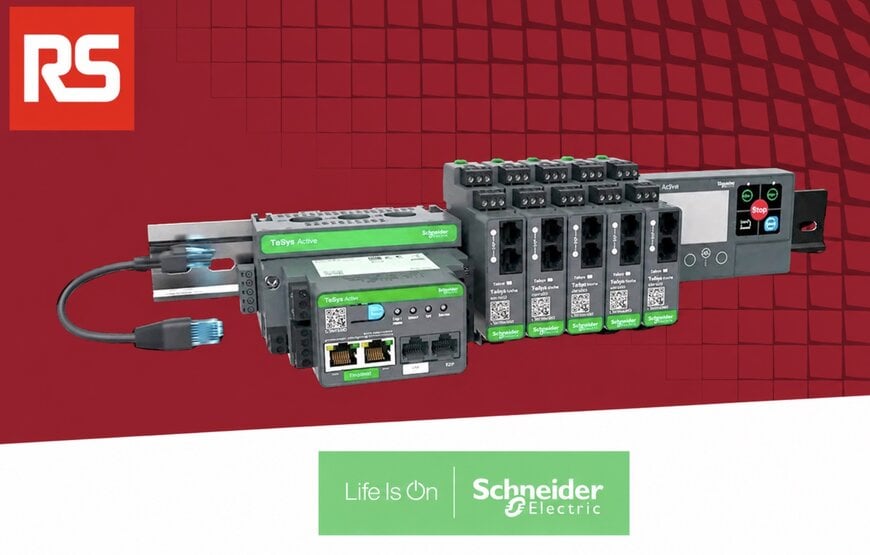
Schneider Electric, in partnership with industrial solutions provider RS, is releasing the TeSys Tera intelligent motor management system to add continuous digital visibility to legacy pumps, fans, and motor drives. This architecture specifically targets infrastructure modernization within continuous process facilities and heavy-duty applications across the oil and gas, mining, chemical, pharmaceutical, water, and discrete manufacturing sectors.
Addressing Infrastructure Aging and Motor Energy Consumption
Over half of U.S. industrial plants operate with infrastructure aged between 30 and 60 years. In these facilities, electric motor systems account for 36 to 86 percent of overall electricity usage. Unplanned motor failures present significant financial risks, with manufacturing downtime averaging $260,000 per hour. The TeSys Tera system addresses these metrics by replacing conventional hardwired electromechanical starters with connected control nodes, establishing a direct link to the broader industrial automation ecosystem. This implementation allows operators to target a 30 to 50 percent reduction in unplanned downtime and up to a 20 percent decrease in power consumption.
Technical Capabilities and Predictive Diagnostics
Designed for AC induction motors drawing up to 810A, the system monitors real-time voltage, current, power factor, and thermal capacity. It incorporates fault protection mechanisms to prevent damage from ground faults, phase loss, and stalled or locked rotors. Intelligent algorithms facilitate predictive pre-trip alarming, detecting operational anomalies before equipment failure occurs and allowing for maintenance scheduling during planned service windows. Furthermore, the system supports process continuity by automatically restoring equipment operation following power interruptions and trimming non-essential motor usage during peak demand periods to preserve power quality.
Modular Integration and Edge Architecture
The modular design physically isolates power and control functions, allowing integration into standalone control cabinets and intelligent motor control center (iMCC) panel buckets without requiring full infrastructure replacement. To avoid proprietary vendor lock-in, the system supports native connectivity across multiple network protocols, including EtherNet/IP, Modbus TCP/IP, Modbus Serial, PROFIBUS, and PROFINET, while pairing with SoMove software for open PLC integration. George Nellikunnel, Offer Manager at Schneider Electric, noted that the platform functions as a translation layer between physical equipment and digital software networks, converting raw electrical currents into actionable edge diagnostics to verify conditions remotely and streamline technician dispatch.
Additional Context
This section details technical specifications and competitive benchmarking not included in the original news release.
In the intelligent motor management sector, the Schneider Electric TeSys Tera competes with established modular platforms such as the Siemens SIMOCODE pro and the Rockwell Automation E300 Electronic Overload Relay. All three architectures provide advanced motor protection, diagnostics, and fieldbus connectivity for low-voltage motors. The SIMOCODE pro is heavily optimized for integration into the Siemens TIA (Totally Integrated Automation) portal via PROFIBUS/PROFINET, while the Rockwell E300 is engineered primarily for seamless integration within Rockwell’s Studio 5000 environment using EtherNet/IP. TeSys Tera differentiates itself by maintaining native, built-in support for a wide array of competing protocols—including both PROFINET and EtherNet/IP alongside Modbus—positioning it as a highly agnostic retrofit solution optimized for mixed-vendor legacy plant environments where consolidating the digital supply chain across multiple PLC brands is necessary.
Edited by Aishwarya Mambet, Induportals Editor, with AI assistance.
www.rs-online.com
