
www.magazine-industry-usa.com
30
'26
Written on Modified on
Siemens Launches Microgrid Integrated Switchboard
New packaged, pre-engineered solution combines power distribution, protection, automation, and intelligent microgrid control in a single platform.
www.siemens.com
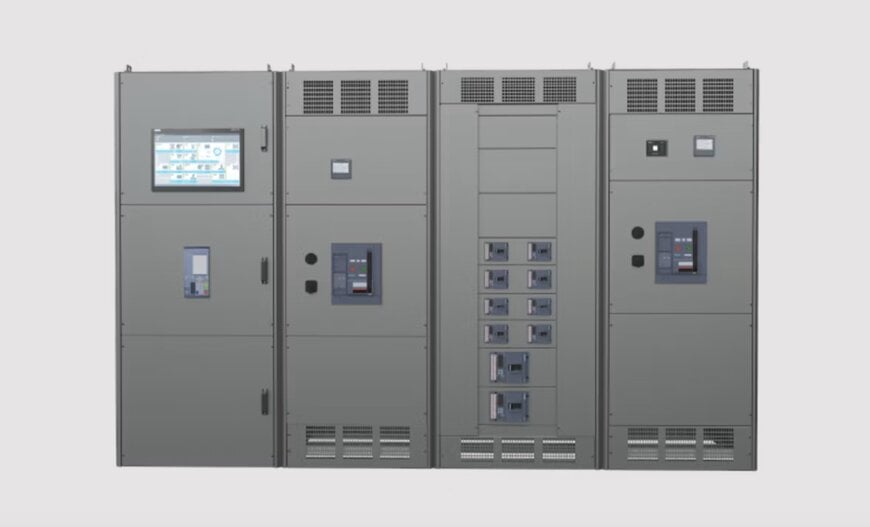
Industrial plants, commercial complexes, and mission-critical facilities are facing mounting grid reliability challenges, volatile electricity tariffs, and stringent corporate decarbonization mandates. While incorporating distributed energy resources (DERs)—such as solar photovoltaic arrays, battery energy storage systems, and backup reciprocating generators—strengthens localized energy security, traditional microgrid implementations remain complex and fragmented. Historically, deploying a microgrid required sourcing low-voltage switchboards, standalone programmable automation controllers, third-party energy management systems, and discrete protective relays from disparate vendors. This piecemeal methodology often introduces protracted on-site engineering, complex field wiring, software integration delays, and prolonged commissioning schedules that escalate project risk. Overcoming these deployment hurdles requires modular, factory-assembled distribution equipment that embeds certified microgrid control logic and cybersecure communications directly into standardized switchboard lineups.
Pre-Engineered Microgrid Control and Seamless Islanding
To streamline energy resilience infrastructure across the United States, Siemens launched its packaged, pre-engineered Microgrid Integrated Switchboard (MIS) solution. The platform consolidates electrical power distribution, overcurrent protection, system automation, and intelligent microgrid control into a standardized, factory-integrated assembly.
The system's control architecture is driven by the Siemens SICAM A8000 microgrid automation engine, designed to monitor, regulate, and optimize diverse power sources. The platform coordinates utility interconnections, onsite generation, battery energy storage systems, and solar photovoltaic systems through an open, vendor-agnostic framework. This open architecture allows facility managers to integrate generation and storage hardware from multiple manufacturers to meet operational parameters without hardware lock-in. During utility disturbances, voltage sags, or catastrophic feeder failures, the switchboard automatically executes fast transitions between grid-tied and islanded operating states, maintaining power continuity across critical loads.
Turnkey Commissioning, Cybersecurity, and Market Applications
By shifting control engineering, internal wiring, and protection testing from the jobsite into a controlled factory environment, the solution reduces on-site integration timelines and project execution risks. The switchboard integrates system-level cybersecurity safeguards, incorporating role-based access control, encrypted communication protocols, and dedicated network security capabilities to protect operational technology networks against unauthorized access.
Jonathan Hill, President of Electrification and Automation at Siemens Smart Infrastructure USA, noted that energy resilience has evolved into an essential operational requirement for commercial and institutional organizations. Hill stated that combining microgrid intelligence with standardized distribution hardware provides operators with a simpler path to deploy microgrids faster, reduce engineering complexity, and operate with greater confidence.
Target deployments for the platform span diverse facility types, including:
- Data centers and high-density computing infrastructure requiring continuous uptime.
- Healthcare campuses and hospitals subject to emergency power supply mandates.
- Commercial office facilities and higher education institutions seeking tariff optimization and demand-charge reduction.
- Advanced manufacturing sites, municipal utilities, and government facilities requiring long-duration operational flexibility.
Additional Context
This section details technical specifications and competitive benchmarking not included in the original product announcement.
In North American low-voltage distribution and microgrid standards, equipment configurations must comply with UL 891 (Standard for Switchboards) and UL 3141 (Outline of Investigation for Distributed Energy Resource Power Control Systems), alongside interconnection requirements defined by IEEE 1547 and IEEE 2030.7 for microgrid control systems. Siemens packages the MIS solution in both indoor NEMA 1 and outdoor NEMA 3R walk-in enclosures, supporting bus ratings typically ranging from 1,200 amperes to 5,000 amperes at 480 volts alternating current. Local site monitoring is delivered via an integrated twenty-two-inch color industrial touchscreen human-machine interface (HMI), while power protection is handled by Siemens SIPROTEC protective relays. The SICAM A8000 automation unit natively processes industry-standard protocols including Modbus TCP, DNP3, and IEC 61850, executing high-speed automated black-start sequences, load shedding, and real-time generation balancing within cycles to prevent voltage collapse during intentional or unintentional islanding.
Within the packaged microgrid and intelligent electrical switchboard sector, Siemens' MIS platform benchmarks against integrated low-voltage architectures from Schneider Electric (EcoStruxure Microgrid Flex and QED-2 switchboards), Eaton (Microgrid Energy System powered by Power Xpert Energy Optimizer), and ABB (MNS-Up and Ability e-mesh). While competitors frequently require external secondary automation panels or third-party engineering consultancies to program specialized programmable logic controllers (PLCs) on site, Siemens integrates the utility-grade SICAM microgrid algorithms and SIPROTEC trip units into the distribution lineup prior to factory testing. This factory-validated approach shortens utility interconnection approval timelines and provides industrial facilities with a turnkey electrical package compliant with evolving Power Control System standards.
Edited by Romila DSilva, Induportals Editor, with AI assistance.
