
www.magazine-industry-usa.com
15
'26
Written on Modified on
Needle-Punched Nonwoven Systems for High-Performance Industrial Filtration Media
ANDRITZ has received an order from Shandong Huazhe to supply a high-speed needle-punched nonwoven production line for PTFE filter media.
www.andritz.com
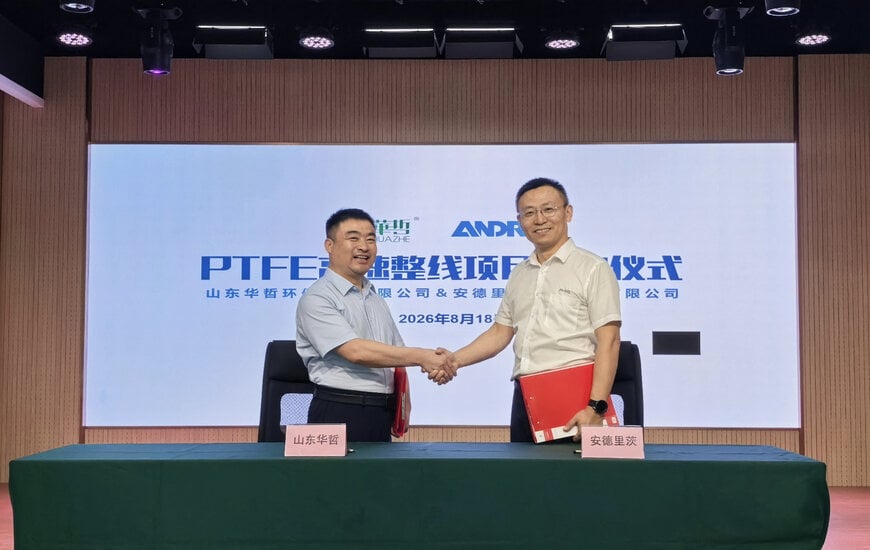
Industrial solid-liquid separation and aggressive flue gas filtration require resilient technical nonwovens capable of withstanding extreme thermal, mechanical, and chemical stresses. To meet stringent emission thresholds and expanding industrial demand, Chinese filtration specialist Shandong Huazhe Environmental Protection Technology Co., Ltd. has commissioned international technology group ANDRITZ to supply a complete high-speed needle-punched nonwoven production system at its headquarters in Jinan, Shandong province.
Engineering Mechanisms for PTFE Fiber Consolidation
Polytetrafluoroethylene (PTFE) fibers are widely utilized in heavy industrial dedusting due to their chemical inertness across the entire pH spectrum and continuous thermal resistance exceeding 250 degrees Celsius. However, processing PTFE through mechanical needle-punching presents complex engineering challenges. The fluoropolymer possesses an exceptionally low friction coefficient, high slip characteristics, and unique tensile elongation behavior, which can lead to fiber damage, poor web cohesion, and non-uniform mass distribution under aggressive mechanical needling.
The nonwoven processing line delivered by ANDRITZ utilizes gentle fiber-opening and precision web-forming mechanisms to process delicate fluoropolymer filaments without fibrillating or breaking the fibers. The mechanical consolidation sequence mechanically interlocks the staple fibers through controlled vertical penetration strokes, establishing a uniform microporous three-dimensional structure necessary to achieve deep-bed particulate capture without inducing high baseline pressure drop across the filter medium.
Kinematic Features of the A-Type Needleloom
The installation represents the initial commercial deployment of the ANDRITZ neXloom A-Type needleloom, engineered specifically for technical nonwoven fabrics and demanding filtration applications. The machine configuration combines cost-efficient production mechanics with high process flexibility across variable needling densities.
A defining mechanical feature of the system is the integration of a random needle pattern board configuration. In conventional needlelooms, repetitive linear needle arrangements can induce continuous longitudinal track marks or localized density variations, creating bypass channels for ultrafine particulate matter. By distributing needle penetrations across an engineered non-linear pattern, the loom eliminates striations, generating an isotropic web with homogeneous air permeability and uniform tensile strength across both machine and cross directions.
The plant order was booked in the third quarter of 2026, with system commissioning and site delivery scheduled for the first quarter of 2027. This project expands on the technical cooperation established between the companies in 2023, which involved the supply of an ANDRITZ web-forming system delivered in 2024.
Industrial Applications in Flue Gas and Liquid Separation
Shandong Huazhe will deploy the new line to expand manufacturing capacity for industrial dust collection bags, cage-supported filter sleeves, and solid-liquid separation media. High-density PTFE needle felts are primarily installed in the baghouses of coal-fired power plants, municipal waste-to-energy incineration facilities, metallurgical smelting operations, and cement kilns.
In these operating environments, filter media endure continuous exposure to acidic flue gas constituents, including sulfur oxides, nitrogen oxides, and hydrogen chloride, alongside high moisture levels and temperature cycles up to 260 degrees Celsius. The dimensional stability and surface uniformity achieved through high-speed needle consolidation ensure that subsequent finishing processes, such as thermal calendering and PTFE microporous membrane lamination, can attain particulate capture efficiencies surpassing 99.99 percent to comply with ultra-low industrial emission standards.
Additional Context:
This section details technical specifications and competitive benchmarking not included in the original product announcement.
In industrial filtration felt manufacturing, needle-punching machinery benchmarks are established primarily by mechanical stroke frequency, linear line speed, needle board layout geometry, and web draft control. Traditional needlelooms across the nonwovens sector, including the DiloGroup DiloLines (incorporating DI-LOOM series machines with elliptical or circular stroke kinematics) and Autefa Solutions Stylus needlelooms, compete directly in the production of high-density technical felts.
A critical benchmark in PTFE filter felt production is needle penetration density and mechanical stroke velocity. PTFE felts typically demand finished area weights ranging from 450 to 800 grams per square meter, consolidated through multiple passes to achieve controlled air permeability between 30 and 80 liters per square meter per second at a 200 Pascal test pressure. While standard industrial needlelooms can operate at stroke frequencies exceeding 2,000 strokes per minute for synthetic polymers such as polyester or polypropylene, the processing of 100 percent PTFE staple fibers requires constrained stroke rates and optimized barb geometries on the felting needles to avoid frictional heating and thermal filament fusion.
The neXloom A-Type operates within ANDRITZ's broader needleloom architecture alongside heavy-duty industrial platforms such as the neXline eXcelle and aXcess ranges. Benchmarking in this mid-to-high capacity category focuses on balancing energy consumption, needle board changeover times, and random punching geometry to prevent laminar delamination under repeated pulse-jet reverse air cleaning cycles in industrial baghouses. Compliance requirements for industrial filtration media increasingly reference standard ISO 16890 for particulate air filter testing and EN 13284 for stationary source emissions, where the isotropic density profile imparted by random needling directly influences secondary emission capture and filter cake release.
Edited by Natania Lyngdoh, Induportals editor, with AI assistance.
www.andritz.com
-2296-71282-204124.png)