
www.magazine-industry-usa.com
09
'26
Written on Modified on
Turnkey Touch Controllers with Parallel Sensing
Microchip's MTCH3380P and MTCH3240P controllers enable fast touch acquisition and robust performance for complex interfaces, including display-free applications.
www.microchip.com
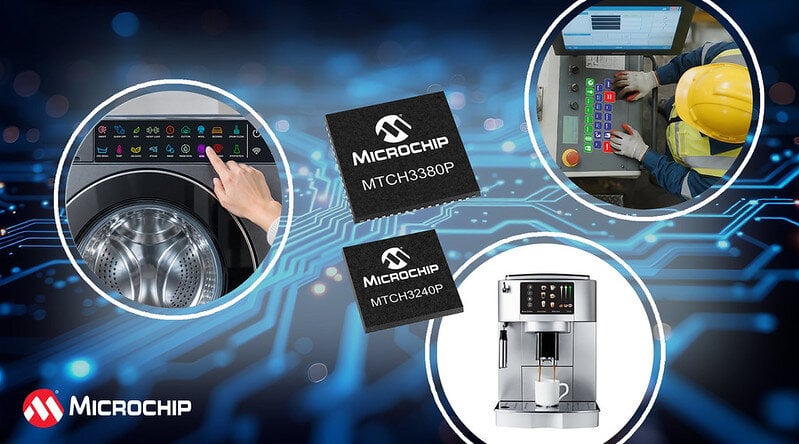
Microchip Technology has expanded its turnkey capacitive-touch portfolio with the introduction of the MTCH3380P and MTCH3240P controllers. The devices are engineered to help appliance and equipment manufacturers deploy display-free Human Machine Interfaces (HMIs)—such as illuminated capacitive-touch buttons, sliders, and wheels—at reduced system cost and lower design complexity without incurring acquisition-time penalties or signal degradation.
Parallel Sensing Architecture and Channel Capacities
The MTCH3380P and MTCH3240P incorporate parallel sensing architectures driven by 12 on-chip analog-to-digital converters (ADCs) operating concurrently. This simultaneous acquisition maintains fast response rates and a high signal-to-noise ratio (SNR) across high sensor counts in electrically noisy environments. In terms of channel capacity:
- The MTCH3380P supports up to 38 sensors in self-capacitance mode and up to 64 sensors in mutual-capacitance mode.
- The MTCH3240P accommodates up to 24 self-capacitance sensors and up to 32 mutual-capacitance sensors.
These sensing capabilities enable reliable touch detection through thick overlay materials and support operation when users are wearing gloves. The devices withstand operating temperatures up to 105°C, addressing operational requirements for major home appliances—such as ovens, cooktops, refrigerators, and washing machines—as well as outdoor systems including electric vehicle (EV) chargers, parking meters, and interactive kiosks exposed to moisture or cold conditions.
Functional Safety and Ecosystem Support
The controllers support IEC/UL 60730 Class B functional safety certification to assist manufacturers with home appliance regulatory compliance. Development and integration are supported through Microchip’s touch-sensing ecosystem, which includes the mTouch Studio development environment, evaluation hardware, and host software drivers for Linux and Zephyr RTOS.
“Manufacturers are increasingly looking for ways to reduce system cost while still delivering intuitive and visually appealing user interfaces. As display-free HMIs incorporate more touch controls, maintaining responsive and reliable touch performance becomes increasingly challenging,” said Giovanni Fontana, senior director of Microchip’s human machine interface division. “Our MTCH3380P and MTCH3240P controllers address the touch-sensing challenges associated with display-free interfaces by delivering fast touch acquisition and high signal-to-noise ratio, helping enable responsive, reliable operation even in demanding applications.”
Additional Context
This section details technical specifications not included in the original news release.
Capacitive touch controllers employ charge-transfer or sigma-delta conversion topologies to measure minute picofarad (pF) and sub-picofarad capacitance shifts induced by conductive finger proximity. In self-capacitance architectures, parasitic capacitance between individual electrode traces and system ground is measured directly; in mutual-capacitance matrices, drive (Tx) and sense (Rx) electrode intersections isolate localized coupling capacitance, preventing false multi-touch triggers and phantom key actuations. Parallel ADC multiplexing addresses the charge-settling constraints inherent in sequential single-channel scanning, lowering total scan frame periods and mitigating high-frequency electromagnetic interference (EMI).
To satisfy IEC/UL 60730 Class B requirements for automatic electrical controls in household appliances, touch-sensing microcontrollers execute non-interruptible self-diagnostic routines. These encompass dynamic memory integrity checks (March tests for SRAM, cyclic redundancy checks for Flash), clock frequency drift monitoring, register readback verification, and periodic validation of analog references. Noise immunity against conducted radio-frequency disturbances—typically specified under IEC 61000-4-6 test profiles up to 10 Vrms across 150 kHz to 80 MHz—is achieved via frequency hopping, median digital filtering, and differential baseline tracking algorithms implemented directly at the controller firmware layer.
Edited by Romila DSilva, Induportals Editor, with AI assistance.
Functional Safety and Ecosystem Support
The controllers support IEC/UL 60730 Class B functional safety certification to assist manufacturers with home appliance regulatory compliance. Development and integration are supported through Microchip’s touch-sensing ecosystem, which includes the mTouch Studio development environment, evaluation hardware, and host software drivers for Linux and Zephyr RTOS.
“Manufacturers are increasingly looking for ways to reduce system cost while still delivering intuitive and visually appealing user interfaces. As display-free HMIs incorporate more touch controls, maintaining responsive and reliable touch performance becomes increasingly challenging,” said Giovanni Fontana, senior director of Microchip’s human machine interface division. “Our MTCH3380P and MTCH3240P controllers address the touch-sensing challenges associated with display-free interfaces by delivering fast touch acquisition and high signal-to-noise ratio, helping enable responsive, reliable operation even in demanding applications.”
Additional Context
This section details technical specifications not included in the original news release.
Capacitive touch controllers employ charge-transfer or sigma-delta conversion topologies to measure minute picofarad (pF) and sub-picofarad capacitance shifts induced by conductive finger proximity. In self-capacitance architectures, parasitic capacitance between individual electrode traces and system ground is measured directly; in mutual-capacitance matrices, drive (Tx) and sense (Rx) electrode intersections isolate localized coupling capacitance, preventing false multi-touch triggers and phantom key actuations. Parallel ADC multiplexing addresses the charge-settling constraints inherent in sequential single-channel scanning, lowering total scan frame periods and mitigating high-frequency electromagnetic interference (EMI).
To satisfy IEC/UL 60730 Class B requirements for automatic electrical controls in household appliances, touch-sensing microcontrollers execute non-interruptible self-diagnostic routines. These encompass dynamic memory integrity checks (March tests for SRAM, cyclic redundancy checks for Flash), clock frequency drift monitoring, register readback verification, and periodic validation of analog references. Noise immunity against conducted radio-frequency disturbances—typically specified under IEC 61000-4-6 test profiles up to 10 Vrms across 150 kHz to 80 MHz—is achieved via frequency hopping, median digital filtering, and differential baseline tracking algorithms implemented directly at the controller firmware layer.
Edited by Romila DSilva, Induportals Editor, with AI assistance.
