
From Information Silos to Enhanced Value
Artificial intelligence, cloud services and automation are supposed to make engineering more productive. However, for Eplan Vice President Customer Journey Jan Fleming, that is just a part of the challenge.
www.eplan.com

Eplan Next26—launched this May in Munich—was a global engineering event that attracted around 1,500 attendees from 36 countries, offering new products, a Future Lab and a Partner Plaza. Yet apart from its new music festival–like format, with something for everyone, it also provided Jan Fleming with a platform for a bigger message:: “Eplan views itself as the link between the various players in the industry—from component manufacturers to machine and plant-system builders to operators.” And it’s exactly these connections that are set to become increasingly intertwined in the future—not just organizationally, but digitally. The goal is seamless, end-to-end processes, from planning to operations.
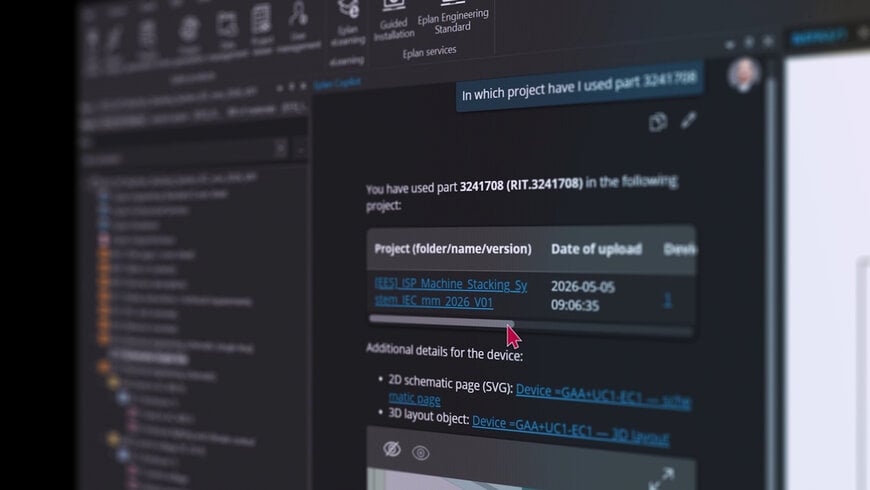
Directly integrated: the intelligent engineering assistant Eplan Copilot makes validated information available more quickly in the Eplan Platform 2027 and provides specific recommendations for action.
Gradually from copilot to pilot
The most visible kickoff was the launch of Eplan Copilot, which brings together engineering knowledge, platform functionality and specific tasks using natural language. For example, if an engineer wants to know in which projects a specific component has been used, they can just simply input the part number. The AI then searches through all the projects stored in the cloud and returns the results. “We want to make it easy for users to quickly get their bearings in the Eplan software and provide them with information and functions exactly when they need them,” says Fleming, describing the company’s approach.
However, Eplan draws a clear line between providing assistance and taking over autonomously. Copilot will initially draw on verified Eplan expertise. In the future, knowledge from partner companies, customers and standards will be incorporated. Fleming: “In engineering, the results must be reproduceable and reliable. For this, the architecture has to be right.” That’s why Copilot doesn’t just work with random information scraped from the internet. “Even a machine that is designed 99 percent correctly still won’t work when it comes down to it.” The vision nonetheless remains ambitious; with a growing foundation of knowledge and additional skills, what is starting as a copilot will gradually mature into an autonomous pilot.

Jan Fleming at the Eplan Next26 in Munich: “Eplan views itself as the link between the various players in the industry—from component manufacturers to machine and plant-system builders to operators.”
The platform becomes a foundation of data
The next stage of development is Eplan Platform 2027, which has been available since the beginning of September. The company reports that around five hundred customer requests were incorporated into the development process. Fleming speaks of “unconditional user-friendliness.” New functions in Eplan Preplanning, Eplan Electric P8 and Eplan Pro Panel are designed to simplify and further automate steps in the planning process, including in preliminary planning and for generating projects in 3D. That’s why Fleming views this version as much more than just a traditional software update. “The core benefit that Eplan provides companies is the ability to scale—that is to say, making the completion of more projects and more variants manageable using the available resources.”
This also includes systematically organizing reutilization. Rule-based project generation can already deliver significant productivity gains at the moment without necessarily requiring the use of AI. “Scaling doesn’t start only with artificial intelligence,” Fleming notes. “When we standardize, reuse and automatically assemble functions, we gain speed and quality, while also addressing the shortage of skilled workers.” Much of this already works in a rules-based manner. “In Eplan, standardized, reusable schematic functions are assembled into project-specific solutions. AI doesn’t play much of a role in this”—yet massive economies of scale are still achieved.
At the same time, data management in the cloud is becoming more important, strategically speaking. Project data, master data and device data can no longer be treated as separate entities. With Eplan Platform 2027, the synchronization of master data and device data via the Eplan Cloud is set to become an even more integral part of the workflow. Fleming: “For us, end-to-end means that data doesn’t stop at the perimeter of a single application.” So the goal is greater than just a more user-friendly interface. The platform will become a consistent and comprehensive foundation of data for subsequent process steps.
At Eplan Next26, the manufacturer Eaton demonstrated how deep this data foundation can extend into downstream processes. In a switchgear system plant in China, the Eplan Platform serves as the backbone for the company’s electrical engineering, where humanoid robots use cameras to inspect wiring and verify that the labeling matches the engineering documentation. Fleming sees this as more than just a spectacular AI use-case: “The robot scans the cabinet, compares the labeling with the schematics and recognizes incorrectly labeled or incorrectly wired connections. This demonstrates the advantages that clean engineering data can deliver, all the way through to quality assurance.”
Standards transform data into a process chain
Eplan Smart Sourcing, which also premiered at the Next26, shows just how well this process can work. The solution connects electrical engineering and procurement: during the planning phase, engineers can check whether required components are available from the manufacturers and distributors connected to the system, and also find out when they can be delivered. Critical parts can be replaced earlier in the process and validated bills of materials can be turned over to the procurement department. Fleming: “Smart Sourcing is a great example of how we’re closing the gap in the end-to-end process. It connects a technical decision made in engineering directly to actual availability in the supply chain.”
Of course, such connections only work when the participating systems speak the same language. That’s why open standards are taking center stage in the Eplan strategy. Fleming: “AI isn’t worth much without clean, standardized data.” The Asset Administration Shell, or AAS, is designed to make data transferable in a structured way regardless of manufacturer. ECLASS Advanced helps provide an important semantic foundation for this. The Industrial Digital Twin Association (IDTA) uses the AAS to define the structure, interfaces and semantics for a standardized digital twin.
This isn’t just about standardization for Eplan. The Data Portal currently contains more than 4 million static and configurable device specifications from more than 550 manufacturers. When such data is available in a standardized format, it can be used, reused and processed automatically not only in the schematics but also across additional process steps. Fleming: “Data can only become a true driver for productivity when it is unambiguous and can be reused without the need for translation or reformatting.” In his view, the cloud, AI and AAS are not separate technology trends but building blocks of the same end-to-end architecture.
Fleming openly admits that the Asset Administration Shell has been under discussion for years. In Germany in particular, he notes, there is a great deal of conceptualization and scientific analysis, yet pragmatic implementation into marketable solutions doesn’t always happen quickly enough. This time, though, he sees an opportunity to achieve the necessary critical mass: “Just committing to a standard won’t get us anywhere. The key question is whether or not we can create solutions that are easy for people to use.” Large industrial companies have to build real-world applications aside from just paying lip service to the AAS.
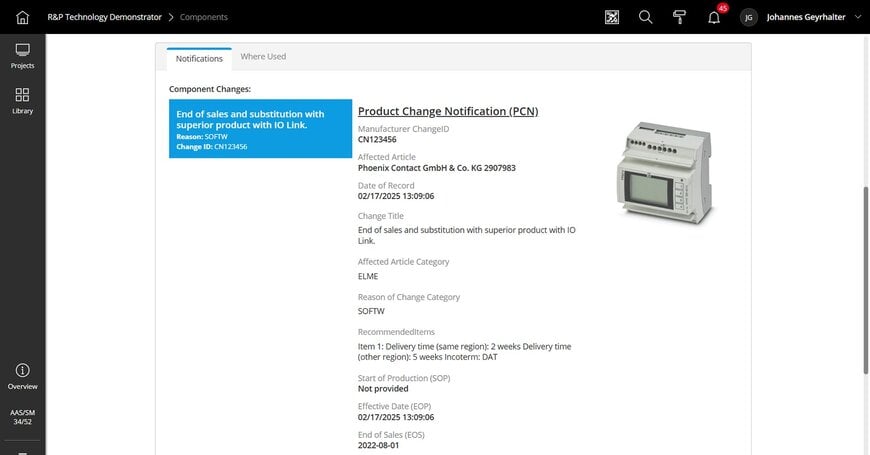
If a manufacturer changes a component, users will automatically be notified on a project-specific basis. Standardized Product Change Notifications allow for further automation of the change management process.
When the change finds the user
Product Change Notification, or PCN, demonstrates how concrete this can be. Describing the problem from the point of view of a component manufacturer, Fleming says: “A component is delivered to a control cabinet manufacturer, the control cabinet is installed into a machine and this is then delivered to the operator. In the end, as the component manufacturer, how do I reach the user of my component when I have no idea where it’s been installed?” From a data perspective, these dots can be connected through the AAS and Eplan Projects.
Eplan and Phoenix Contact have developed a use case for this based on the AAS. If a manufacturer changes a component, discontinues it or releases a safety-relevant update for it, the information can be transmitted in a structured way and processed in the Eplan Data Portal. The engineer receives a notification and can identify the projects or existing systems where the affected item is being used. Fleming: “These are exactly the applications where we see whether a standard creates real added value or not. The information shouldn’t just sit somewhere, unused. It must automatically get to the place where it triggers a decision. At the SPS trade show in November, Eplan and Phoenix Contact will be presenting the new PCN solution. We’re demonstrating that in Germany, we can take a really good idea and establish a pragmatic solution on the market.”
This also changes Eplan’s role, which is increasingly shifting from being the supplier of an engineering platform to that of becoming a key player in a digital ecosystem that connects component manufacturers, machine and plant system builders, control cabinet manufacturers, distributors and operators. What matters most is not just which functions the software offers, but whether the data remains useable across different companies and processes.
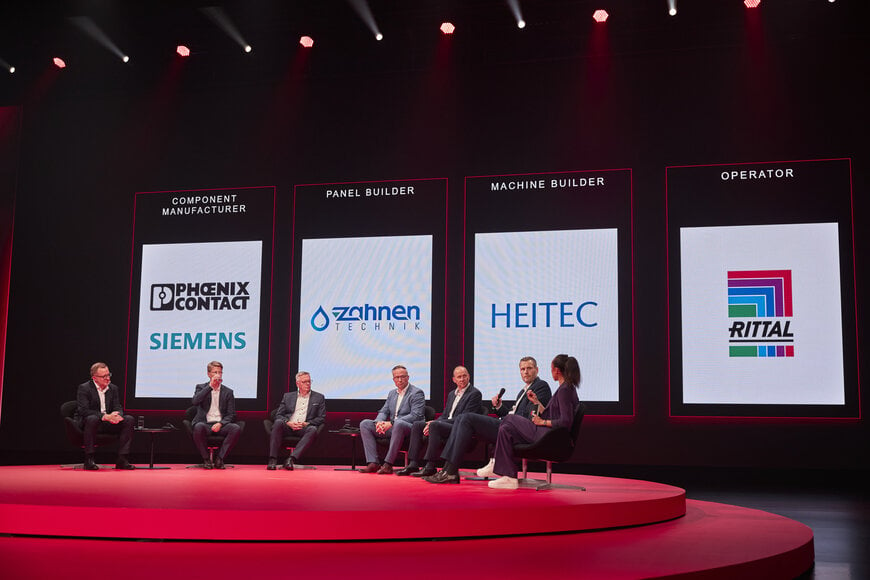
At the Connected Industry panel discussion, it was announced that Eplan is planning a solution that utilizes the Asset Administration Shell. It will be presented with Phoenix Contact at the SPS trade show in November.
Eplan Next27 as proof point
And this is where we come full circle back to Eplan Next. Back in May at the Eplan Next26, during the Connected Industry panel discussion, a commitment was made to develop concrete solutions using the Asset Administration Shell. The SPS trade show will mark the next milestone—Eplan and Phoenix Contact will fulfill that commitment when they present their first solution. The next Eplan Next has been announced for June 9 and 10, 2027 in Cologne. Fleming not only promises additional product innovations and an even larger presence, but, above all, visible progress on data-driven topics: “Eplan Next27 will be a proof point for us. Have we made significant strides with AAS and end-to-end processes—or will we be standing there, one year on, saying we really ought to?”
Fleming sees two lines of development converging here. On the one hand, AI, automation and improved usability are intended to turn users into the “best-possible engineers.” On the other hand, standardized data and open interfaces aim to close the process chain across organizational boundaries. Autonomous engineering wouldn’t be the starting point of this, but rather the end result of a well-structured data and process architecture. Or, as Fleming puts it: “Only when the data is consistent across the board can we truly use artificial intelligence consistently.”
www.eplan.com
Register directly for the Eplan Next27 here: Eplan Next27
Author: Ronald Heinze/ Chief Editor Open Automation, Germany
