
www.magazine-industry-usa.com
18
'26
Written on Modified on
Rockwell Automation Showcases Industrial Technology for Sustainable Action at Climate Week NYC 2026
Connected data, industrial AI and sustainable product design help manufacturers improve energy efficiency, track emissions and advance measurable sustainability goals.
www.rockwellautomation.com
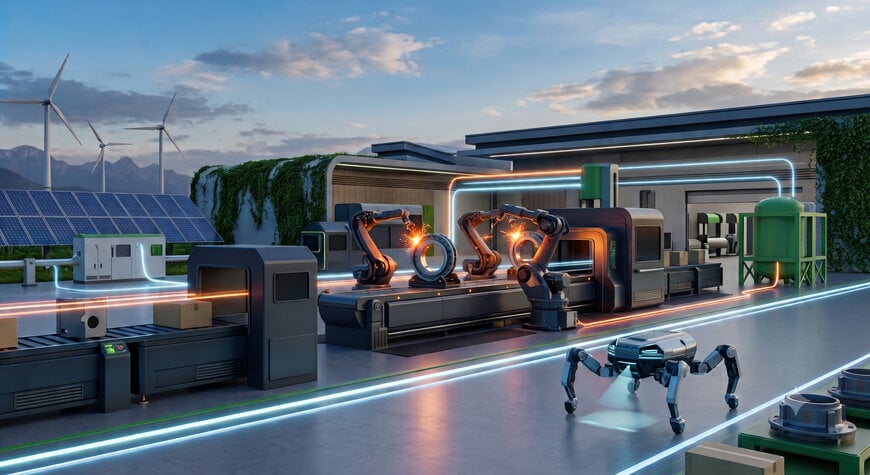
AI Generated Image
Rockwell Automation has announced initiatives to demonstrate how connected operational technologies and machine learning architectures drive industrial energy efficiency and emissions reduction. The software solutions and engineering frameworks target process and discrete manufacturing industries seeking to align productivity targets with sustainability and decarbonization mandates.
Operational Telemetry and Industrial Artificial Intelligence Systems
Modern production facilities encounter increasing regulatory pressure to monitor emissions and mitigate power demand spikes across critical assets. In response, digital infrastructure is shifting from isolated monitoring stations to unified enterprise data ecosystems that calculate environmental impact indicators in real time. The integration of connected operational data enables plant engineers to capture energy consumption patterns at the machine level, identify process anomalies, and implement corrective controls without disrupting line throughput.
To achieve this visibility, specialized analytical engines operate directly within the automation layer. FactoryTalk Analytics LogixAI provides embedded machine learning capabilities that run inside programmable automation controller chassis, monitoring controller tags to detect equipment degradation and thermodynamic inefficiencies without requiring cloud data extraction. Concurrently, generative tools such as FactoryTalk Design Studio Copilot assist automation engineers in generating, modifying, and validating control logic, reducing code deployment cycles and minimizing operational variance across automated cells.
Industrial Decarbonization and Event Presentation
The convergence of predictive modeling and control execution addresses enterprise decarbonization targets by curbing indirect emissions from energy consumption while mitigating raw material waste. By applying predictive algorithms to continuous operations, plants can dynamically adjust power draws, cycle high-energy assets during off-peak periods, and improve overall equipment effectiveness.
These deployment strategies and engineering frameworks will be presented at Climate Week NYC 2026, which takes place in New York from September 20 to 27 under the overarching theme "Energy. Impact. Action." According to Emmanuel Guilhamon, Vice President of Sustainability at Rockwell Automation, unifying connected sensor data, machine-learning analytics, and sustainable product engineering provides industrial organizations with the empirical data required to convert environmental targets into measurable production improvements.
Additional Context:
This section details technical specifications and competitive benchmarking not included in the original product announcement
In the industrial energy management and operational AI sector, Rockwell Automation's architecture centers on controller-integrated edge inference. FactoryTalk Analytics LogixAI executes directly within ControlLogix hardware racks, providing deterministic anomaly detection by analyzing local input and output signals without transmitting sensitive telemetry off premises. This hardware-level approach is paired with FactoryTalk Design Studio Copilot, which incorporates domain-specific generative models into cloud-based engineering environments to generate ladder logic and functional block documentation.
The primary industrial automation benchmarks for this capability include Siemens Xcelerator (incorporating Siemens Industrial Copilot and Energy Manager software) and Schneider Electric EcoStruxure (specifically EcoStruxure Resource Advisor Copilot and Autonomous Production Advisor). Siemens Industrial Copilot, developed in conjunction with Microsoft, integrates with Totally Integrated Automation (TIA) Portal to generate programmable logic controller code and automate SCADA diagnostics, while Siemens Energy Manager measures site-wide carbon intensity across enterprise levels.
Schneider Electric EcoStruxure focuses heavily on enterprise resource accounting and microgrid dispatch, utilizing its EcoStruxure Resource Advisor to aggregate Scope 1, Scope 2, and Scope 3 greenhouse gas data alongside automated peak shaving. While Schneider Electric emphasizes broad multi-facility energy aggregation and Siemens leverages deep integration with digital twin simulation environments, Rockwell Automation distinguishes its deployment by embedding mathematical models directly onto local backplanes, minimizing latency between anomaly detection and controller-level intervention.
Edited by Natania Lyngdoh, Induportals editor, assisted by AI.
www.rockwellautomation.com
Rockwell Automation has announced initiatives to demonstrate how connected operational technologies and machine learning architectures drive industrial energy efficiency and emissions reduction. The software solutions and engineering frameworks target process and discrete manufacturing industries seeking to align productivity targets with sustainability and decarbonization mandates.
Operational Telemetry and Industrial Artificial Intelligence Systems
Modern production facilities encounter increasing regulatory pressure to monitor emissions and mitigate power demand spikes across critical assets. In response, digital infrastructure is shifting from isolated monitoring stations to unified enterprise data ecosystems that calculate environmental impact indicators in real time. The integration of connected operational data enables plant engineers to capture energy consumption patterns at the machine level, identify process anomalies, and implement corrective controls without disrupting line throughput.
To achieve this visibility, specialized analytical engines operate directly within the automation layer. FactoryTalk Analytics LogixAI provides embedded machine learning capabilities that run inside programmable automation controller chassis, monitoring controller tags to detect equipment degradation and thermodynamic inefficiencies without requiring cloud data extraction. Concurrently, generative tools such as FactoryTalk Design Studio Copilot assist automation engineers in generating, modifying, and validating control logic, reducing code deployment cycles and minimizing operational variance across automated cells.
Industrial Decarbonization and Event Presentation
The convergence of predictive modeling and control execution addresses enterprise decarbonization targets by curbing indirect emissions from energy consumption while mitigating raw material waste. By applying predictive algorithms to continuous operations, plants can dynamically adjust power draws, cycle high-energy assets during off-peak periods, and improve overall equipment effectiveness.
These deployment strategies and engineering frameworks will be presented at Climate Week NYC 2026, which takes place in New York from September 20 to 27 under the overarching theme "Energy. Impact. Action." According to Emmanuel Guilhamon, Vice President of Sustainability at Rockwell Automation, unifying connected sensor data, machine-learning analytics, and sustainable product engineering provides industrial organizations with the empirical data required to convert environmental targets into measurable production improvements.
Additional Context:
This section details technical specifications and competitive benchmarking not included in the original product announcement
In the industrial energy management and operational AI sector, Rockwell Automation's architecture centers on controller-integrated edge inference. FactoryTalk Analytics LogixAI executes directly within ControlLogix hardware racks, providing deterministic anomaly detection by analyzing local input and output signals without transmitting sensitive telemetry off premises. This hardware-level approach is paired with FactoryTalk Design Studio Copilot, which incorporates domain-specific generative models into cloud-based engineering environments to generate ladder logic and functional block documentation.
The primary industrial automation benchmarks for this capability include Siemens Xcelerator (incorporating Siemens Industrial Copilot and Energy Manager software) and Schneider Electric EcoStruxure (specifically EcoStruxure Resource Advisor Copilot and Autonomous Production Advisor). Siemens Industrial Copilot, developed in conjunction with Microsoft, integrates with Totally Integrated Automation (TIA) Portal to generate programmable logic controller code and automate SCADA diagnostics, while Siemens Energy Manager measures site-wide carbon intensity across enterprise levels.
Schneider Electric EcoStruxure focuses heavily on enterprise resource accounting and microgrid dispatch, utilizing its EcoStruxure Resource Advisor to aggregate Scope 1, Scope 2, and Scope 3 greenhouse gas data alongside automated peak shaving. While Schneider Electric emphasizes broad multi-facility energy aggregation and Siemens leverages deep integration with digital twin simulation environments, Rockwell Automation distinguishes its deployment by embedding mathematical models directly onto local backplanes, minimizing latency between anomaly detection and controller-level intervention.
Edited by Natania Lyngdoh, Induportals editor, assisted by AI.
www.rockwellautomation.com
