
www.magazine-industry-usa.com
10
'26
Written on Modified on
Siemens & Battery-NY Build Digitalized Pilot Factory for U.S. Battery Manufacturing
Standardized automation, data architecture and Digital Twin capabilities aim to connect research with scalable production while reducing integration complexity and scale-up risks.
www.siemens.com
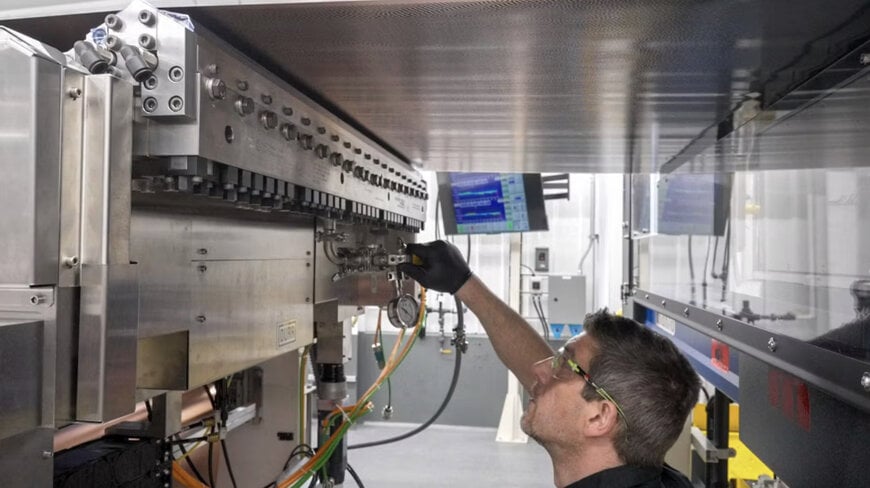
Battery-NY and Siemens are collaborating to implement a unified automation and digital manufacturing architecture within an advanced battery prototyping facility. The initiative establishes a standardized industrial data foundation across the energy storage sector to enable flexible cell development and accelerate commercial production scaling.
Operational Challenge and Integration Requirements
Industrial battery manufacturing scale-up involves integrating machinery from diverse specialized equipment builders. Disparate control protocols and fragmented data formats across separate production stages typically generate costly custom integrations, inconsistent quality tracking, and extended commissioning periods. To resolve these operational constraints, the Binghamton University-led Battery-NY initiative requires a standardized industrial automation structure to link multi-vendor equipment into a cohesive production environment.
Unified Automation and Data Architecture
Siemens provides the operational technology and information technology (IT/OT) architecture based on the Siemens Battery Automation Framework. This modular toolbox establishes uniform equipment interfaces and standardized control principles across core production stages, including mixing, coating, calendaring, slitting, cell assembly, formation, and cycling. Siemens Foundational Technologies supplies the industrial data roadmap to support Digital Twin simulation, AI-driven analytics, and software-defined automation. Battery-NY implements these controls across its primary equipment landscape to enable material genealogy, automated track-and-trace functions, and centralized operational dashboards.
Pilot Deployment and Industrial Validation
The architecture is deployed at the flexible battery development and pilot production facility in upstate New York, supported by the U.S. Economic Development Administration and Empire State Development. The facility provides an industrially relevant testing environment where academic researchers, equipment suppliers, and commercial manufacturers evaluate new cell chemistries and manufacturing workflows under repeatable operating conditions. Standardizing machine interfaces before hardware commissioning eliminates proprietary integration bottlenecks and mitigates scaling risks.
"The collaboration focuses on validating research outcomes in a production-oriented environment, reducing scale-up risk and creating a data-driven foundation for future industrial deployment," stated Dr. Sudhir Rajagopalan, Research and Development Project Manager at Siemens Foundational Technologies.
Edited by Natania Lyngdoh, Induportals editor, assisted by AI.
www.siemens.com
-2296-71282-204124.png)