
www.magazine-industry-usa.com
03
'26
Written on Modified on
Renishaw introduces 5-axis touch-trigger system with 300 mm inspection reach
The new PH20 PLUS system builds on the proven measurement capabilities of the PH20, enabling high-speed touch-trigger measurement across a wider range of applications.
www.renishaw.com
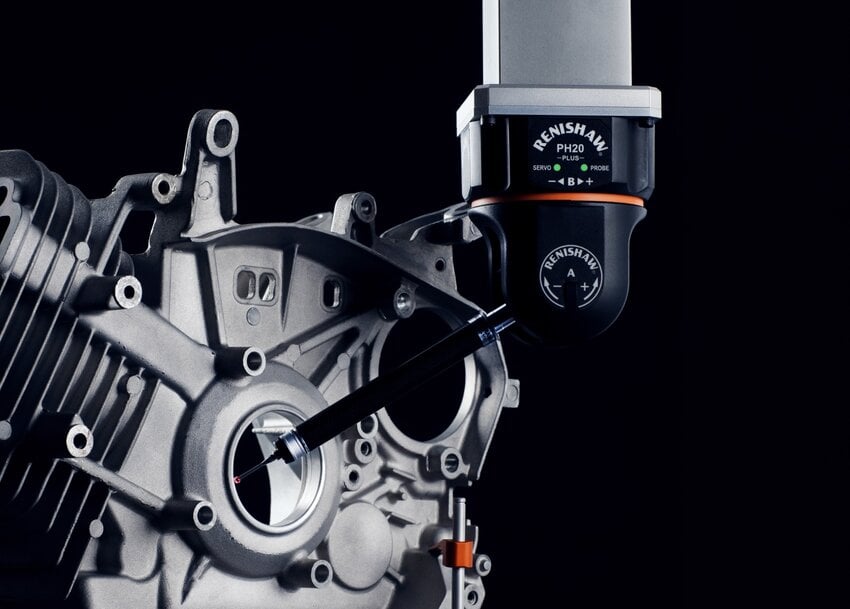
Renishaw announced the launch of the PH20 PLUS, the next generation of its established 5-axis touch-trigger probe head. Developed as a direct replacement for the PH20 introduced in 2010, the system incorporates the 5-axis motion control technology originally developed for the REVO® measurement system. By taking measurement points using rapid head rotary motion instead of accelerating the mass of the entire CMM bridge and quill, the PH20 PLUS minimizes dynamic machine errors, eliminates head-indexing downtime, and optimizes throughput.
Increased reach and improved capability
The redesigned A-axis features a new kinematic mount that supports a wider range of probe module extensions. This enables the PH20 PLUS head to use longer and heavier probe configurations giving users improved access to features deep inside parts and in hard-to-reach areas. The result is an additional 107 mm of reach, significantly increasing the accessible measurement volume without compromising usability.
With a 50 mm stylus, the PH20 PLUS head offers a maximum working length of up to 300 mm from the centre of the A-axis, an increase of over 50% compared with the current PH20 system.
Based on the industry standard TP20 probe system, the new PE20 modules feature a larger kinematic mount for direct interface with the PH20 PLUS head and are available in a range of lengths to suit different applications.
Backwards compatibility protects existing investment
The PH20 PLUS system has been designed as a direct replacement for the PH20. The system maintains compatibility with the existing range of TP20 modules (excluding the extended force module), ensuring straightforward upgrades. Existing TP20 probe modules can be used via the PB20 adaptor, enabling customers to keep their current hardware. This supports the continued use of established stylus configurations and existing part programmes, helping to minimise transition effort and protect previous tooling investment.
The PH20 PLUS system can also be configured to match the effective working length of existing PH20 system installations, simplifying upgrade and replacement decisions.
New modular rack system for automated module changing
A new modular rack system has been developed to support automatic and repeatable probe module changing with the PH20 PLUS head. The system mounts to an MRS2 rail, which can be installed on the CMM bed or directly onto the machine frame. It includes configurable change ports for TP20 modules, temperature-controlled ports for PE20 modules, and connector modules to distribute electrical power across the rack.
In addition, the powered PCR20 rack provides a standalone solution capable of holding multiple probe modules and accessories, enabling flexible configuration based on application requirements.
Designed for efficient integration
The new PH20 PLUS system is fully compatible with Renishaw's UCC controller and integrates in the same way as the original PH20 system, providing a direct, drop in replacement for existing CMM installations.
Visitors to IMTS 2026 will be able to see the PH20 PLUS 5-axis touch-trigger system demonstrated on the booths of various CMM manufacturers, and Renishaw staff will be on hand to discuss the new product at the Quality Assurance booths 134314 and 134524.
Additional Context
This section details technical specifications and competitive benchmarking not included in the original news release.
Standard coordinate measuring machine configurations utilize 3-axis indexing heads, such as the PH10M Plus or the HH-A-T5, which constrain articulation to fixed 7.5-degree angular increments and require accelerating the entire CMM quill and bridge to take measurement points. This structural mass creates dynamic inertia, restricting probing speeds to avoid deflection errors.
In contrast, 5-axis systems execute point measurements using localized rotary head motion, bypassing machine frame inertia to increase touch speeds. The 5-axis architecture uses inferred calibration to calculate all intermediate angles in a single routine, eliminating the repetitive multi-angle recalibrations required by discrete indexing heads. Furthermore, while standard TP20 setups are mechanically limited to roughly 150 mm extensions to avoid false triggers, enlarging the kinematic mount to support up to 300 mm working lengths enables deep-bore access without requiring heavy, complex scanning heads.
Edited by Romila DSilva, Induportals Editor, with AI assistance.
www.renishaw.com
-2296-71282-204124.png)