
European Consortium Develops Transformative Manufacturing Model for Pharmaceuticals Ingredients
New approach represents a significant advance in modernizing outdated pharmaceutical supply chains and manufacturing processes.
www.dedietrich.com
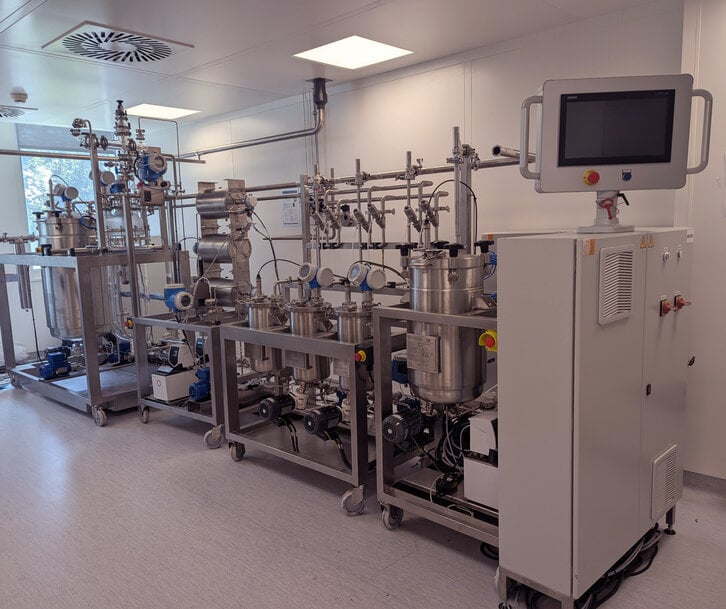
A European consortium has successfully demonstrated a new way of manufacturing pharmaceutical ingredients that could help reduce dependence on centralised production, strengthen medicine supply chains and accelerate the industrialisation of critical drugs.
The PIPAC consortium, composed of De Dietrich, Alysophil, Bruker and Novalix, announced the successful completion of a pilot programme validating a continuous manufacturing platform for pharmaceutical active ingredients (APIs).
The platform combines continuous-flow chemistry, AI monitored real-time analytical monitoring and control to enable pharmaceutical compounds to be produced, monitored and optimised continuously rather than through traditional batch manufacturing.
The consortium successfully validated the technology through the continuous-flow production of fentanyl, one of the pharmaceutical industry's most potent and tightly regulated active pharmaceutical ingredients. The achievement demonstrates the platform's ability to operate under challenging manufacturing conditions and provides a foundation for the future production of other pharmaceutical ingredients.
The milestone comes as governments and pharmaceutical companies seek new ways to reshore supply-chain resilience following years of disruption, geopolitical uncertainty and increasing concern over the concentration of API manufacturing capacity in a limited number of regions.
A potential shift away from traditional batch manufacturing
For decades, pharmaceutical ingredient production has relied largely on batch manufacturing, requiring lengthy scale-up phases and significant commitments of time, capital and raw materials before production processes can be fully validated.
The PIPAC project set out to challenge that model. By integrating continuous flow synthesis, AI monitored advanced process analytics and automated process control into a single platform, the consortium has demonstrated a manufacturing approach capable of delivering greater flexibility, enhanced process robustness and faster pathways from development to production.
Unlike traditional batch production, continuous manufacturing allows product quality and process performance to be assessed throughout production, enabling earlier intervention, reduced scale-up risk and more efficient use of resources.
The approach also opens the possibility of smaller, modular production units that could support future decentralised manufacturing strategies and strengthen regional pharmaceutical production capabilities.
Bringing together expertise across the value chain
The project combines expertise spanning pharmaceutical synthesis, analytical technologies, process control and industrial engineering.
Novalix designed and implemented the continuous-flow synthesis route.
Bruker contributed advanced analytical capabilities, enabling continuous real-time measurement and monitoring of the process.
Alysophil developed AlchemDrive, an autonomous AI driven process-control platform that continuously analyses production data and adjusts key manufacturing parameters in real time.
De Dietrich developed the industrial hardware platform and automation architecture, integrating synthesis, analytics and process control into a scalable manufacturing environment designed for future industrial deployment.
Towards industrial and GMP deployment
The successful demonstrator establishes a foundation for future GMP-compatible continuous manufacturing systems.
The platform can be expanded to incorporate downstream processing operations such as filtration, purification and drying, creating a pathway towards fully integrated pharmaceutical production.
By enabling manufacturing to be scaled through continuous operation rather than traditional batch scale-up, the technology has the potential to accelerate industrial deployment while improving flexibility, efficiency and supply-chain resilience.
Frédéric Guichard, Group Executive Director, De Dietrich commented:
"For decades, pharmaceutical manufacturing has relied on production models that were designed for a different era. Today, the industry faces new challenges: supply-chain resilience, production sovereignty, faster industrialization and greater flexibility. PIPAc demonstrates that it is possible to rethink how pharmaceutical ingredients are manufactured. By combining continuous production, real-time analytics and intelligent process control, we have created a platform that has the potential to transform how critical medicines are produced in the future."
www.dedietrich.com
-2296-71282-204124.png)