
www.magazine-industry-usa.com
26
'26
Written on Modified on
Carrier Transicold Launches All-Electric Vector 8200 TRU
Company’s first engine-less multi-temperature TRU helps fresh and frozen food fleets add supplemental cold storage capacity during seasonal peaks.
www.carrier.com
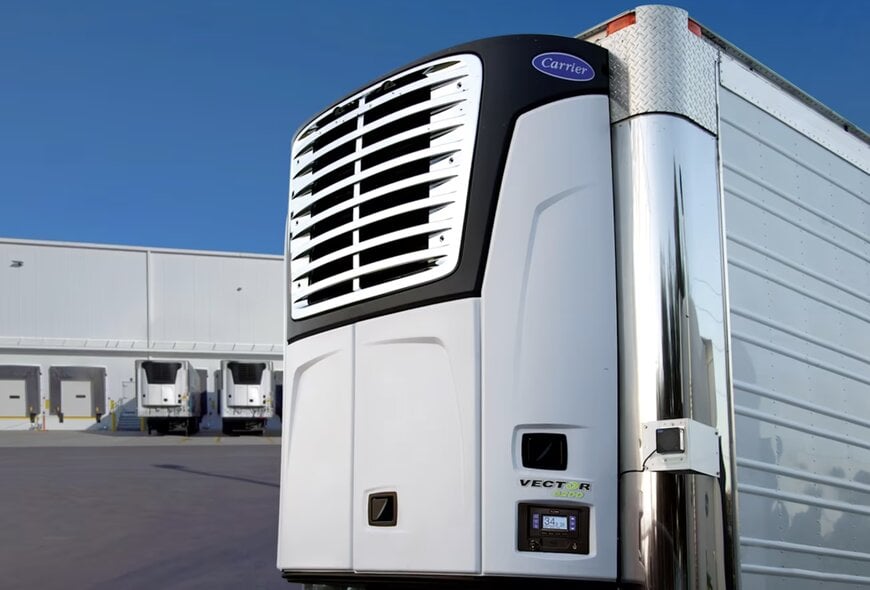
Carrier Transicold has announced the commercial availability of the Vector 8200 through its North American dealer network. The engineless transport refrigeration unit provides single- and multi-temperature cooling for stationary trailers, delivering on-site cold storage capacity for food shippers and logistics operators managing seasonal volume peaks, facility maintenance, and unexpected surges in inventory.
All-Electric Architecture and Power Demand Management
The Vector 8200 operates entirely on shore power or external electrical sources, eliminating direct diesel exhaust emissions, engine noise, and ongoing fuel costs.
- E-Drive Energy Management: Features the TRU-Demand E-Drive power management system, which actively monitors power consumption, stabilizes voltage during brownouts, and mitigates peak load spikes when multiple connected units restart following power outages.
- Multi-Zone Configurations: Serves as Carrier Transicold's first engineless TRU supporting multi-temperature profiles, utilizing four remote evaporator configurations to independently cool one-, two-, or three-compartment trailer setups.
- Wide Thermal Range: Delivers 58,000 BTU/hr of cooling capacity at 35°F, 33,500 BTU/hr at 0°F, and 22,000 BTU/hr at -20°F, alongside integrated electric heating and automatic defrost cycles.
Advanced Digital Controls and Hardware Reliability
The unit integrates APX control architecture featuring IntelliSet and ProductShield software for precise temperature regulation, alongside a DataLink recorder that logs temperature histories for regulatory food safety compliance. Telematics integration via Lynx Fleet provides remote tracking, operational diagnostics, and two-way control.
Hardware specifications include a hermetic electric scroll compressor, microchannel condenser coils, maintenance-free AC fan motors, an electronic expansion valve, a 40-amp battery charger, and a roof-mounted solar charging panel, with optional liftgate charging modules.
Additional Context
This section details technical specifications not included in the original news release.
Stationary electric transport refrigeration units utilize closed-loop vapor compression cycles optimized for low global warming potential synthetic and natural refrigerants, such as R-452A or R-404A replacements. Hermetic scroll compressor mechanisms provide continuous compression cycles with minimal moving parts, reducing mechanical friction, dynamic vibration, and acoustic noise emissions to levels well below 65 A-weighted decibels at standard operating distances. The compressor and evaporator motors operate via variable-frequency drives that adjust compressor speed according to thermal box load, reducing electrical power consumption and preventing high inrush current during compressor motor start-up.
Microchannel aluminum heat exchangers maximize heat rejection efficiency by providing high surface-area-to-volume ratios and low internal refrigerant charge requirements compared to conventional copper-tube and aluminum-fin coils. Electronic expansion valves dynamically regulate refrigerant superheat at the evaporator outlet, maintaining stable setpoint accuracy within plus or minus 0.5 degrees Fahrenheit across variable ambient temperature extremes spanning minus 20 degrees Fahrenheit to 120 degrees Fahrenheit. The onboard 12-volt DC auxiliary electrical systems are continuously buffered by photovoltaic solar collectors and industrial-grade smart battery chargers to sustain microprocessor memory, remote telematics transceivers, and alarm logging during primary AC power disconnections.
Edited by Romila DSilva, Induportals Editor, with AI assistance.
The unit integrates APX control architecture featuring IntelliSet and ProductShield software for precise temperature regulation, alongside a DataLink recorder that logs temperature histories for regulatory food safety compliance. Telematics integration via Lynx Fleet provides remote tracking, operational diagnostics, and two-way control.
Hardware specifications include a hermetic electric scroll compressor, microchannel condenser coils, maintenance-free AC fan motors, an electronic expansion valve, a 40-amp battery charger, and a roof-mounted solar charging panel, with optional liftgate charging modules.
Additional Context
This section details technical specifications not included in the original news release.
Stationary electric transport refrigeration units utilize closed-loop vapor compression cycles optimized for low global warming potential synthetic and natural refrigerants, such as R-452A or R-404A replacements. Hermetic scroll compressor mechanisms provide continuous compression cycles with minimal moving parts, reducing mechanical friction, dynamic vibration, and acoustic noise emissions to levels well below 65 A-weighted decibels at standard operating distances. The compressor and evaporator motors operate via variable-frequency drives that adjust compressor speed according to thermal box load, reducing electrical power consumption and preventing high inrush current during compressor motor start-up.
Microchannel aluminum heat exchangers maximize heat rejection efficiency by providing high surface-area-to-volume ratios and low internal refrigerant charge requirements compared to conventional copper-tube and aluminum-fin coils. Electronic expansion valves dynamically regulate refrigerant superheat at the evaporator outlet, maintaining stable setpoint accuracy within plus or minus 0.5 degrees Fahrenheit across variable ambient temperature extremes spanning minus 20 degrees Fahrenheit to 120 degrees Fahrenheit. The onboard 12-volt DC auxiliary electrical systems are continuously buffered by photovoltaic solar collectors and industrial-grade smart battery chargers to sustain microprocessor memory, remote telematics transceivers, and alarm logging during primary AC power disconnections.
Edited by Romila DSilva, Induportals Editor, with AI assistance.
-2296-71282-204124.png)