
www.magazine-industry-usa.com
21
'26
Written on Modified on
High-Voltage Dead Tank Breakers Target Utility Substations
LS ELECTRIC America introduces 245 kV and 362 kV dead tank circuit breakers for utility and high-voltage substation applications.
www.lselectricamerica.com
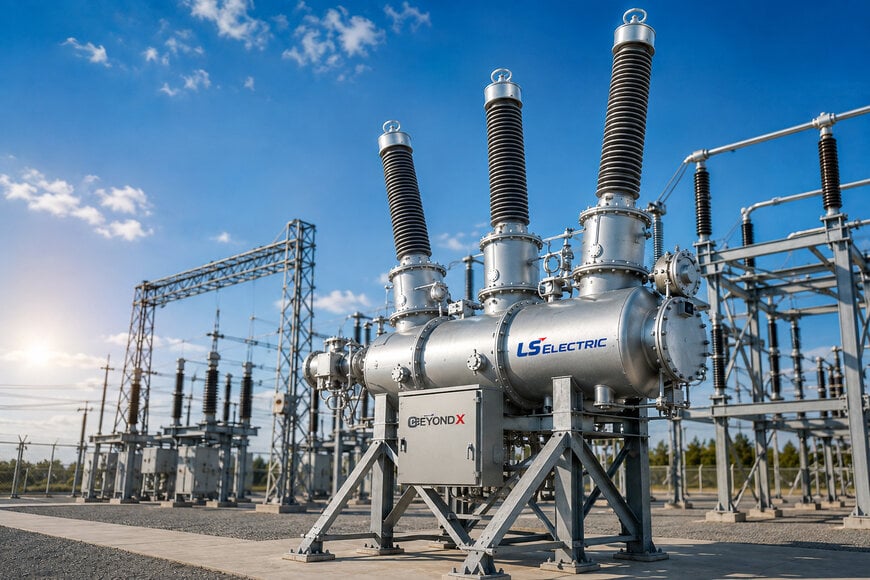
LS ELECTRIC America has introduced a dead tank circuit breaker platform for 245 kV and 362 kV power systems, targeting utility and grid-operator applications where high short-circuit interruption capability, controlled maintenance requirements and efficient substation layouts are required. The breakers use grounded metal enclosures around the interrupting chambers and SF6 insulation and interruption technology.
Grounded enclosure contains high-voltage components
A dead tank circuit breaker places the interrupting chamber inside a grounded metal tank. This arrangement encloses the high-voltage components and keeps the external tank at ground potential, limiting exposure to energized parts during operation and maintenance.
For utility substations, the configuration is relevant to applications where equipment must withstand environmental and electrical stresses while providing controlled access for maintenance personnel. The sealed construction also helps limit contamination of internal components and supports longer service intervals.
The 245 kV and 362 kV models are designed for high-voltage switching and fault-clearing duties. Both versions are rated for a 63 kA short-circuit current, with a specified two-cycle interrupting time and 33.4 ms breaking time.
SF6 interruption supports rapid fault clearing
The breaker uses SF6 gas for insulation and arc interruption. During a fault, the interrupter separates its contacts and uses the gas medium to extinguish the electrical arc. Rapid interruption limits the duration of fault current and helps reduce the time during which connected equipment is exposed to abnormal electrical conditions.
The 63 kA short-circuit rating defines the specified fault current that the breaker can interrupt under its applicable rating conditions. The two-cycle interruption rating corresponds to the stated 33.4 ms breaking time at a 60 Hz system frequency.
Continuous-current configurations range from 2000 A to 5000 A. This allows the platform to address different substation loading requirements without changing the basic breaker technology.
Sealed construction supports maintenance reduction
The breaker is designed with a sealed enclosure and robust construction intended to withstand mechanical and electrical stresses encountered during service. Containing the interrupting chamber within the tank also helps protect internal components from external contamination.
Reduced maintenance requirements can be particularly relevant in utility installations where equipment downtime affects network availability. The press release does not specify a fixed maintenance interval or quantified lifecycle-cost reduction, so these benefits depend on the installation conditions and the applicable maintenance program.
Substation layout and remote operation
The platform is also designed for applications where substation footprint is constrained. Its compact construction can help equipment planners use available space more efficiently, although the actual footprint depends on the selected voltage rating, current rating, auxiliary equipment and site configuration.
An integrated control system provides monitoring and remote-operation capabilities. In a substation environment, these functions can allow operators to supervise breaker status and operate the equipment from a remote control location, reducing the need for immediate physical intervention during switching operations.
The 245 kV model uses a common frame structure, while the 362 kV model uses a separate frame structure. The two configurations provide different mechanical arrangements for integration into high-voltage substation designs.
Operation under demanding environmental conditions
The breakers are specified for ambient temperatures from -40°C to +50°C. They are also designed for seismic performance in accordance with IEEE 693-2005 High, according to the company.
These specifications are relevant to substations exposed to wide temperature variations or significant seismic loads. Actual site suitability still depends on the complete installation design and the applicable project requirements.
Applications include utility and grid infrastructure
The platform is intended for high-voltage substations operated by utilities and grid operators. Typical applications for this class of equipment include switching and protection of transmission and subtransmission assets where fault currents can reach tens of kiloamperes.
The combination of 245 kV and 362 kV voltage classes, continuous-current ratings up to 5000 A and a 63 kA short-circuit rating gives the platform coverage across several high-voltage substation configurations.
Additional Context:
This section details technical specifications and competitive benchmarking not included in the original product announcement
Dead tank circuit breakers are an established technology category, and comparable products are available from several major high-voltage equipment manufacturers. At 245 kV, Hitachi Energy lists dead tank breakers with short-circuit breaking ratings from 50 kA to 90 kA, including 63 kA models with two-cycle interruption and continuous-current ratings up to 5000 A.
GE Vernova also offers a 245 kV, 63 kA dead tank circuit breaker with continuous-current ratings of 3000 A, 4000 A and 5000 A. Its published specifications include two- or three-cycle interruption and 33 ms or 50 ms break times, depending on the configuration.
Siemens Energy lists dead tank circuit breakers covering 72.5 kV to 550 kV, with models offering interruption ratings up to 90 kA and two-cycle operation. Its portfolio also includes dead tank compact designs at 145 kV and 245 kV intended for space-constrained substation applications.
These published specifications indicate that the 245 kV, 63 kA and two-cycle ratings of the LS ELECTRIC America platform fall within established performance ranges for comparable dead tank circuit breakers. The stated 362 kV, 63 kA configuration addresses a higher voltage class, but a direct competitive comparison would require equivalent published specifications for interrupting time, continuous current, insulation levels, seismic qualification and physical dimensions.
An additional industry trend is the development of SF6-free alternatives. Hitachi Energy, for example, announced SF6-free dead tank circuit breaker technologies for 420 kV and 800 kV systems in 2026, while GE Vernova has commercially available SF6-free dead tank technology at lower voltage levels. This reflects increasing development activity around alternative insulation and interruption media, although the LS ELECTRIC America platform described in the announcement uses SF6 technology.
Edited by Sucithra Mani, Induportals editor – adapted by AI.
www.lselectricamerica.com
