
www.magazine-industry-usa.com
07
'26
Written on Modified on
FANUC Presents High-accuracy, High-stiffness Robot
By combining high stiffness with advanced accuracy control as standard, the new series enables applications such as milling, drilling and deburring to be performed by a robot.
www.fanuc.eu
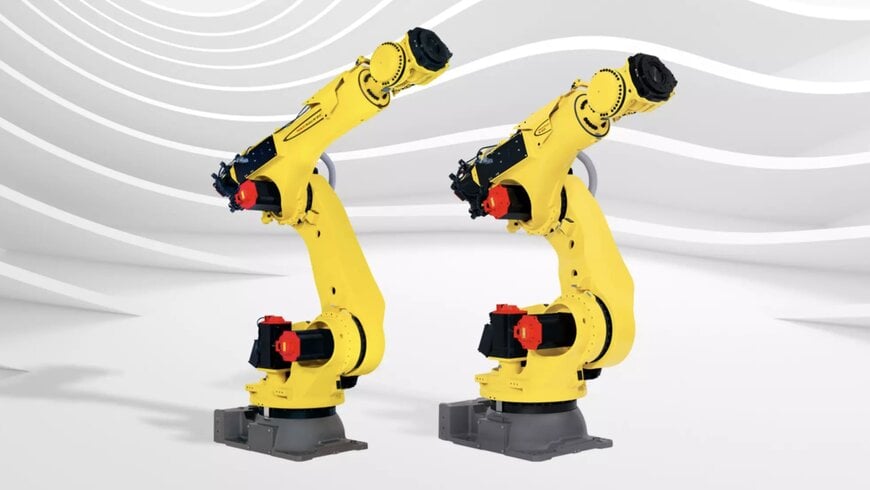
FANUC has launched its M-810 series six-axis articulated machining robots, designed for heavy-duty milling, drilling, and deburring of large metal components across automotive, aerospace, and general manufacturing applications. The system combines high structural stiffness with standardized accuracy control to perform material removal tasks traditionally assigned to large, capital-intensive CNC machine tools.
Product Lineup and Machining Envelopes
The M-810 series comprises two distinct models engineered for high-load industrial applications. The M-810/270-27B features a maximum payload capacity of 270 kg alongside a 2.7 m operating reach, delivering a larger working envelope and higher load handling capability compared to predecessor models. The companion M-810/190-20B model provides a 190 kg payload capacity. Both models target production environments where part dimensions, structural complexity, and toolhead mass require combined reaching envelope and mechanical strength.
Calibration, Adaptive Control, and Process Stability
The robotic units utilize integrated iRCalibration Signature technology to maintain consistent absolute positioning and path accuracy under external machining loads. To preserve process stability, an enhanced control system automatically detects active cutting forces during operation and adapts control parameters in real time. This dynamic adaptation limits toolpath deviation under heavy material-removal conditions to deliver uniform machining quality across the workpiece surface.
Six-Axis Kinematics and Factory Cell Reconfiguration
Utilizing a six-axis articulated arm design, the robots position cutting tools to approach workpieces from multiple spatial angles. This kinematic flexibility allows access to complex contours, undercuts, and enclosed geometries that present physical access limitations for conventional three- or four-axis machine tools. The floor-mounted articulated configuration allows manufacturing facilities to reconfigure machining cells or repurpose existing equipment as component geometries and production volumes change over time.
Industrial Protection and Control Architecture
Built for wet and harsh industrial environments, the robot series features IP67 ingress protection to prevent fluid, metal chip, and swarf contamination from compromising internal mechanisms. Operational control is managed via the R-50iA robot controller paired with a lightweight, touch-panel Teach Pendant interface that supports path control routines and embedded cybersecurity protocols.
Deployment Strategy for Large-Scale Workpieces
The robot series provides a flexible cell architecture for machining large structural components, including automotive gigacasting parts. Rather than mounting large-scale castings inside oversized, fixed-bed CNC machine enclosures, processing cells can be configured with one or more six-axis robots operating around a stationary, grounded workpiece.
Additional Context
This section details technical specifications and competitive benchmarking not included in the original news release.
Automated material removal on large metallic components is traditionally performed by rigid gantry computer numerical control (CNC) machine tools. While gantry CNC mills achieve dynamic stiffness exceeding 50 N/µm, conventional six-axis industrial robots typically exhibit dynamic stiffness below 1 N/µm, causing mechanical chatter and toolpath deflection under heavy cutting loads. Dedicated high-rigidity machining robots address joint compliance by pairing reinforced casting frames with real-time force feedback algorithms that dynamically adjust servo torque during milling and drilling operations. Additionally, integrated absolute calibration compensates for thermal expansion and gear backlash across the workspace, enabling direct execution of computer-aided manufacturing toolpaths. Compared to fixed, enclosed gantry CNC machines, floor-mounted articulated machining robots process stationary gigacastings and structural frames within a smaller footprint and at lower capital investment.
Edited by Romila DSilva, Induportals Editor, with AI assistance.
www.fanuc.eu
