
www.magazine-industry-usa.com
12
'26
Written on Modified on
Telit Cinterion Launches a GNSS Module
New single-frequency GNSS module combines multiconstellation reliability, cost efficiency and design continuity for IoT and industrial applications.
www.telit.com
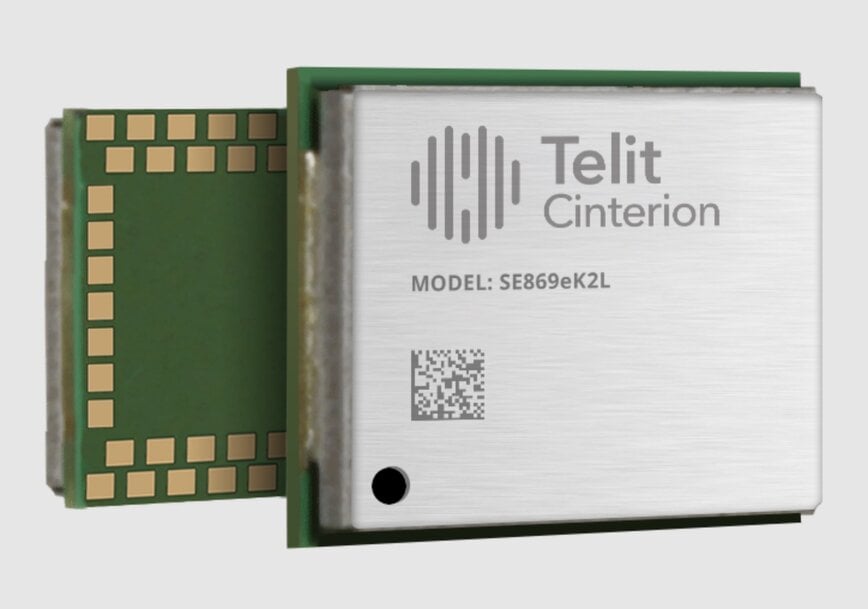
Telit Cinterion has announced the release of the SE869eK2L, a single-frequency L1 Global Navigation Satellite System (GNSS) module engineered to support device manufacturers in upgrading legacy positioning hardware. The platform focuses on enhancing tracking performance and cost efficiency while preserving hardware design continuity.
Multiconstellation Support and Technical Scope
The SE869eK2L is developed on the Airoha AG3352 hardware platform, providing concurrent processing across multiple global navigation constellations, including GPS, GLONASS, Galileo, BeiDou, and the QZSS regional network. The module achieves a positioning accuracy of approximately 1.5 meters and delivers data update rates up to 10 Hz.
This functional capability renders the component suitable for connected industrial equipment and IoT devices that require dependable positioning matrices without the administrative costs or manufacturing complexity associated with higher-end, multi-band GNSS architectures.
Pin-to-Pin Compatibility and Migration Framework
For original equipment manufacturers (OEMs) managing product refresh schedules, the module provides a direct migration path from Telit Cinterion’s existing SL869L-V2 and legacy xL869 hardware modules. The unit features a standard 12.2 x 16 mm physical footprint that maintains full pin-to-pin compatibility with industry-standard form factors. This layout allows OEMs to extend the life cycle of current device layouts while gaining updated operational specifications and component supply chain flexibility. The physical footprint layout also incorporates reserved pins dedicated for future configuration extensions.
The component is configured for a wide range of IoT and industrial deployment scenarios, including:
- Asset tracking and fleet management systems
- Smart infrastructure and industrial equipment
- Cell tower synchronization networks
- Wi-Fi 6E and Wi-Fi 7 routing equipment
Hardware Variants and Router Compliance
The SE869eK2L supports connected devices requiring stable L1 positioning through two distinct hardware supply voltage variants: a 3.3 V option and a 1.8 V option. This dual configuration allows system designers to align the module with localized power architectures and system requirements.
Dedicated firmware packages provide native compatibility with Windows Location Services and activate high-precision timing functionalities, delivering synchronization clock outputs with a jitter rating of ±7 ns. Furthermore, the module incorporates a specialized Wi-Fi navigation mode. This sub-protocol enables compliance with Automated Frequency Coordination (AFC) regulations mandated for high-frequency Wi-Fi 6E and Wi-Fi 7 routers.
Device manufacturers building connected systems can combine the SE869eK2L with Telit Cinterion's portfolio of cellular modules—including cellular units engineered without embedded GNSS capabilities—simplifying component sourcing, hardware integration, and technical support pathways through a unified supplier network.
Additional Context
This section details technical specifications not included in the original news release.
Single-frequency L1 GNSS modules capture satellite positioning data within the primary radio frequency band centered at 1575.42 MHz. Because these systems rely on a single frequency layer, they are susceptible to ionospheric delay errors, where solar radiation and free electron variations in the upper atmosphere refract the satellite signal, causing timing delays that affect spatial calculations. To mitigate these atmospheric anomalies and improve accuracy to the 1.5-meter range, modern L1 receivers utilize internal software engines that process Satellite-Based Augmentation System (SBAS) data streams, such as WAAS in North America or EGNOS in Europe. These systems broadcast regional differential correction parameters via geostationary satellites to refine local pseudorange measurements.
For cellular towers and industrial communication networks, precise synchronization relies on the extraction of a highly accurate Pulse Per Second (PPS) hardware signal from the GNSS receiver. The tracking engine locks onto the atomic clocks of the satellite constellations, disciplining an internal temperature-compensated crystal oscillator (TCXO) to generate the timing output. Minimizing signal jitter down to ±7 nanoseconds is necessary to prevent packet collisions and maintain slot alignment in Time Division Multiple Access (TDMA) and 5G cellular communication channels.
In indoor or dense urban environments where line-of-sight satellite tracking is blocked, automated frequency coordination systems for Wi-Fi 6E and Wi-Fi 7 routers utilize the module's localized geolocation coordinates to query cloud-based regulatory databases. This verification step identifies adjacent licensed microwave links, allowing the router's transmitter to dynamically adjust its operating channel and power levels to eliminate RF interference across shared spectrum baselines.
Edited by Romila DSilva, Induportals Editor, with AI assistance.
The SE869eK2L supports connected devices requiring stable L1 positioning through two distinct hardware supply voltage variants: a 3.3 V option and a 1.8 V option. This dual configuration allows system designers to align the module with localized power architectures and system requirements.
Dedicated firmware packages provide native compatibility with Windows Location Services and activate high-precision timing functionalities, delivering synchronization clock outputs with a jitter rating of ±7 ns. Furthermore, the module incorporates a specialized Wi-Fi navigation mode. This sub-protocol enables compliance with Automated Frequency Coordination (AFC) regulations mandated for high-frequency Wi-Fi 6E and Wi-Fi 7 routers.
Device manufacturers building connected systems can combine the SE869eK2L with Telit Cinterion's portfolio of cellular modules—including cellular units engineered without embedded GNSS capabilities—simplifying component sourcing, hardware integration, and technical support pathways through a unified supplier network.
Additional Context
This section details technical specifications not included in the original news release.
Single-frequency L1 GNSS modules capture satellite positioning data within the primary radio frequency band centered at 1575.42 MHz. Because these systems rely on a single frequency layer, they are susceptible to ionospheric delay errors, where solar radiation and free electron variations in the upper atmosphere refract the satellite signal, causing timing delays that affect spatial calculations. To mitigate these atmospheric anomalies and improve accuracy to the 1.5-meter range, modern L1 receivers utilize internal software engines that process Satellite-Based Augmentation System (SBAS) data streams, such as WAAS in North America or EGNOS in Europe. These systems broadcast regional differential correction parameters via geostationary satellites to refine local pseudorange measurements.
For cellular towers and industrial communication networks, precise synchronization relies on the extraction of a highly accurate Pulse Per Second (PPS) hardware signal from the GNSS receiver. The tracking engine locks onto the atomic clocks of the satellite constellations, disciplining an internal temperature-compensated crystal oscillator (TCXO) to generate the timing output. Minimizing signal jitter down to ±7 nanoseconds is necessary to prevent packet collisions and maintain slot alignment in Time Division Multiple Access (TDMA) and 5G cellular communication channels.
In indoor or dense urban environments where line-of-sight satellite tracking is blocked, automated frequency coordination systems for Wi-Fi 6E and Wi-Fi 7 routers utilize the module's localized geolocation coordinates to query cloud-based regulatory databases. This verification step identifies adjacent licensed microwave links, allowing the router's transmitter to dynamically adjust its operating channel and power levels to eliminate RF interference across shared spectrum baselines.
Edited by Romila DSilva, Induportals Editor, with AI assistance.
-2296-71282-204124.png)