
www.magazine-industry-usa.com
10
'26
Written on Modified on
Aquatech & Prairie Lithium Scale Direct Lithium Extraction Deployment
Modular extraction system advances commercial lithium production, validating resource viability while supporting efficient battery materials supply.
www.aquatech.com
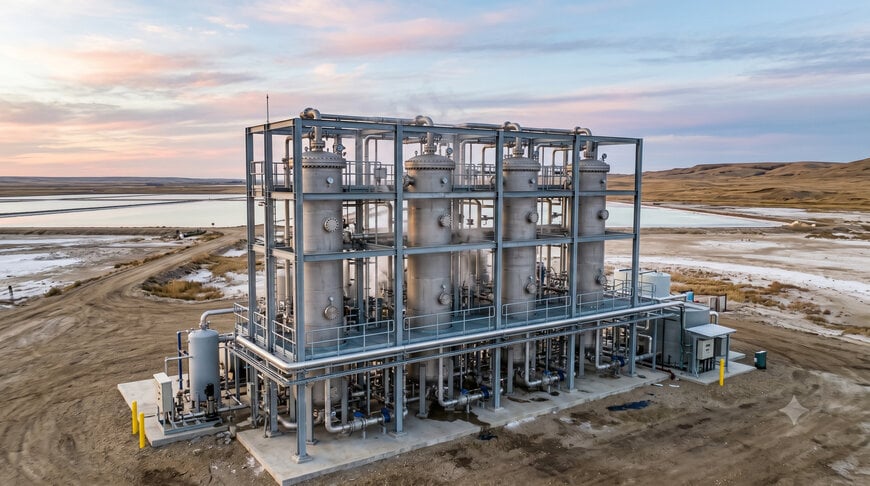
AI Generated Image
Aquatech and Prairie Lithium have entered into an industrial equipment supply agreement to deploy North America's largest direct lithium extraction installation in Saskatchewan, Canada. This strategic partnership integrates advanced water treatment engineering with subsurface mineral resources to accelerate the commercial production of battery-grade materials. The primary goal of this collaboration is to establish a high-throughput, modular direct lithium extraction unit capable of processing a 4.6 million metric ton lithium carbonate equivalent resource base.
System Architecture and Modular Deployment Configurations
The infrastructure installation utilizes specialized lithium selective sorption technology operated under a proprietary engineering platform to generate a purified lithium chloride stream. The technical configuration relies on a modularized setup consisting of four full-scale selective sorption columns. This specific four-column design allows for continuous-flow extraction cycles, minimizing process downtime during media regeneration phases.
The manufacturing approach utilizes pre-fabricated modular units that streamline transport and installation logistics. Moving away from traditional field-constructed chemical processing plants, the system is delivered as a structured modular assembly. This configuration simplifies onsite physical integration, reduces engineering footprints, and standardizes piping, instrumentation, and control interfaces at the asset location.
Operational Reliability and Technical Performance Specifications
The underlying extraction technology has been validated through extensive operational testing to ensure processing stability under variable brine conditions. The extraction mechanism has logged more than 15,000 continuous direct lithium extraction cycles over a four-year operational evaluation period, treating more than 1 million barrels of Smackover brine. This testing record establishes the baseline degradation rates of the sorbent media and verifies long-term lithium recovery efficiency under industrial loads.
The implementation phase brings together specialized capabilities across the processing value chain. Aquatech acts as the process technology licensor and modular equipment supplier, providing the core extraction architecture and project execution parameters. Prairie Lithium manages the source brine resource base, which holds a 4.6 million metric ton lithium carbonate equivalent capacity, and oversees the complete asset integration and upcoming facility commissioning.
Additional Context:
This section details technical specifications and competitive benchmarking not included in the original product announcement.
The deployment of advanced direct lithium extraction systems represents a significant shift from conventional evaporative processing methodologies and alternative chemical precipitation frameworks. Traditional lithium extraction relies on massive solar evaporation ponds that require between 12 and 24 months to concentrate lithium solutions, making them highly dependent on specific regional weather patterns and causing substantial local water loss. The selective sorption process compresses this production timeline to a few hours by directly capturing lithium ions from the brine stream and returning the lithium-depleted brine back to its subsurface source.
In comparison to alternative direct lithium extraction approaches, such as ion exchange frameworks or membrane-based nanofiltration systems, lithium selective sorption columns exhibit distinct operational characteristics. While ion exchange systems often require substantial chemical inputs—specifically concentrated acids—for elution and pH adjustment, selective sorption technology utilizes water-driven thermal or displacement desorption mechanisms. This limits regular chemical consumption and reduces the volume of corrosive waste streams.
Furthermore, the modular four-column configuration prevents the high osmotic fouling rates commonly observed in multi-stage nanofiltration systems, maintaining consistent recovery rates when processing high-salinity oilfield brines containing elevated concentrations of interfering divalent ions like calcium and magnesium.
Edited by Natania Lyngdoh, Induportals editor, assisted by AI.
www.aquatech.com
Aquatech and Prairie Lithium have entered into an industrial equipment supply agreement to deploy North America's largest direct lithium extraction installation in Saskatchewan, Canada. This strategic partnership integrates advanced water treatment engineering with subsurface mineral resources to accelerate the commercial production of battery-grade materials. The primary goal of this collaboration is to establish a high-throughput, modular direct lithium extraction unit capable of processing a 4.6 million metric ton lithium carbonate equivalent resource base.
System Architecture and Modular Deployment Configurations
The infrastructure installation utilizes specialized lithium selective sorption technology operated under a proprietary engineering platform to generate a purified lithium chloride stream. The technical configuration relies on a modularized setup consisting of four full-scale selective sorption columns. This specific four-column design allows for continuous-flow extraction cycles, minimizing process downtime during media regeneration phases.
The manufacturing approach utilizes pre-fabricated modular units that streamline transport and installation logistics. Moving away from traditional field-constructed chemical processing plants, the system is delivered as a structured modular assembly. This configuration simplifies onsite physical integration, reduces engineering footprints, and standardizes piping, instrumentation, and control interfaces at the asset location.
Operational Reliability and Technical Performance Specifications
The underlying extraction technology has been validated through extensive operational testing to ensure processing stability under variable brine conditions. The extraction mechanism has logged more than 15,000 continuous direct lithium extraction cycles over a four-year operational evaluation period, treating more than 1 million barrels of Smackover brine. This testing record establishes the baseline degradation rates of the sorbent media and verifies long-term lithium recovery efficiency under industrial loads.
The implementation phase brings together specialized capabilities across the processing value chain. Aquatech acts as the process technology licensor and modular equipment supplier, providing the core extraction architecture and project execution parameters. Prairie Lithium manages the source brine resource base, which holds a 4.6 million metric ton lithium carbonate equivalent capacity, and oversees the complete asset integration and upcoming facility commissioning.
Additional Context:
This section details technical specifications and competitive benchmarking not included in the original product announcement.
The deployment of advanced direct lithium extraction systems represents a significant shift from conventional evaporative processing methodologies and alternative chemical precipitation frameworks. Traditional lithium extraction relies on massive solar evaporation ponds that require between 12 and 24 months to concentrate lithium solutions, making them highly dependent on specific regional weather patterns and causing substantial local water loss. The selective sorption process compresses this production timeline to a few hours by directly capturing lithium ions from the brine stream and returning the lithium-depleted brine back to its subsurface source.
In comparison to alternative direct lithium extraction approaches, such as ion exchange frameworks or membrane-based nanofiltration systems, lithium selective sorption columns exhibit distinct operational characteristics. While ion exchange systems often require substantial chemical inputs—specifically concentrated acids—for elution and pH adjustment, selective sorption technology utilizes water-driven thermal or displacement desorption mechanisms. This limits regular chemical consumption and reduces the volume of corrosive waste streams.
Furthermore, the modular four-column configuration prevents the high osmotic fouling rates commonly observed in multi-stage nanofiltration systems, maintaining consistent recovery rates when processing high-salinity oilfield brines containing elevated concentrations of interfering divalent ions like calcium and magnesium.
Edited by Natania Lyngdoh, Induportals editor, assisted by AI.
www.aquatech.com
-2296-71282-204124.png)