
www.magazine-industry-usa.com
22
'26
Written on Modified on
FANUC to showcase ready-to-deploy collaborative robot solutions at Automate 2026
FANUC America will introduce its dedicated Cobot and Go exhibit featuring pre-engineered CRX collaborative robot systems developed with integrators to help manufacturers accelerate automation deployment with scalable, application-ready solutions.
www.fanuc.eu
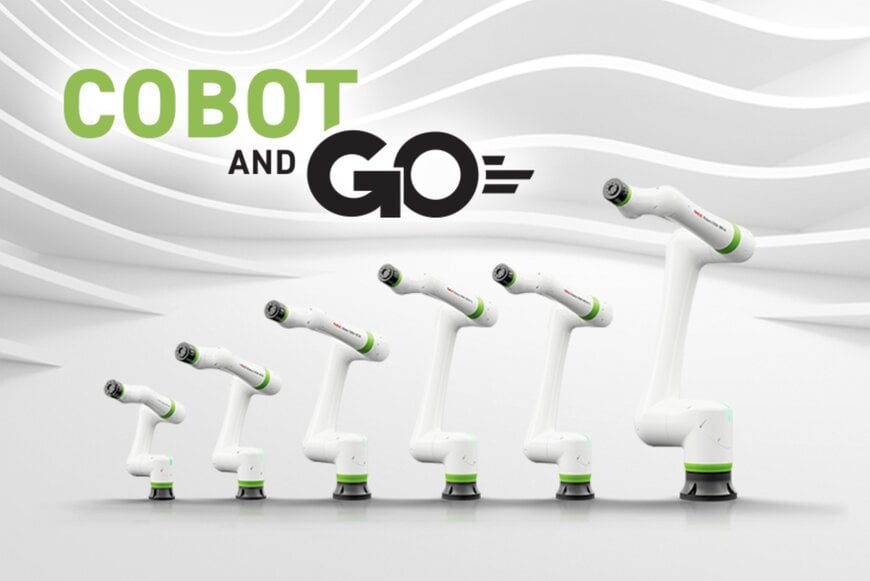
FANUC America will debut a dedicated Cobot and Go booth (#1001) at Automate 2026, June 22–26 at McCormick Place in Chicago, featuring pre-engineered collaborative robot systems built for rapid deployment and developed with leading system integrators and distributors.
Located adjacent to FANUC’s main booth (#1401), the Cobot and Go exhibit highlights application-ready solutions based on FANUC’s CRX series of collaborative robots, demonstrating how manufacturers can implement automation quickly using standardized, portable systems rather than custom-built cells.
Technical Specifications of Pre-Engineered Application Cells
The collaborative systems utilize advanced motion controllers and software interfaces to execute specialized tasks with minimal manual programming:
- Automated Painting and Coating: Developed by Robotic Technical Support Services, the EZPainter system pairs a CRX-10iA cobot with automated color-change mechanics and programmable paths. This setup delivers consistent, repeatable spray application on complex automotive components.
- Machine Tending and Post-Processing: A drawer-based machine tending unit by Vention utilizes stacked drawers and standardized trays for high-density storage. For post-machining operations, a system from Matrix Design automates part washing, blow-off drying, and inspection while utilizing an industrial PC to stream performance logs directly into Manufacturing Execution Systems (MES).
- Extended-Reach Welding Loops: Partnering with Lincoln Electric, the Cooper ADAPT welding system mounts a CRX-10iA/L cobot on a 7th-axis linear rail. The layout integrates a rotary positioner to execute dual-work-zone welding operations over extended structural footprints.
- Dispensing and Assembly Operations: Mission Design and Automation's Dispense Buddy cell employs a drag-and-drop interface with pick-to-light bins and a flexible fixture table to automate simulated printed circuit board assembly and precision adhesive tracking.
Vision-Guided Kinematics and AI Asset Inspection
To handle highly variable material flows, several systems leverage intelligent vision tracking and trained neural networks. Genuine Cable Group's inspection cell utilizes Inbolt AI vision hardware to identify and track randomly oriented parts for precise material handling. Within e-commerce and logistics workflows, a CMES Robotics picking solution identifies specific stock-keeping units (SKUs) for automated bagging. Furthermore, Applied Manufacturing Technologies (AMT) implements an AI-driven depalletizing cell that evaluates mixed-SKU pallets in real time, dynamically calculating the optimal robotic pick paths for varying box sizes, graphics, and orientations.
Trade Show Presentation and Fleet Modernization Staging
The complete technical portfolio will be presented at the Automate 2026 trade show, held at McCormick Place in Chicago from June 22–26, 2026. These mobile out-of-the-box setups operate using standard facility electrical power and integrated pneumatic systems, minimizing the time required for on-site commissioning. Shifting from one-off non-standard engineering to reproducible, distributor-supported cell structures allows manufacturers to mitigate workforce constraints, ensure consistent execution quality, and build an intelligent network of edge-connected robotics.
Additional Context
This section details technical specifications and competitive benchmarking not included in the original news announcement.
In comparison to traditional, high-payload industrial robotics that require permanent safety fencing and extensive PLC hand-coding, the FANUC CRX collaborative platform relies on sensitive joint torque sensors to perform contact-stop safety compliance under ISO 10218-1 standards. While major competitors like Universal Robots (UR20/UR30 series) or Yaskawa HC-series offer standalone cobot arms, FANUC’s differentiator is the collaborative pre-validation of complete, application-specific functional blocks with third-party integrators.
Technical benchmarks indicate that the dual-work-zone 7th-axis linear rail integration used in the welding cell maintains a repeatable positional tolerance within ±0.04 millimeters, matching the strict mechanical accuracy required for heavy continuous-cycle automation lines. Furthermore, while conventional vision guidance systems experience significant processing latency, the integrated Inbolt AI edge processors reduce spatial pose-estimation latency to under 50 milliseconds, allowing the cobot to track fluctuating or moving targets on an active conveyor line. This optimization of part-handling cycles balances out the initial hardware investment, delivering a sustainable and easily deployable alternative for modular factory floor modernization.
Edited by Romila DSilva, Induportals Editor, with AI assistance.
To handle highly variable material flows, several systems leverage intelligent vision tracking and trained neural networks. Genuine Cable Group's inspection cell utilizes Inbolt AI vision hardware to identify and track randomly oriented parts for precise material handling. Within e-commerce and logistics workflows, a CMES Robotics picking solution identifies specific stock-keeping units (SKUs) for automated bagging. Furthermore, Applied Manufacturing Technologies (AMT) implements an AI-driven depalletizing cell that evaluates mixed-SKU pallets in real time, dynamically calculating the optimal robotic pick paths for varying box sizes, graphics, and orientations.
Trade Show Presentation and Fleet Modernization Staging
The complete technical portfolio will be presented at the Automate 2026 trade show, held at McCormick Place in Chicago from June 22–26, 2026. These mobile out-of-the-box setups operate using standard facility electrical power and integrated pneumatic systems, minimizing the time required for on-site commissioning. Shifting from one-off non-standard engineering to reproducible, distributor-supported cell structures allows manufacturers to mitigate workforce constraints, ensure consistent execution quality, and build an intelligent network of edge-connected robotics.
Additional Context
This section details technical specifications and competitive benchmarking not included in the original news announcement.
In comparison to traditional, high-payload industrial robotics that require permanent safety fencing and extensive PLC hand-coding, the FANUC CRX collaborative platform relies on sensitive joint torque sensors to perform contact-stop safety compliance under ISO 10218-1 standards. While major competitors like Universal Robots (UR20/UR30 series) or Yaskawa HC-series offer standalone cobot arms, FANUC’s differentiator is the collaborative pre-validation of complete, application-specific functional blocks with third-party integrators.
Technical benchmarks indicate that the dual-work-zone 7th-axis linear rail integration used in the welding cell maintains a repeatable positional tolerance within ±0.04 millimeters, matching the strict mechanical accuracy required for heavy continuous-cycle automation lines. Furthermore, while conventional vision guidance systems experience significant processing latency, the integrated Inbolt AI edge processors reduce spatial pose-estimation latency to under 50 milliseconds, allowing the cobot to track fluctuating or moving targets on an active conveyor line. This optimization of part-handling cycles balances out the initial hardware investment, delivering a sustainable and easily deployable alternative for modular factory floor modernization.
Edited by Romila DSilva, Induportals Editor, with AI assistance.
-2296-71282-204124.png)