
www.magazine-industry-usa.com
24
'26
Written on Modified on
Lithium-ion battery welding systems for quality control
Styler highlights importance of welding consistency in battery manufacturing, enabling reliable performance, reduced defects and improved production efficiency.
www.stylerwelding.com
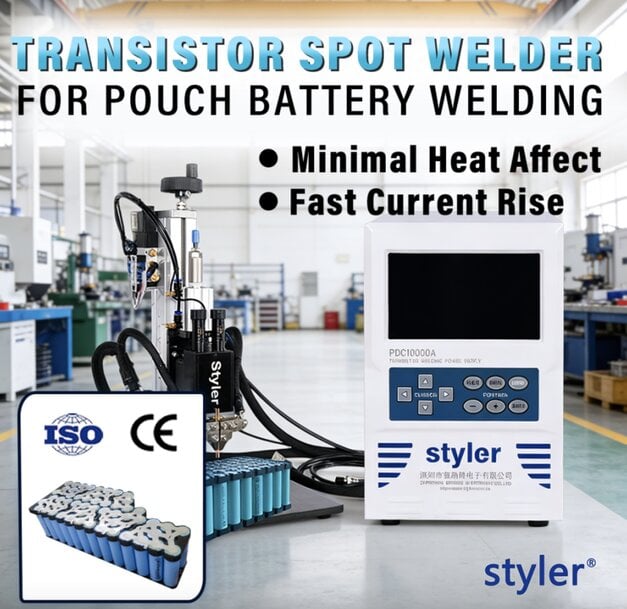
The shift toward electric mobility and large-scale energy storage has transformed the Lithium Ion Battery Welding Machine from a simple assembly tool into a critical guardian of product integrity. In high-stakes manufacturing, the difference between a high-performance battery pack and a safety hazard often comes down to the microscopic quality of a single weld nugget.
The Hidden Threat: The "Virtual Weld"
In the digital supply chain of battery manufacturing, the most dangerous failure is the one you cannot see. A virtual weld occurs when the interface between a battery tab and a terminal appears fused but lacks true molecular bonding.
- The Risk: These welds pass initial visual inspections but harbor high electrical resistance.
- The Consequence: During the high-current cycles common in EVs, these points of resistance generate localized heat, leading to thermal runaway or premature pack failure.
- The Solution: High-end welding systems mitigate this through real-time monitoring of displacement and current, ensuring the bond is structural rather than superficial.
Material Complexity: A Multi-Metal Challenge
Modern battery packs are not uniform. They are a complex automotive data ecosystem of conductive materials, each requiring a specific "welding recipe."
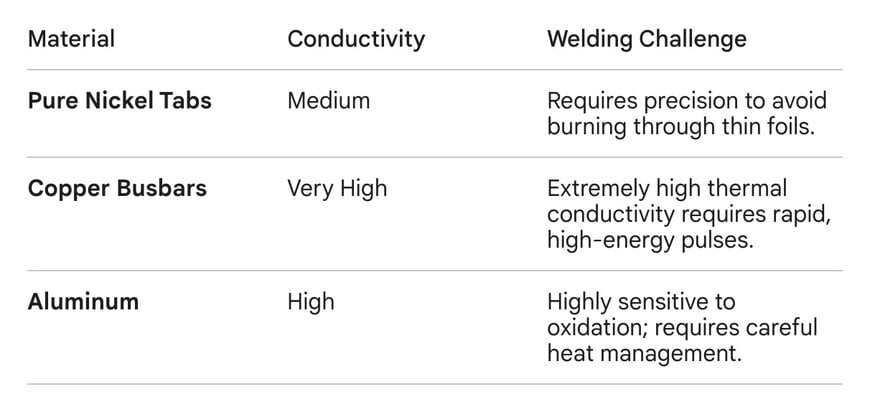
Advanced welding machines must store multiple parameter sets, allowing for instant switching between energy profiles as the production line moves from tab-to-cell welding to busbar-to-module assembly.
Pillars of High-Yield Welding Systems
To maintain a high first-pass yield, manufacturers are moving away from manual "guesswork" toward data-driven systems. A top-tier battery welding machine is defined by:
Modern battery packs are not uniform. They are a complex automotive data ecosystem of conductive materials, each requiring a specific "welding recipe."
Advanced welding machines must store multiple parameter sets, allowing for instant switching between energy profiles as the production line moves from tab-to-cell welding to busbar-to-module assembly.
Pillars of High-Yield Welding Systems
To maintain a high first-pass yield, manufacturers are moving away from manual "guesswork" toward data-driven systems. A top-tier battery welding machine is defined by:
- Closed-Loop Control: Systems that adjust current and pressure in milliseconds based on feedback from the weld site.
- Weld Data Logging: Every weld is recorded, creating a "digital birth certificate" for each battery pack. This traceability is essential for meeting automotive safety standards.
- Automated Tooling: Reducing human intervention eliminates variable electrode force—one of the primary causes of spatter and inconsistent resistance.
Impact on the Manufacturing Bottom Line
Stable welding quality does more than just ensure safety; it is a primary driver of cost efficiency. By improving the repeatability of the welding process, manufacturers see a dramatic reduction in:
Stable welding quality does more than just ensure safety; it is a primary driver of cost efficiency. By improving the repeatability of the welding process, manufacturers see a dramatic reduction in:
- Scrap Rates: Less wasted raw materials from "blown" welds.
- Rework Time: Fewer packs need to be disassembled and repaired.
- Liability Risk: Higher reliability in the field reduces the astronomical costs of recalls.
As the industry scales, the integration of Styler’s spot welding and laser systems represents the move toward an "intelligent" production floor where the machine is as much a quality inspector as it is an assembly tool.
Edited by Romila DSilva, Induportals Editor, with AI assistance.
Edited by Romila DSilva, Induportals Editor, with AI assistance.
-2296-71282-204124.png)