
www.magazine-industry-usa.com
08
'26
Written on Modified on
GVH and AFRY advance SMR deployment
GE Vernova Hitachi Nuclear Energy and AFRY collaborate to support BWRX-300 small modular reactor deployment and licensing in Europe.
www.gevernova.com
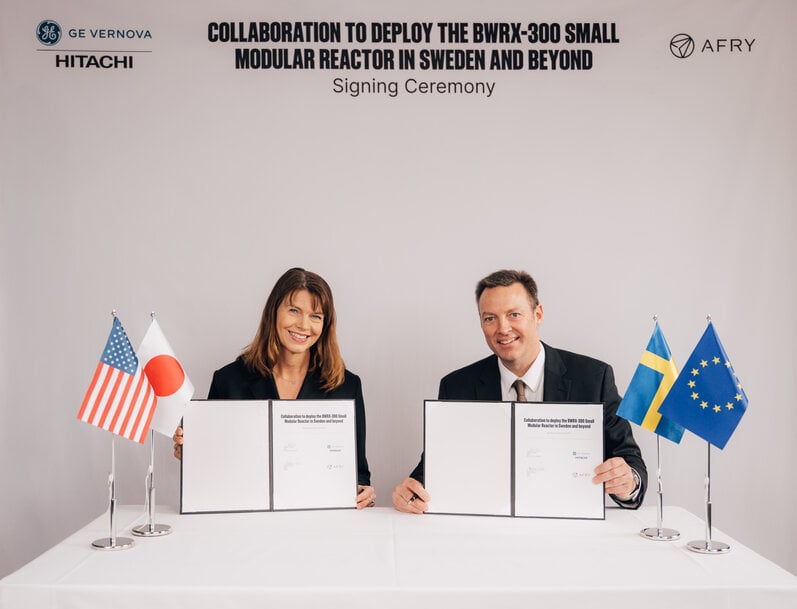
Linda Pålsson, President and CEO, AFRY; and Jason Cooper, CEO, GE Vernova Hitachi
GE Vernova Hitachi Nuclear Energy and AFRY have signed a Main Services Agreement to support the deployment of the BWRX-300 small modular reactor (SMR).
The collaboration focuses on nuclear energy infrastructure and small modular reactor deployment, addressing the need for scalable, low-carbon power generation in Europe.
Context: Industrial and energy transition requirements
European energy systems are undergoing structural changes driven by decarbonisation targets, electrification, and energy security concerns. SMRs are positioned as a flexible nuclear solution, offering lower capital requirements, modular construction, and suitability for integration into existing grids.
The partnership aims to support the development of a regional industrial ecosystem capable of delivering SMR projects efficiently while enabling participation from local engineering and manufacturing sectors.
Technical roles and collaboration framework
Under the agreement, AFRY will provide engineering, project management, and advisory services across SMR deployment projects. Its role includes leveraging regional expertise and supporting integration with European regulatory and industrial frameworks.
GE Vernova Hitachi Nuclear Energy contributes its BWRX-300 reactor technology and global project experience. The collaboration combines reactor design capabilities with engineering execution and local market knowledge.
A key component of the cooperation includes support for licensing activities. AFRY will assist in preparing the application for the BWRX-300 reactor to the Swedish Radiation Safety Authority (SSM), ensuring alignment with national regulatory requirements.
Technology and deployment model
The BWRX-300 is a small modular reactor designed for simplified construction and repeatable deployment. The collaboration is structured to enable standardized project delivery, improving efficiency across multiple installations.
This approach emphasizes:
GE Vernova Hitachi Nuclear Energy and AFRY have signed a Main Services Agreement to support the deployment of the BWRX-300 small modular reactor (SMR).
The collaboration focuses on nuclear energy infrastructure and small modular reactor deployment, addressing the need for scalable, low-carbon power generation in Europe.
Context: Industrial and energy transition requirements
European energy systems are undergoing structural changes driven by decarbonisation targets, electrification, and energy security concerns. SMRs are positioned as a flexible nuclear solution, offering lower capital requirements, modular construction, and suitability for integration into existing grids.
The partnership aims to support the development of a regional industrial ecosystem capable of delivering SMR projects efficiently while enabling participation from local engineering and manufacturing sectors.
Technical roles and collaboration framework
Under the agreement, AFRY will provide engineering, project management, and advisory services across SMR deployment projects. Its role includes leveraging regional expertise and supporting integration with European regulatory and industrial frameworks.
GE Vernova Hitachi Nuclear Energy contributes its BWRX-300 reactor technology and global project experience. The collaboration combines reactor design capabilities with engineering execution and local market knowledge.
A key component of the cooperation includes support for licensing activities. AFRY will assist in preparing the application for the BWRX-300 reactor to the Swedish Radiation Safety Authority (SSM), ensuring alignment with national regulatory requirements.
Technology and deployment model
The BWRX-300 is a small modular reactor designed for simplified construction and repeatable deployment. The collaboration is structured to enable standardized project delivery, improving efficiency across multiple installations.
This approach emphasizes:
- Modular construction and scalability
- Replication of standardized plant designs
- Integration with existing energy infrastructure
- Reduced project complexity compared to conventional nuclear plants
By combining engineering and advisory capabilities with reactor technology, the partners aim to establish a framework for consistent deployment across European markets.
Implementation and global project context
The agreement supports both current and future SMR projects. Globally, deployment of the BWRX-300 is progressing, with the first unit under construction at Ontario Power Generation’s Darlington site in Canada.
Additional developments include regulatory review activities in the United States, where the Tennessee Valley Authority has submitted an application for a BWRX-300 installation at the Clinch River site.
These projects contribute to validating the technology and establishing reference cases for further international deployment.
Expected impact on energy systems
The collaboration is expected to strengthen local industrial participation in nuclear projects while supporting the transition to low-carbon energy systems.
From a technical perspective, the integration of engineering services with standardized reactor technology enables:
Implementation and global project context
The agreement supports both current and future SMR projects. Globally, deployment of the BWRX-300 is progressing, with the first unit under construction at Ontario Power Generation’s Darlington site in Canada.
Additional developments include regulatory review activities in the United States, where the Tennessee Valley Authority has submitted an application for a BWRX-300 installation at the Clinch River site.
These projects contribute to validating the technology and establishing reference cases for further international deployment.
Expected impact on energy systems
The collaboration is expected to strengthen local industrial participation in nuclear projects while supporting the transition to low-carbon energy systems.
From a technical perspective, the integration of engineering services with standardized reactor technology enables:
- Improved project execution efficiency
- Development of regional supply chains
- Enhanced scalability of nuclear power deployment
This model supports the broader adoption of SMRs as part of Europe’s energy transition strategy.
Outlook for SMR ecosystems
The agreement reflects a shift toward collaborative, ecosystem-based deployment of nuclear technologies. By combining global reactor development with regional engineering expertise, the partnership aims to accelerate SMR adoption and support long-term energy infrastructure development.
Edited by an industrial journalist, Lekshman Ramdas, with AI assistance.
www.gevernova.com
Outlook for SMR ecosystems
The agreement reflects a shift toward collaborative, ecosystem-based deployment of nuclear technologies. By combining global reactor development with regional engineering expertise, the partnership aims to accelerate SMR adoption and support long-term energy infrastructure development.
Edited by an industrial journalist, Lekshman Ramdas, with AI assistance.
www.gevernova.com
-2296-71282-204124.png)