
www.magazine-industry-usa.com
21
'26
Written on Modified on
AI-Driven Industrial Robotics for Flexible Automation
ABB Robotics and its partners are deploying AI-based robotic systems for adaptive control, autonomous mobility, and digital infrastructure at Global Industrie 2026 (March 30 to April 2, 2026).
new.abb.com
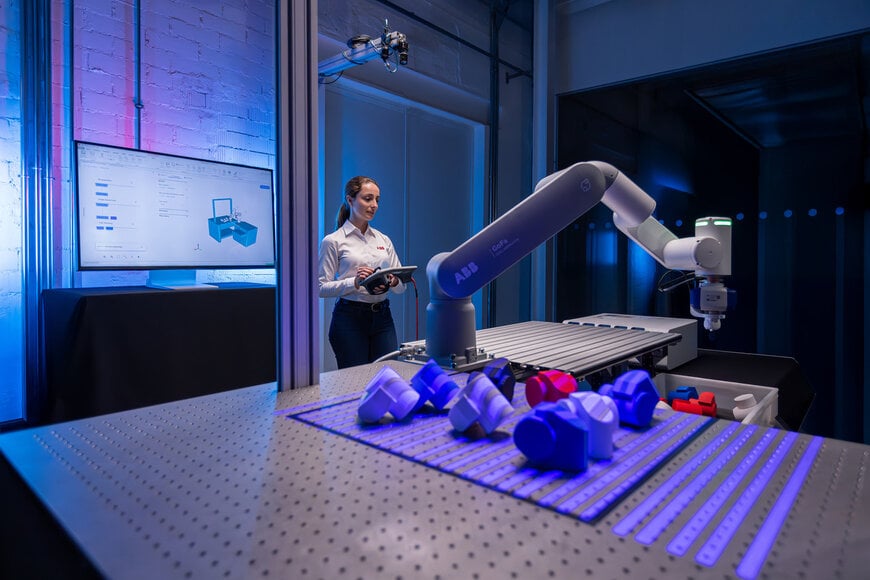
ABB Robotics is developing robotic systems that integrate artificial intelligence to improve adaptability, trajectory planning, and intralogistics automation in industrial and logistics environments.
Context of the Collaboration
ABB Robotics relies on an ecosystem of sensor suppliers, software developers, and industrial integrators to address the growing variability of production systems. Industrial environments require frequent changes, management of multiple products, and reduced commissioning times.
This collaboration is based on integrating ABB’s robotic controllers, engineering software, and services with third-party sensors, AI models, and integration solutions. The objective is to enable scalable deployment of industrial automation solutions in sectors such as automotive, electronics, and intralogistics.
Technical Solution and Division of Responsibilities
The technical framework is based on the concept of Autonomous Versatile Robotics (AVR), which combines AI-based perception, motion planning, and navigation.
ABB provides the core architecture, including:
- OmniCore controllers for real-time control
- RobotStudio and RobotWare software for simulation and execution
- Software modules integrating AI functionalities
Partners contribute vision systems and sensors compatible through standard industrial protocols.
Key Technologies
Key Technologies
- AI Vision System (OmniCore Eye Motion): Analyzes data from cameras or sensors to adjust trajectories in real time. This approach reduces commissioning phases by up to 90%.
- Automatic Path Planning Software: Continuously generates collision-free trajectories. Integrated into RobotStudio, it can reduce cycle times by up to 50%.
- Visual SLAM Navigation (AMR P603V): Enables autonomous localization and navigation in dynamic environments, with a payload capacity of up to 1,500 kg.
Deployment and Implementation
The solutions are designed to integrate into existing production lines using a modular approach:
The solutions are designed to integrate into existing production lines using a modular approach:
- Simulation and validation in RobotStudio
- Integration with control systems and sensors
- Commissioning with reduced programming
- Continuous optimization based on data
Autonomous mobile robots operate in shared environments and interface with MES and warehouse management systems.
Applications and Use Cases
Targeted applications include:
Applications and Use Cases
Targeted applications include:
- Robotic picking in flexible production
- Spot welding in automotive manufacturing
- Autonomous pallet transport
- Automated quality control
These applications improve process stability by reducing human intervention and adapting operations to variability.
Results and Expected Impact
The benefits are based on measurable mechanisms:
Results and Expected Impact
The benefits are based on measurable mechanisms:
- Reduced commissioning times
- Shorter production cycles
- Improved equipment availability
Tools such as OptiFact analyze the entire production line to optimize interfaces, energy consumption, and maintenance.
Maintenance and refurbishment services extend equipment lifecycle and contribute to sustainable management of industrial digital infrastructure.
Edited by an industrial journalist Sucithra Mani with AI assistance.
www.abb.com
Maintenance and refurbishment services extend equipment lifecycle and contribute to sustainable management of industrial digital infrastructure.
Edited by an industrial journalist Sucithra Mani with AI assistance.
www.abb.com
