
www.magazine-industry-usa.com
18
'26
Written on Modified on
Trane Technologies Improves AI Data Center Thermal Efficiency
Updated reference designs integrated with Omniverse DSX increase cooling efficiency and enable higher IT power allocation in large-scale AI factories.
www.tranetechnologies.com
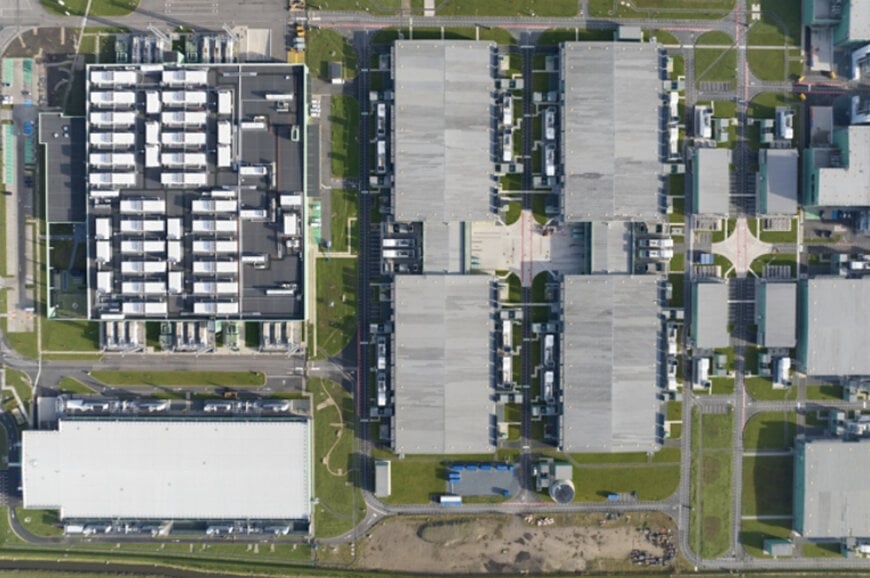
Data centers, high-performance computing (HPC), and AI infrastructure are facing growing thermal constraints as compute density increases, making efficient cooling design a critical factor in system scalability. Trane Technologies has introduced enhancements to its thermal management reference design for gigawatt-scale AI factories, alongside two new system architectures aimed at improving energy efficiency and cooling performance.
The updated design, developed to integrate with the NVIDIA Omniverse DSX Blueprint for AI data centers, achieves close to a 10% improvement in overall thermal management efficiency compared to the earlier 1-gigawatt configuration. This gain translates into approximately 22 megawatts (MW) of additional cooling capacity that can be reallocated to IT power, enabling higher compute output without increasing total energy consumption.
Rather than focusing solely on component-level improvements, the approach combines system-level optimization with digital simulation. The integration with Omniverse DSX enables the creation of high-fidelity digital twins, allowing engineers to simulate thermal behavior, airflow, and energy performance before deployment. This reduces design uncertainty and supports more accurate scaling of AI infrastructure.
New reference designs for large-scale AI cooling
The expanded Trane Continuum Rubin DSX portfolio introduces two distinct architectures targeting different deployment scenarios.
The 250 MW duplex simplified system design emphasizes extended use of free cooling and incorporates heat recovery. By redirecting approximately 10% of the heat rejection load into usable heat recovery, the system reduces overall energy waste while increasing thermal management efficiency by around 14%. This approach is particularly relevant for regions with favorable ambient conditions or facilities aiming to reuse waste heat.
The second design, a 1-gigawatt air-cooled system architecture, uses magnetic-bearing chillers with 3 MW unit capacity. This configuration reduces the number of required units and eliminates the need for waterside economizers, simplifying system layout. Magnetic-bearing technology enables oil-free operation, which reduces maintenance requirements and improves operational efficiency, while also lowering noise levels in large installations.
Digital simulation and scalability in AI factories
A key aspect of the updated designs is the use of OpenUSD-based SimReady assets to support digital twin environments. These assets include structured metadata that improves configurability and allows more automated simulation workflows. For engineers, this means faster iteration during the design phase and improved accuracy when modeling large-scale thermal systems.
The ability to simulate different cooling strategies—such as air-cooled versus hybrid systems—helps operators identify optimal configurations for specific workloads and environmental conditions. This is particularly important for AI factories, where workloads can vary significantly and require dynamic thermal management strategies.
Addressing thermal challenges in AI infrastructure
As AI clusters scale toward gigawatt-level power consumption, thermal management becomes a limiting factor not only for reliability but also for energy efficiency. By improving cooling system efficiency and enabling better allocation of power to compute resources, these reference designs address a central challenge in modern data center engineering.
While comparable solutions exist from other data center cooling providers—such as liquid cooling systems or hybrid air-liquid architectures—these designs focus on integrating system-level efficiency improvements with digital twin simulation, enabling more predictable performance at scale.
The introduction of these updated and new reference designs reflects a shift toward combining thermal engineering with simulation-driven optimization, supporting the deployment of next-generation AI data centers.
Edited by Industrial Journalist, Natania Lyngdoh — Adapted by AI.
www.tranetechnologies.com
-2296-71282-204124.png)