
www.magazine-industry-usa.com
16
'26
Written on Modified on
High-Voltage Bench Power Supplies for R&D Testing
Conrad Sourcing Platform distributes Voltcraft laboratory units designed for controlled high-energy experiments in e-mobility, biomedical instrumentation and renewable-energy validation.
www.conrad.com
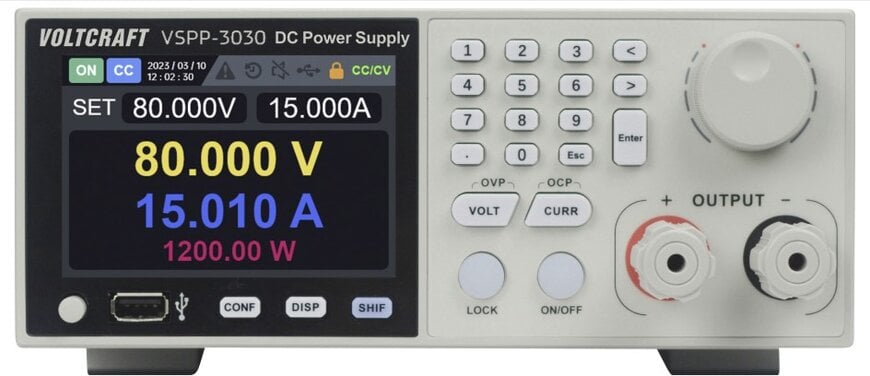
Laboratory testing in power electronics increasingly requires controlled DC levels far above conventional bench supplies. To address these validation tasks, Voltcraft introduced the VSPP high-voltage bench PSU series, distributed via the Conrad Sourcing Platform.
Bridging lab instrumentation and industrial voltage levels
Development work in battery systems, medical devices and power-conversion hardware often moves between precision measurement and high-energy testing. Traditional laboratory supplies offer accuracy but limited voltage, while industrial systems deliver power without measurement-grade stability.
The six-model VSPP range targets this gap by providing continuously adjustable outputs from 0 to 600 VDC with rated power between 1200 W and 3000 W. Voltage regulation accuracy is specified at ≤0.05% with offsets of ±20 mV, ±50 mV or ±100 mV depending on model, and current accuracy at ≤0.05% with ±20 mA or ±30 mA deviation.
Low-noise output is intended to preserve signal integrity during sensor calibration and electronics characterization, where switching ripple from high-power sources can distort measurements.
Modular scaling for automated test equipment
In validation labs and ATE setups, test power requirements frequently change as prototypes evolve. The units support both series and parallel operation, allowing higher voltage or higher current configurations without replacing equipment.
The highest-power configuration allows up to ten supplies connected in parallel, producing currents up to 300 A. This modular architecture enables incremental expansion of test benches instead of switching to dedicated industrial power racks.
Integration into automated test equipment is supported through USB, LAN and RS-485 interfaces, and the housing fits standard 19-inch racks commonly used in electronics laboratories and battery-testing stations.
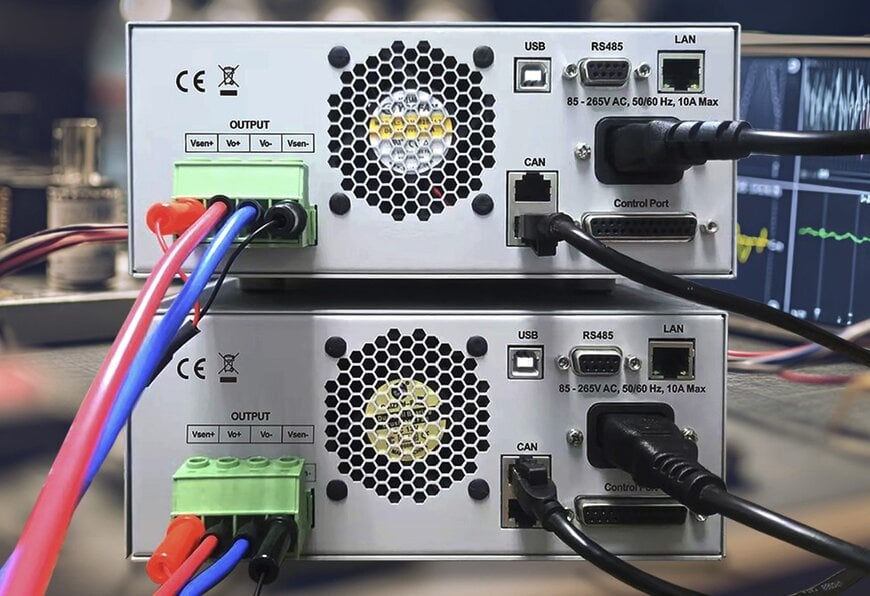
Embedded programmability for repeatable measurements
The devices include linked-list programmability, enabling stored voltage and current sequences to run directly on the instrument. Repetitive measurement cycles — typical in power electronics qualification — can therefore execute without a host PC.
Control resolution reaches 10 mV and 1 mA steps, while remote operation allows external automation software to manage test routines within a digital supply chain environment. Each unit provides a single output channel and accepts universal mains input from 85 VAC to 265 VAC at 50/60 Hz, allowing deployment across international laboratory infrastructures.
Application scope
By combining measurement-grade precision with higher energy levels, the series is intended for:
- battery module characterization in e-mobility development
- insulation and leakage testing in biomedical equipment
- DC-link and inverter validation in renewable-energy converters
- component stress testing in power semiconductor design
The VSPP series positions bench instrumentation closer to industrial validation conditions while retaining laboratory-level measurement control.
www.conrad.com
www.conrad.com
