
www.magazine-industry-usa.com
27
'26
Written on Modified on
Vertical Turbine Pumps in High-Head Fluid Systems
National Pump Company highlights design developments supporting deep-well, municipal, and industrial duty across water, energy, and process infrastructure.
www.nationalpumpcompany.com
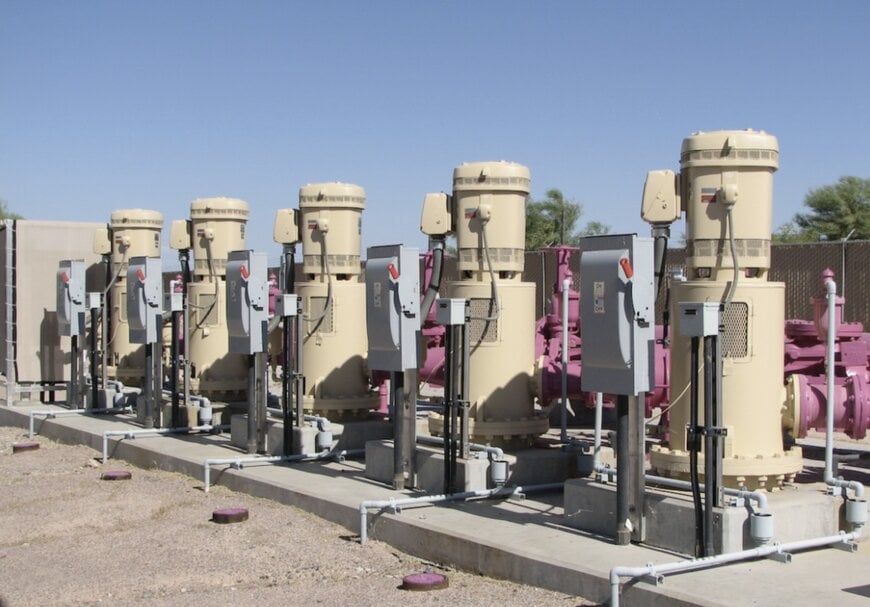
Vertical turbine pumps (VTPs) are used where high flow rates, significant lift, or limited suction head make horizontal pump configurations impractical. Common installations include municipal water supply, irrigation, desalination, cooling water circuits, petroleum terminals, and mine dewatering. Recent project references include aquifer storage systems for water reinjection and pumped-storage hydropower schemes; within this context, National Pump Company detailed expanded performance ranges and engineering practices for modern VTP designs.
Where vertical configurations make hydraulic sense
Unlike horizontal pumps that depend on suction lift, VTPs position the impellers below the liquid surface. This flooded suction condition removes the need for priming systems and reduces civil works such as deep pits or elevated reservoirs. The arrangement is particularly relevant in industrial pumping systems handling large volumes at high static heads.
Multistage bowl assemblies allow additional impellers to be stacked vertically, increasing discharge pressure without enlarging the pump footprint. This modular approach supports applications requiring both high head and high flow, including deep groundwater wells and large transfer stations.
Modern industrial units cited in the release operate at heads up to 2,500 feet, flow rates up to 20,000 gallons per minute, and driver ratings up to 2,000 horsepower, placing them in the upper performance range of vertical line-shaft pump technology.
From groundwater wells to process industries
VTPs were originally developed for deep-well groundwater extraction. As well depths increased beyond roughly 50 feet, enclosed line-shaft designs became standard. In these systems, the shaft and bearings are housed in an enclosing tube filled with lubricant, isolating rotating components from the pumped fluid. This reduces wear and extends bearing life in deep installations.
Groundwater duty typically involves clean water and standardized specifications. Expansion into petroleum, power generation, and industrial process service introduced more variable fluids, higher temperatures, and stricter mechanical requirements. These sectors drove the adoption of custom hydraulics, specialized alloys, and tighter mechanical tolerances.
Managing suction energy and cavitation risk
A central factor in VTP adoption has been Net Positive Suction Head (NPSH). Cavitation occurs when available suction energy (NPSHA) falls below the pump’s required value (NPSHR), causing vapor bubble formation at the impeller eye and leading to erosion, vibration, and performance loss.
Because VTP impellers operate below grade, system designers can increase NPSHA by submerging the suction stage rather than modifying upstream tank elevations. “Can-style” vertical turbine pumps extend this concept by placing the hydraulic assembly inside a suction can, enabling low-NPSH operation without deep civil structures. This configuration has been used for condensate service in power plants and for light hydrocarbons such as propane and butane in midstream energy infrastructure, where vapor pressure and suction stability are critical.
Core construction and hydraulic elements
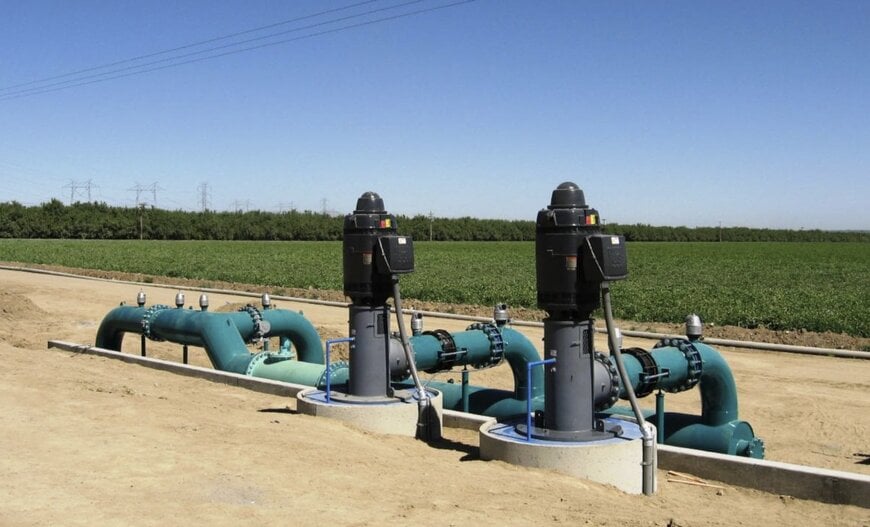
A typical VTP includes a surface-mounted motor, a discharge head that redirects flow into the discharge piping, a vertical column pipe that conveys fluid upward and houses the line shaft, and a bowl assembly at the bottom containing one or more impellers. Because the hydraulic end remains submerged, startup does not depend on external priming systems.
Hydraulic performance is adjusted by selecting impeller diameters, stage count, and bowl geometry to match duty point requirements. Internal coatings may be applied to bowl passages to reduce hydraulic losses and improve efficiency in high-head service.
Controlling vibration through analysis and installation
Tall, slender rotating assemblies are sensitive to lateral vibration and resonance. Manufacturers apply rotor balancing, shaft stiffness optimization, and coupling alignment to separate operating speeds from structural natural frequencies.
Finite Element Analysis (FEA) is used to model structural modes and predict resonance risks before fabrication. Computational Fluid Dynamics (CFD) evaluates internal flow patterns, identifying recirculation or turbulence zones that can induce hydraulic excitation forces. Field reliability also depends on rigid foundations, accurate vertical alignment, and secure column support. In critical services, vibration sensors support condition-based maintenance by detecting deviations from baseline behavior.
Material choices for dry running and abrasives
Dry running, particularly in hot water or marginal NPSH service, can rapidly damage line-shaft bearings due to loss of lubrication. Traditional carbon bearings offered chemical resistance but were brittle. Newer metallic alloys and engineered non-metallic bearing materials provide improved toughness and wear resistance under boundary-lubrication conditions.
Abrasive service presents a separate challenge. Sand, silt, and process solids accelerate wear in bowls, impellers, and bearings. Enclosed line-shaft construction reduces abrasive contact with the shaft. Hard coatings, surface treatments, and abrasion-resistant alloys are used on wetted components, while elastomeric and composite bearings are increasingly applied where particle-laden fluids are expected.
Variable speed operation and resonance risks
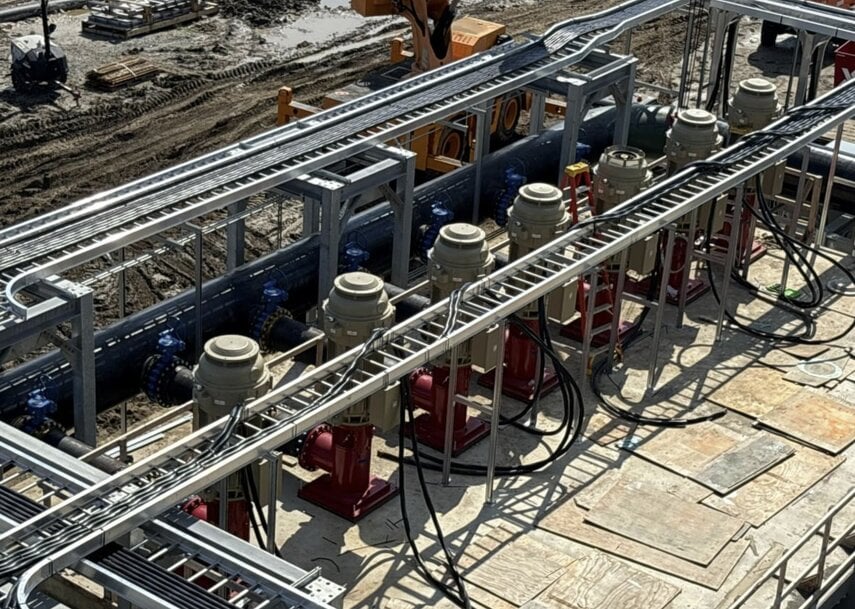
Variable Frequency Drives (VFDs) allow VTPs to operate over a speed range rather than at a fixed synchronous speed. This enables closer matching of pump output to system demand, reducing throttling losses and improving part-load efficiency.
However, sweeping through multiple speeds increases the chance of operating near structural natural frequencies. As a result, rotordynamic and structural analysis must consider the full VFD operating window, not just nominal speed, to avoid resonance and excessive vibration.
Requirements for potable water installations
In municipal drinking water systems, NSF certification verifies that pump materials and lubricants do not introduce contaminants. Compliance requires traceability of wetted components, use of approved alloys such as stainless steel or aluminum bronze, and food-grade lubricants where applicable.
Certified assemblies may use mechanical seals or packing suitable for potable water. Protective internal and external coatings, such as Tnemec N-140 Pota-Pox Plus, are specified to prevent corrosion while meeting water quality standards. Annual material reviews and documented quality checks are part of maintaining certification.
A mature design adapted for modern duty
Vertical turbine pumps remain a long-established technology, but performance expansion has come from improved materials, advanced simulation tools, and tighter vibration control. These developments support higher heads, broader fluid compatibility, and integration with variable-speed drives, extending the role of VTPs across municipal, industrial, and energy-sector fluid handling.
www.nationalpumpcompany.com
-2296-71282-204124.png)