
www.magazine-industry-usa.com
19
'25
Written on Modified on
Software Update Enables Objective Surface Inspection
Micro-Epsilon extends 3DInspect with surface inspection functions for standardized, sensor-based quality control of industrial components.
www.micro-epsilon.com
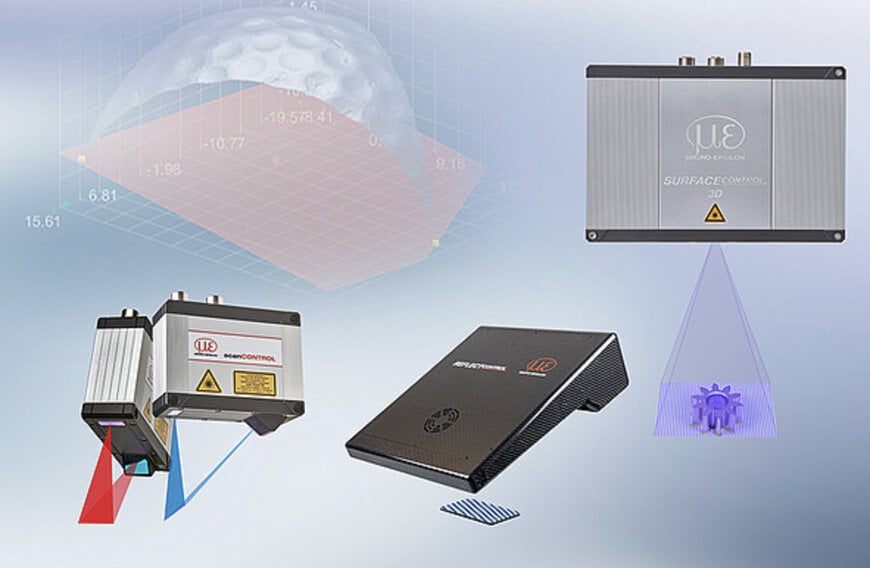
With version 3.0, the 3DInspect software from Micro-Epsilon adds dedicated surface inspection functions that enable the detection and evaluation of surface deviations based on defined, reproducible criteria.
Relevance for industrial quality inspection
3DInspect is a software tool designed for use with all 3D sensors from Micro-Epsilon and is applied in industrial measurement and inspection tasks. The new version 3.0 expands its functionality to include surface inspection, allowing deviations from an ideal, homogeneous surface to be identified and analyzed. This enables the software to be used for digital quality control in production and inspection environments, where objective evaluation and early defect detection are required.
Inspection processes are carried out according to predefined parameters, eliminating subjective influences that typically occur in visual inspections. As a result, deviations can be identified at an early stage and assessed consistently across series production.
Form removal for surface deviation analysis
A central element of the new release is the form removal functionality, which provides several methods for highlighting surface irregularities. The “trend removal” function makes small defects such as dents, bulges, uneven areas or surface structures visible in a targeted manner. This supports reliable identification of minor deviations that may not be apparent in raw measurement data.
In addition, the “digital smoothing stone” function enables high-precision inspection of series parts. This function digitally replicates the smoothing stone used in automotive body construction to verify homogeneous surfaces on raw car bodies. By applying this method, surface quality can be evaluated consistently across multiple components.
The introduction of a “digital master” further supports comparative inspection. One or more reference parts classified as OK are combined into a master dataset, which serves as a nominal reference. Subsequent components can then be compared directly with this master file to perform objective actual-to-target evaluations.
Additional inspection and evaluation functions
Version 3.0 also introduces functions for sorting and counting elevations and depressions on a surface. This capability is particularly relevant for automated pin detection, where pin lengths within a defined tolerance range can be classified as OK or NOK based on quantitative criteria.
Further enhancements include functions for aligning 3D point clouds as well as for unwrapping cylindrical and spherical geometries. These features support consistent evaluation of complex component shapes and extend the applicability of the software to a wider range of industrial inspection tasks.
Technical scope of version 3.0
The new release of 3DInspect integrates surface inspection, defect detection and geometric processing into a single software environment. By combining trend removal, digital smoothing, master-based comparison and structured defect evaluation, the software supports standardized, data-driven quality control workflows in applications such as automotive manufacturing, mechanical engineering and precision component production.
www.micro-epsilon.com
