
The Power of the Blend: How Collaboration and Partnership Drive Increased Output
Sackett-Waconia replaces legacy belt-driven components with NORD direct drive gearmotors to eliminate routine maintenance, boost operational safety, and maximize equipment uptime in harsh fertilizer processing environments.
www.nord.com
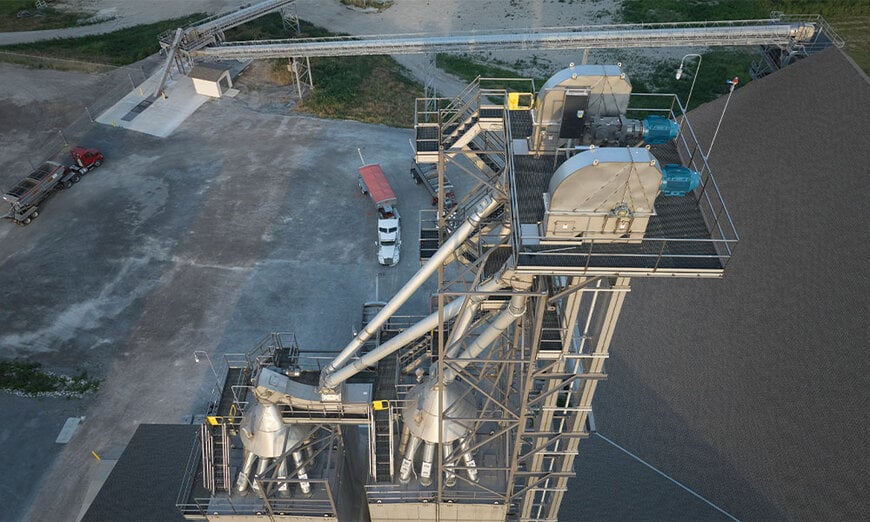
NORD DRIVESYSTEMS helps a Midwest manufacturing company increase equipment uptime, reduce operating costs, and make life simpler for its customers
“Two out of every five people on Earth today owe their lives to the higher crop outputs that fertilizer has made possible.” That’s from Microsoft cofounder Bill Gates and his 2013 essay Here’s My Plan to Improve Our World—And How You Can Help for Wired magazine, where he admits he’s “a little obsessed with fertilizer.”
So was Augustus J. “Gus” Sackett. In 1897, he founded what would become Sackett-Waconia, a leader in fertilizer blending and handling systems. The entrepreneur could not have foreseen the staggering number of lives modern fertilizer would one day save. But in pre-World War I America, he clearly knew how to design, engineer, and build the equipment needed to process it—the company has been granted more than 200 patents over the years, many of which are still in use today.
The Norwood Young America, Minnesota-based manufacturer’s latest innovation promises to make fertilizer blending even more efficient. “People don’t have to tension belts on our new HIM 2.0 Precision Blender,” notes Sackett-Waconia project engineer Matt Barnes. “Less guarding is required, maintenance is easier, and everything is basically safer to work around. These are just a few of the improvements made possible with direct drive gearmotors.”
The company that supplied those motors? NORD DRIVESYSTEMS, the company’s primary drive supplier and a collaborator from well before the blender redesign.
Breaking Conventions
Sackett-Waconia’s Director of Business Development, Evan Halscheid, explains that over the past five years or so, direct drives had been “pretty much a given” on international projects. But for most of the company’s history—and for much of the domestic fertilizer processing industry—V-belts and sheaves have long been the standard for powering rotary components.
The reasons are understandable. Belts are inexpensive, widely available, and forgiving. They tolerate minor misalignment and don’t require special tooling for adjustment. And as anyone who’s worked on a tractor can attest, belt drives are familiar. Together, these conveniences are a big part of why they’ve stayed in place across generations of equipment, much of it operating at the dry-blend retail facilities Sackett-Waconia serves.
“That’s just what everyone in the U.S. is familiar with,” says Halscheid. “When it came time to replace something, they kept going with what they knew.”
But familiarity comes with a cost. As Barnes noted earlier, belts must be tensioned periodically, a step that many operators overlook until equipment fails. Belt drives also require that the operator remove the guard for servicing, then remember to replace it before bringing the blender back online. During all of this, the equipment sits idle—its owner is spending money on parts and labor, and trucks might have to wait in line while the loading facility scrambles to get it repaired.
“A lot of these locations are running lean, so they don’t always have people available for routine maintenance, tensioning belts, and checking oil levels,” Barnes says. “They need equipment that just runs.”
Adam Reynolds is the District Sales Manager for NORD DRIVESYSTEMS. He’s worked closely with Sackett-Waconia since the start of the relationship and notes that installation is another concern. “Normally with heavy equipment like this, you have to install the gearbox, motor mounts and motor, sheaves, bushings and belts, then get everything aligned and tensioned properly. As a result, there’s a lot of dialing in at the job site. Customers want to eliminate as much of this effort as possible while also making the equipment safer to operate, with reduced maintenance.”
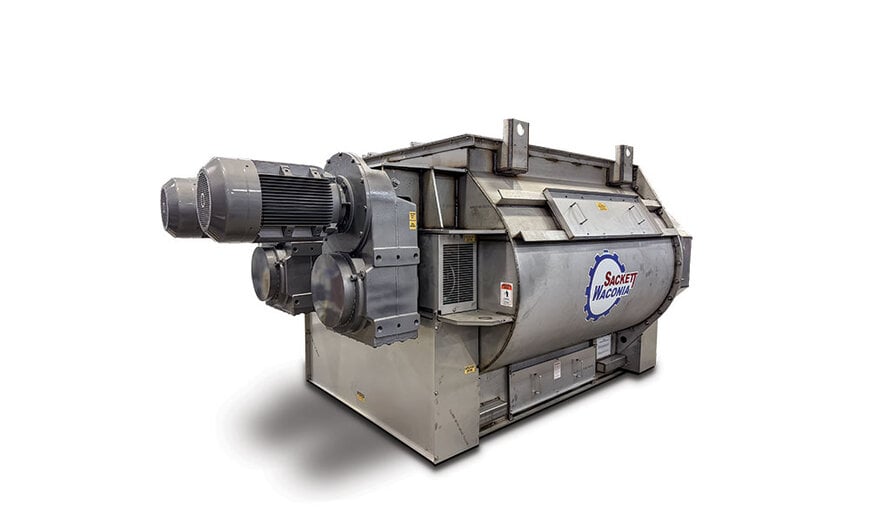
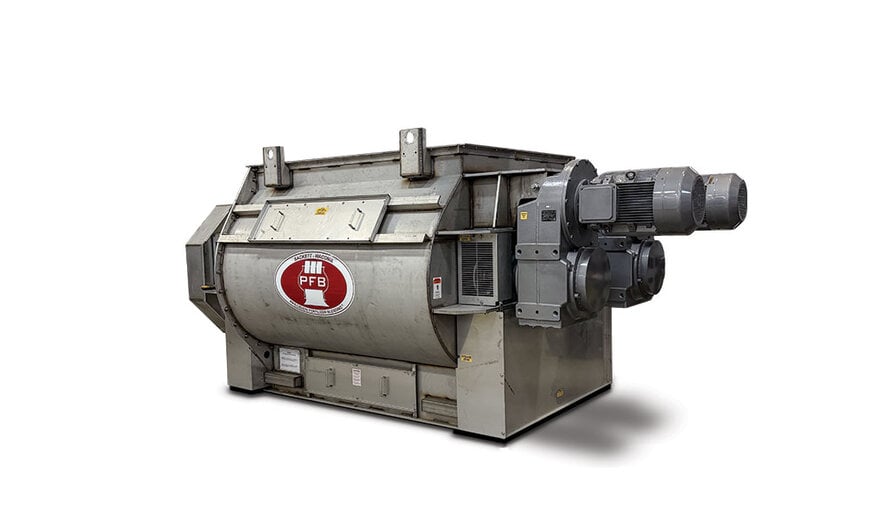
The HIM 2.0 precision blender checks all of these boxes. At the heart of each machine is a pair of NORD UNICASE parallel shaft-mount gearmotors—one for each counter-rotating rotor shaft—replacing the single-motor, belt-driven arrangement of earlier generations with sealed direct drive packages.
“We basically redesigned it, giving customers a newer, cleaner, and much more effective version of a product we’d always made,” says Halscheid. “This includes easier equipment access, smarter ‘bomb bay’ door operation, and a full conversion to stainless steel components. The equipment from several decades ago was almost all carbon steel, and in this harsh environment, it would be subject to corrosion. The HIM 2.0 name came out of that redesign—it wasn’t all about the move to direct drive, although NORD certainly played a part in that decision.”
Built for the 4Rs
Sackett-Waconia has long designed its systems and equipment with the needs of modern agriculture in mind, and this means supporting The Fertilizer Institute’s (TFI) 4R Nutrient Stewardship program:
- Right Source: Matches fertilizer type to specific crop needs.
- Right Rate: Matches the amount of fertilizer to crop requirements.
- Right Time: Makes nutrients available when crops need them.
- Right Place: Keeps nutrients where crops can use them.
The HIM 2.0 and its precision fertilizer blending (PFB) capabilities are no exception. A pair of synchronized, overlapping paddles keeps all particles moving during the blending process, eliminating the “dead zones” that would otherwise occur. The gentle motion also reduces the risk of particle damage, something that’s especially important with newer polymer-coated fertilizers and micronutrients that are sensitive to degradation.
And by maximizing particle contact, the design allows lower volumes of nitrogen stabilizer and other liquid additives to be applied, reducing costs while improving additive efficiency. The result is a blender purpose-built for the precision the 4Rs require: accurate ratios, uniform distribution, and minimal waste.
Making Connections
The NORD partnership didn’t begin with the HIM 2.0 project, however—by the time the redesigned blender came off the drawing board, Sackett-Waconia had been specifying NORD gearmotors across most of its equipment lines since 2021. Assisted by Adam Reynolds, NORD’s District Sales Manager for their territory, Sackett-Waconia’s engineering team evaluated and ultimately selected NORD—known in the industry for its German-engineered industrial drives with U.S. manufacturing headquarters in Waunakee, Wisconsin—as their primary drive supplier. Driven by a shared commitment to meet customer expectations, the initial adoption of NORD’s products has matured into a deeply rooted partnership, marked by years of strategic alignment and mutual success.
There’s also myNORD, the company’s online drive selection, quoting, ordering, and tracking portal. Customers can size, spec, and price drives themselves, with 3D STEP files delivered at any point in the design process. “Sackett-Waconia’s engineering team is self-sufficient on myNORD and has been pretty much since the beginning of the relationship,” Reynolds says. “It’s a great resource for them, just as it is for all of our customers.”
First Steps
Early in that relationship, Sackett-Waconia chose its first NORD job strategically: Gromark, a fertilizer facility in Amherst Junction, Wisconsin, located close to NORD’s Waunakee plant. Because the customer’s primary concern was service after the sale—what would happen if a drive went down—proximity to replacement parts answered the question directly. The result was a near-complete conversion to NORD across the site; the only holdout was the HIM mixer itself, which had not yet been redesigned.
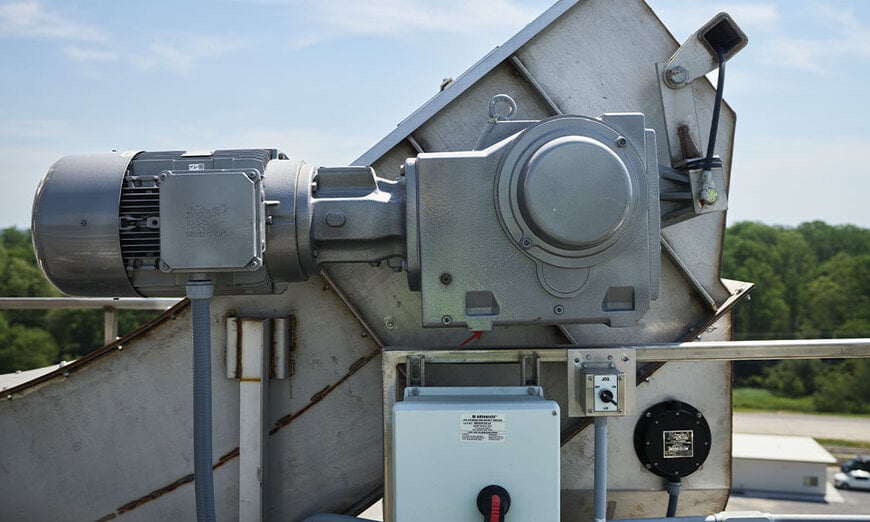
Other projects soon followed, and by the time HIM 2.0 was ready for production, Sackett-Waconia was using NORD drives in virtually all system designs, many of them protected with NORD’s NSD4+ coating. Says Reynolds, “We coat the entire gearbox and motor with a corrosion-resistant paint, a step that’s especially important in the fertilizer industry with its harsh chemical environment.”
The new blender’s first large-scale implementation was for a customer at the Port of Rosedale, a Mississippi terminal where more than twenty NORD gear drives now run across the site’s receiving, conveying, and blending operations. An all-electric E-crane that Barnes describes as “pretty cool in its own right” pulls urea, potash, ammonium phosphate, and other fertilizer components off river barges at 600 tons per hour (TPH). It’s then fed through a lump buster and carried up more than 1,000 feet of conveyors into the main building, every one of them direct drive.
Bucket elevators powered by 125-horsepower NORD MAXXDRIVE industrial gear units then lift the material to storage bins above matching blend towers, where it’s gravity-fed through weigh hoppers into the HIM 2.0 mixers below. Since either tower can operate as a straight wholesale loadout when demand is steady, or both can blend simultaneously when volume picks up, the arrangement provides a balance of flexibility and throughput.
Beyond Performance
When asked what the new system delivers in terms of increased throughput or operating cost, Halscheid provides a surprising answer. “Performance is important, but it’s not the game changer here,” he says. “If you need 50 horsepower to rotate a shaft, you’ll get that with anyone’s drive unit. NORD’s direct drive package delivers on other, more tangible fronts—a simpler design, fewer parts to manufacture, easier assembly, commissioning, and maintenance, and perhaps most importantly, safer operation.”
Barnes agrees, noting that longevity and predictability are equally important. “We’re running NORD drives across roughly a dozen sites now, and over three to four years, we haven’t had a single gearbox failure. A motor here or there, maybe, but not a gearbox.”
That kind of reliability matters as fertilizer dealers face increasing pressure to deliver more precise blends, faster turnarounds, and predictable uptime through the planting and harvest seasons. The HIM 2.0, paired with a top-to-bottom NORD direct drive package, gives them a system designed for those expectations—not just at startup, but for the long years of corrosive, around-the-clock operation that follow.
-2296-71282-204124.png)