
www.magazine-industry-usa.com
02
'26
Written on Modified on
Scaling Additive Manufacturing with Cloud-Enabled Automation Platforms
To expand its local production model, Haddy adopted Siemens Xcelerator to integrate product data, robotic kinematics, and circular material strategies.
www.siemens.com
Application Area: Additive Manufacturing / Industrial Automation
Industry Sector: Manufacturing / Furniture, Marine, and Defense
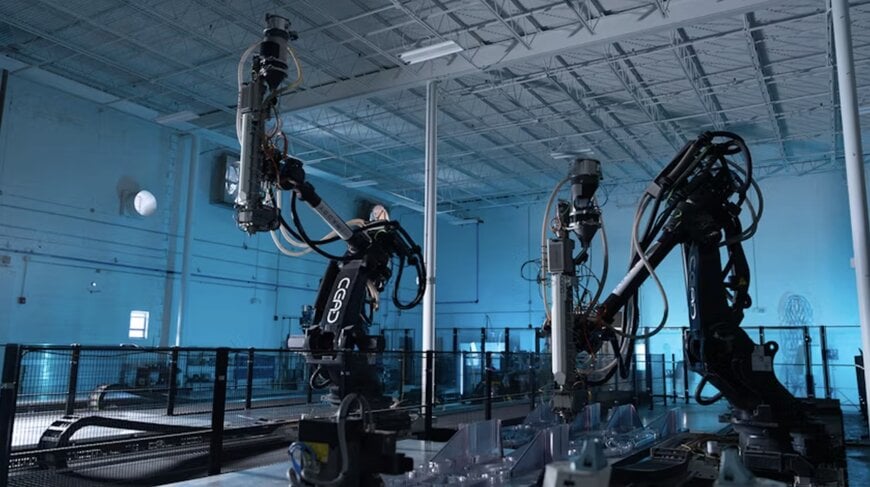
Haddy, a United States-based additive manufacturing firm, operates in the industrial production sector with a focus on manufacturing large-format components across sectors such as furniture, marine, and defense. The company's business model addresses several operational and environmental challenges, notably reducing supply-chain complexity, minimizing transportation-related emissions, and curbing material waste destined for landfills.
To overcome these challenges, Haddy's goals center on scaling local production capabilities, enabling rapid design iterations, and maintaining product consistency across multiple manufacturing locations. Additionally, the company seeks to manage circular material lifecycles, ensuring that large-scale products made from recyclable or biodegradable materials can be reprocessed into production feedstock at the end of their operational life.
To connect design, automation, and manufacturing data, Haddy selected the Siemens Xcelerator open digital business platform. The software suite was chosen to provide a consistent digital thread that scales a distributed production model while optimizing factory operations through artificial intelligence (AI) and cloud computing. Siemens is supporting this expansion by delivering integrated design, simulation, and hardware-control tools, allowing Haddy to grow its decentralized assembly footprint with minimal information technology (IT) overhead.
Decentralized Infrastructure and the Digital Thread
Haddy executes its regional manufacturing strategy through a distributed network of digitally standardized, AI-enabled microfactories. By keeping physical factories close to end-use markets and utilizing domestic material supply chains, the company eliminates logistics bottlenecks.
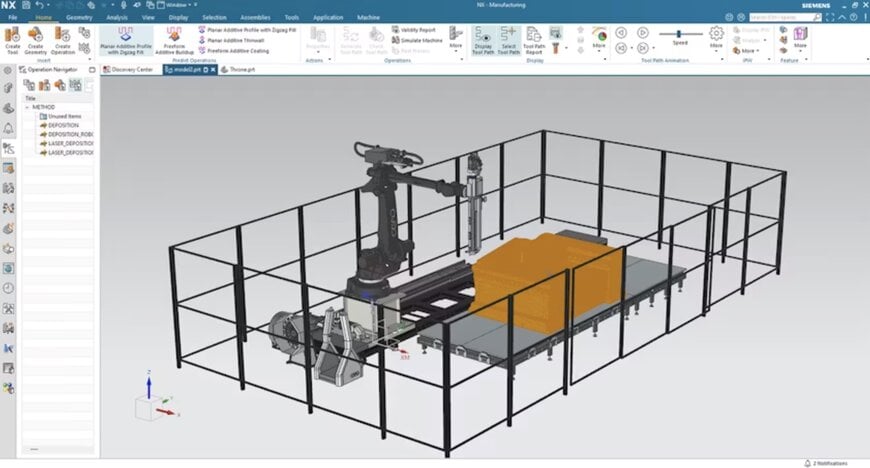
The technical architecture underpinning these microfactories relies on the Siemens Xcelerator portfolio to bridge product design, manufacturing planning, and shop-floor automation. Initial part geometry and design preparation for robotic fabrication are managed via Siemens’ Designcenter™ software. To maintain identical manufacturing standards and engineering changes across various sites, Teamcenter® software is deployed to centralize product data management and system configuration.
Robotic Control and Extrusion Integration
On the factory floor, high-precision motion control and execution are driven by Siemens' SINUMERIK computer numerical control (CNC) platform. Rather than treating robotics and machining as separate control tasks, the CNC system orchestrates the entire robotic additive manufacturing assembly. Jay Rogers, chief executive officer of Haddy, explains the operational impact of the integrated suite:
"Adopting Siemens Xcelerator helps us connect design, automation and manufacturing in a way that supports circularity, local sourcing and rapid iteration while using data and AI to continuously improve how our microfactories operate."
The control platform combines traditional CNC-based path control with advanced industrial robot kinematics. This centralized control loop directly governs heavy hardware execution, including large-format robotic extrusion systems engineered by CEAD.
Cloud-Enabled Scaling and Process Optimization
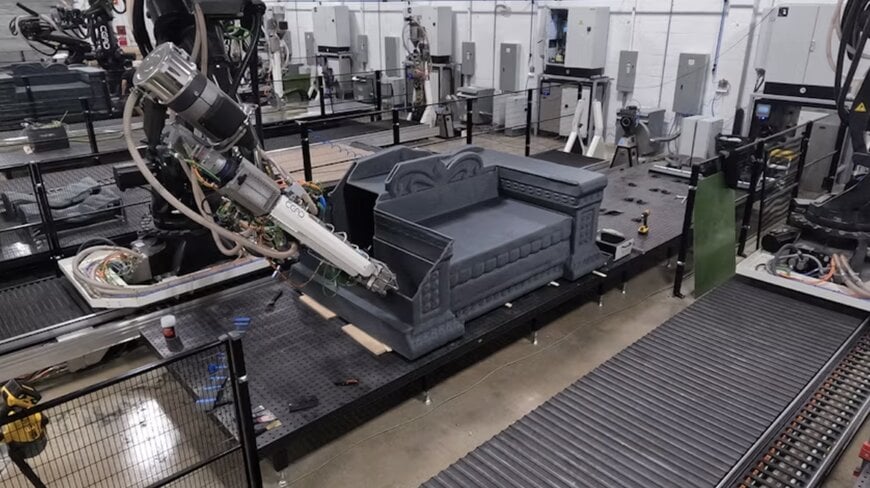
As part of its multi-site expansion, Haddy has integrated Simcenter™ Optistruct® software to assist with structural product optimization and engineering validation of large-scale components. For production-level execution, the company leverages NX™ X Manufacturing, a cloud-enabled manufacturing platform. This solution allows engineering teams to define build strategies, generate NC programming, and run simulations of complex large-format robotic deposition pathways before any physical material is extruded.
The same NX X toolset handles secondary subtractive CNC machining operations, providing computerized manufacturing (CAM) part programming, verification, and simulation within a single environment. Cloud deployment gives the microfactories the computational agility needed to produce parts ranging in scale from a shoe box up to a complete boat hull with low operational IT costs. Furthermore, a value-based software licensing model enables the company to dynamically assign software capabilities on demand as production requirements shift.
Additional Context
This section details technical specifications and competitive benchmarking not included in the original application story.
Technical Specifications
The underlying hardware platform integrated by Haddy utilizes the CEAD Flexbot system, an industrial large-scale additive manufacturing setup. Mechanically, the configuration combines a multi-axis Comau industrial robotic arm with CEAD pellet extrusion technology, controlled directly by a Siemens SINUMERIK One CNC architecture. By embedding the robotic kinematics directly into the CNC kernel (using Siemens Sinumerik Run MyRobot/Direct Control), the system eliminates the path errors typically introduced by translating coordinates between a traditional robot controller and an external toolpath. This hardware-software pairing permits the control of up to 31 synchronized axes, supporting complex gantry or linear track movements and real-time dynamic material flow control during thermoplastic deposition.
Competitive Benchmarking
In the domain of large-format additive manufacturing (LFAM) and enterprise CAD/CAM deployment, software-defined platforms are evaluated on their ability to maintain data continuity between generative design and physical toolpathing.
When analyzing Data Translation & CAD/CAM Unity, the Siemens NX / Xcelerator platform provides native integration, allowing design changes to dynamically update the CAM toolpath and robot simulation without neutral-format data exchange. In comparison, alternative platforms like Autodesk Fusion offer a single-environment CAD/CAM space, though it is traditionally optimized for small-to-medium BOM sizes rather than heavy industrial infrastructure.
Regarding Robotic Kinematics Integration, the Siemens platform features direct CNC-kernel control of robotic joints via SINUMERIK, essentially treating the industrial robot arm as a direct multi-axis machine tool. Conversely, traditional workflows in comparable software architectures use post-processors to convert CAM data into proprietary robot languages (such as KUKA KRL or ABB RAPID), which can introduce path deviations during complex multi-axis interpolation.
For PLM & Distributed Multi-Site Sync, Siemens delivers deep synchronization via Teamcenter PLM to enforce version control across remote microfactories. Meanwhile, competing enterprise setups like Dassault Systèmes 3DEXPERIENCE/CATIA provide comparable enterprise governance for massive, high-complexity assemblies, though typically with different on-premise or cloud deployment cost structures.
Finally, in terms of Licensing and IT Overhead, Siemens relies on SaaS cloud delivery (NX X) combined with value-based token licensing to allow dynamic scaling of advanced utility modules. On the other hand, competitors utilize varied hybrid-cloud models or strict per-seat annual licensing tiers that may require higher initial IT overhead for specialized multi-axis simulation modules. Overall, industry benchmarks show that single-environment CAD-to-CAM digital threads reduce engineering change order (ECO) turnaround times by an average of 16% and accelerate overall development cycles by up to 19% by removing translation errors between disparate design and manufacturing applications.
Edited by Romila DSilva, Induportals Editor, with AI assistance.
www.siemens.com
-2296-71282-204124.png)